Community Corner
Brookfield Funeral Home's History Entwined With Eastland Disaster
Recalling the 100th anniversary of the capsizing of the Eastland in the Chicago River on July 24, 1915, that killed 844 people.


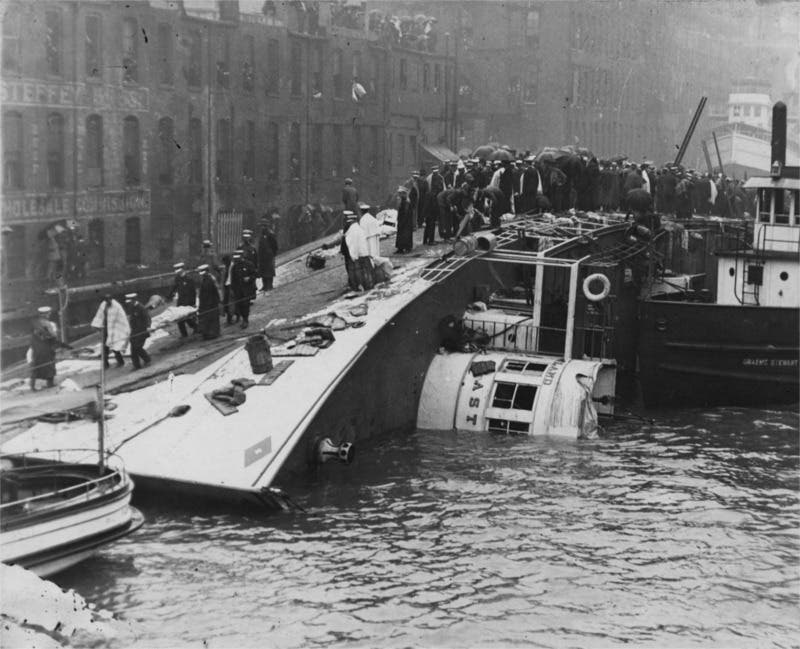

Photos: 1) The Eastland excursion boat laying on her side in 20 feet of water in the Chicago River on July 24, 1915; 2) the Second Regiment Armory that was set up as a temporary morgue for the Eastland victims.
It was 100 years ago this week, July 24, 1915 to be exact, when 844 souls perished when an excursion boat known as the “Speed Queen of the Great Lakes” rolled over on her side in the Chicago River, while still docked at Clark and LaSalle Streets.
The Eastland was Chicago’s own Titanic, and the worst disaster in the city’s history with the largest loss of life up until the city’s 1995 killer heat wave.
Find out what's happening in Western Springsfor free with the latest updates from Patch.
More than 2,500 employees of the Western Electric Company along with their families and friends, gathered early on a drizzly Saturday morning to board one of the five sleek excursion boats hired ferry them to Michigan City, IN, for the company’s fifth annual summer picnic.
Tragedy happened quickly as the Eastland, known as a cranky vessel with a tendency to list, threw a screaming mass of humanity into the Chicago River. The largest loss of life occurred below on the main deck as panicked passengers clamoured for the staircase in an attempt to flee the listing boat.
Find out what's happening in Western Springsfor free with the latest updates from Patch.
The Eastland came to rest on its side on the muddy bottom of the Chicago River in just 20 feet of water. The lucky ones reunited with loved ones still damp from being tossed into the river, as they emerged from the streetcar stops on Chicago’s West Side. Others went searching through the Second Regiment Armory on Washington Boulevard, which was set up as temporary morgue, looking for lost loved ones, sweethearts and friends.
By nightfall, the West Side’s 60 undertakers began collecting the dead to prepare them for a proper burial. Only one of those funeral homes, Hitzeman Funeral Home, then located blocks away from Western Electric at Cicero Avenue and 22nd Street (Cermak), is still in existence today.
Frederick Hitzeman operated out of his frame house, using the first floor rooms as a parlor, and the second floor as living quarters. In those days, wakes would last for three nights and funerals usually took a whole day because of horse transportation.
For fourth-generation owner, Todd Hitzeman, his grandfather, Charles, and great-grandfather, Frederick, worked non-stop over the next four or five days, embalming bodies and making them viewable for open casket wakes.
“Back then everyone in the neighborhood worked at Western Electric and the funeral home was located not to far away,” Hitzeman said in an interview last year for the business’s 110th anniversary. “We had a lot of the Eastland victims and a lot of the families. My great-grandfather and grandfather, Charles, were so busy they were running out of caskets, they had to have them shipped in.”
In an article for the Concordia Historical Institute Quarterly on the 50th anniversary of the Eastland, Pastor Gothhold G. Elbert recalled as a 21-year-old attending three Eastland victims’ funerals at Grace Lutheran Church. The church, located a mile away from Western Electric, lost 25 congregants, including some families who lost multiple members.
Grace Lutheran’s pastor at the time, Henry Boester, wrote of conducting 25 funerals over four days for the Eastland victims:
“Twelve of the victims were buried from the church and 13 from Hitzeman Funeral Home on 26th Street. All funerals were conducted within a period of four days. Five were buried on July 27, 10 on July 28, six on July 29, and four on July 30.”
Concordia Historical Institute Quarterly, 1965
Illustrative of the casket shortage in Chicago following the disaster, Frederick Hitzeman and his son, Charles, improvised. Blanche Homolka recalled that when “my dear sister Carrie was brought home, they had placed her on a sort of wicker sofa.”
In total, Hitzeman Funeral Home took care of 26 bodies, which had to be embalmed and taken to their own homes within two or three days, noted the Eastland Disaster Historical Society.
“Multiple funerals were held at one time because there weren’t enough hearses available to carry victims to the cemetery,” Hitzeman said, whose father, Norbert, relocated the business to Brookfield in 1963. “They were starting to run out embalming fluid. All the suppliers were running out in the Chicago area.”
In total, Hitzeman took care of 26 bodies, which had to be embalmed and taken to their own homes within two or three days.
More than 2,500 passengers and crew members were on board that day – and 844 people lost their lives, including 22 entire families. Seventy percent of the 844 victims were under the age of 25, with the average age of the deceased being 23 years old.
The cause of what capsized the Eastland is still not known, although it is believed that the ship had many structural flaws. Nobody was ever held responsible and common belief was that a cover up occurred.
For the four-generation owned Hitzeman Funeral Home, the Brookfield business’s history will be forever entwined with Chicago’s worst maritime disaster.
Get more local news delivered straight to your inbox. Sign up for free Patch newsletters and alerts.