Politics & Government
Local Amnesty International Group Fights for Rights of Bahai’s in Iran
Evanston vigil to honor seven Bahai's who've been imprisoned for more than two years.


At a prison in Tehran, Iran, seven leaders of the Baha'i religion have been locked away for more than two years for little more than practicing their faith.
For too many wrongly imprisoned persons around the world, the story ends right here, at incarceration. And perhaps it would be so for these seven as well, if not for the dedicated efforts of a local group of citizens fighting for justice to prevail.
"Amnesty International Group 50 [Evanston] has adopted the case of the seven Baha'is," said Elise Auerbach, the Iran Country Specialist at Amnesty International USA. "That means they will work on this particular case long term; they will work until it's resolved."
Find out what's happening in Wilmette-Kenilworthfor free with the latest updates from Patch.
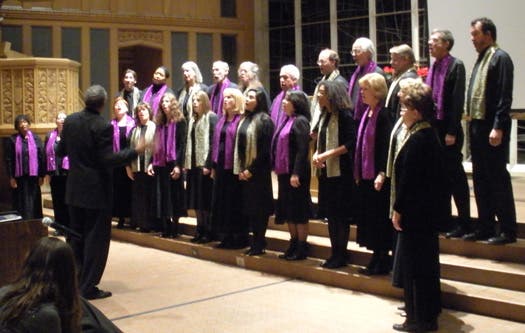
On Thursday, more than 7,000 miles away from Iran, approximately 200 people from the Evanston area met in Alice Millar Chapel on the eve of the United Nations' Human Rights Day to shed light on the way Baha'is are sometimes mistreated in Iran.
Franklin Lewis, associate professor of Persian language and literature at the University of Chicago, said there has been a long history of hostility by the Iranian government toward the Baha'i faith, with the case of the seven imprisoned Baha'i leaders in some way serving as a symbol for the plight of the entire religion.
Find out what's happening in Wilmette-Kenilworthfor free with the latest updates from Patch.
According to him, the issue stems from the Islamic belief that Muhammad, who lived during the 7th Century, was the "seal of the prophets," meaning no other prophet would come after him. Therefore, Lewis said faiths such as Christianity and Judaism are recognized as minority religions in Iran's constitution because their "prophets" predate Muhammad.
The Baha'i faith, on the other hand, recognizes the 19th Century Persian, Baha'u'llah, as the most recent prophet to visit Earth.
"There is a theological view of apostasy in respect to Baha'is," Lewis said.
Thus, the Baha'i faith is not officially recognized in Iran. As a result, those who call themselves Baha'is are subject, in some ways, to second-class status.
For instance, Omid Mermarian, an Iranian journalist who was detained in Iran in 2004, said Baha'is are denied access to higher education. Furthermore, since the Iranian revolution in 1979, more than 200 Baha'is have been killed in Iran while hundreds more have been imprisoned, according to the Baha'i World News Service.
"This isn't a religious issue, it's a civil rights issue," Lewis said, pointing out that the way Baha'is are treated in Iran violates the U.N. Declaration of Human Rights, the Cairo Declaration on Human Rights in Islam and the Arab Charter on Human Rights.
Still, Iran's current government has a reputation for paying little heed to what the rest of the world thinks, so it may seem unlikely that a group of protesters from America could pressure Iran to release the prisoners.
Auerbach, however, said that although Iran might not care about official U.S. government sentiments, it is very sensitive to the perceptions of ordinary citizens.
"I encourage people to write letters," she said. "Believe it or not, Iran is more scared of people like us than the U.S. government. We have no political motives but are only interested in human rights. The more we are involved, the more ashamed they feel."