Schools
Remove 'White Nationalist' Village Founder From School: Petition
Two recent New Trier grads called on Kenilworth school board members to rename Joseph Sears School because of its "despicable" namesake.


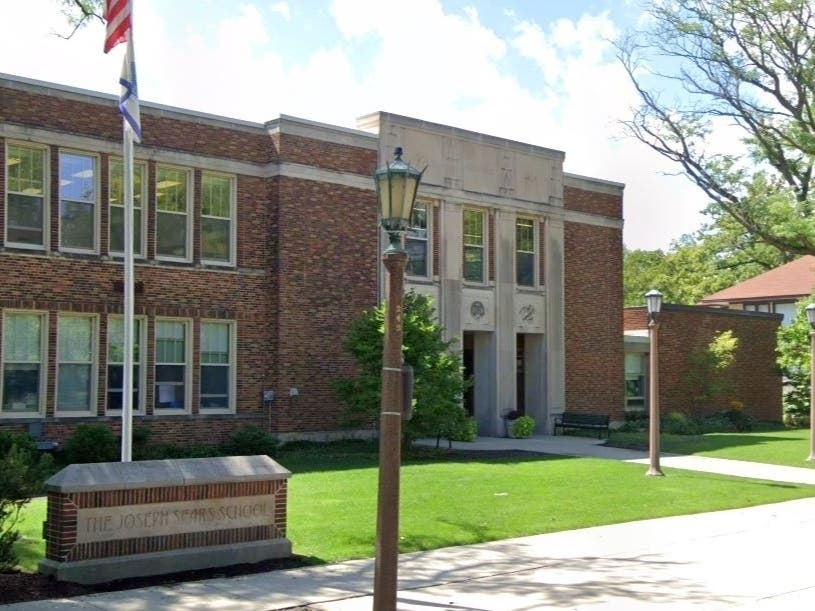
KENILWORTH, IL — The board of Kenilworth School District 38 announced plans to evaluate whether to remove the name of village founder Joseph Sears from the district's lone building. The district issued a statement Tuesday in response to a petition started by a pair of recent New Trier High School graduates calling for the renaming of the 121-year-old school for a second time.
Petition authors Solomon Podorovsky and Jack Yonover described Sears as a "despicable individual" who established Kenilworth with the intention of establishing a ethnically homogeneous town. Keeping his name on the school, their petition argues, effectively praises "white nationalism" as an ideology.
"Joseph Sears founded Kenilworth with four key provisos: 'Large lots, high standards of construction, no alleys, and sales to Caucasians only,'" they said.
Find out what's happening in Wilmette-Kenilworthfor free with the latest updates from Patch.
The petition also noted the May 22, 1966, cross-burning that took place in the front yard the village's first black homeowners, according to newspaper reports from the time.
Illinois Assistant Attorney General Harold Calhoun and his wife, journalist Lillian Calhoun, the first black woman to work in the Chicago Sun-Times newsroom, had purchased the home in 1964, according to a 2013 Shorefront Journal article. A pair of Highland Park teens later confessed to the arson and apologized to his father, the Calhouns' son told Wilmette Life this week, saying the incident should not reflect negatively on Kenilworth or Sears.
Find out what's happening in Wilmette-Kenilworthfor free with the latest updates from Patch.
A review of historical Census data shows there were more black people living in Kenilworth as servants amid decades of racist housing discrimination than in recent years. The village's black population rose from nine people in 1900 to peak at 107 in 1930. In 1990, there were 15 black residents, four in 2000 and seven as counted in the 2010 census.
Yonover and Podorovsky, both Wilmette residents, created the "Kenilworth must remove the name of White Nationalist Joseph Sears from their school" petition June 5. Less than two weeks later, it had collected more than 3,000 signatures. In a text message, Podorovsky told Wilmette-Kenilworth Patch the teens got the idea for the petition following a discussion about why the North Shore lacks ethnic diversity.
"We both began to get kind of riled up and ended up doing a lot of research. As we were looking into things, we started to take particular note of Joseph Sears, especially because we knew he had the school named after him," Podorovsky said. "Eventually, we made a decision that we wanted to do something about it."
He said the goal of the petition was to spark a needed discourse in and around the village, describing the community response so far as empowering and inspiring.
At the District 38 school board's June 8 meeting, both petition authors and two other New Trier alumni expressed their support for renaming Sears School during the portion of the meeting allotted to public comment.
Yonover said renaming Sears School would send a message that the village acknowledged its racist history and was working toward a solution. At a minimum, he called for education about why Kenilworth and other North Shore towns remain so overwhelmingly white. Yonover explained that the motivation behind the petition was a desire to confront institutionalized racism.
"There's a lot of confusion, especially around here, in what that even means. What is institutionalized racism? Are we a part of this? If I'm not racist, how am I a part of the system? And I think what this is — renaming the school — would be a fantastic educational opportunity," Yonover said. "A lot of kids that live in the North Shore don't understand the history of the North Shore. There's a reason that most of our neighbors are white, and it's because of people like Joseph Sears who explicitly limited who could buy houses and the residual effects of that. That is what institutionalized racism is."
Keeping Joseph Sears' name on the school serves as an endorsement of his policies, Podorovsky said at the meeting, which was conducted using videoconferencing software due to the coronavirus pandemic.
"Kenilworth was founded in a manner that really restricted diversity, and that is something that unfortunately continued to this day, whether there was intent from the residents across time or not," Podorovsky said. "I think any action that Kenilworth can take in order to showcase a progressive attitude would be beneficial for everyone."
Jack Slone, a Sears graduate and former Kenilworth resident, said he began to research the village's history after learning about the petition from fellow New Trier alumni. Sears' racism, he told the board, "flew under the radar" for many residents.
"Obviously, that doesn't speak to the current beliefs of the community, but as someone who's actually went to the school where people refer to it by the last name of someone who is blatantly racist, it's hard to ignore the impact of that on the students and the community in general," Slone said.
Pranap Doradla, who said he had been welcomed as a person of color in the community, pointed out history books are full of flawed men who were products of their time.
"We have to keep in mind how much of the person's legacy is dominated by the not-so-good parts. If you look at the North Shore," he said, "it's been a haven for 'white flight' and these traditionally — not so much anymore but still a little bit — segregated communities. And I think that dominates the overwhelming legacy of Joseph Sears, so I don't think there is much to protect there, in my opinion."
Kenilworth resident Lauren Garner also addressed the board during the period of the meeting allotted to comments from the public. Without sharing an opinion one way or the other on renaming the building, Garner said it would be productive for district officials to address the issue.
"I recognize there are a variety of opinions probably within our community on the matter, and I do think that's a debate or a dialogue our community should have," she said. "But more importantly, I think that silence on the matter, or worse, some of the comments or attempts by our community members to categorically shut down the dialogue would be really unfortunate and only go to further reinforce some of the negative perceptions out there that our town is really fighting against."
She recalled learning about the village's reputation for ethnic homogeneity prior to moving from out of state.
"These stereotypes are very real," Garner said. "I'm really glad I overcame them, because I find the community wonderful and welcoming and just 100 percent great, but to ignore the issues being raised would be a mistake."
District 38 Board President Evan Lukasik said he and other board members wanted to understand the past and work to be more inclusive in the future.
"We are committed to promoting and creating a culture of inclusiveness here in this district," Lukasik said. "And that includes examining our history, examining our name during the process."
Board member Mia Sachs is the school board's liaison to the Diversity, Equity and Belonging Committee that the district formed before the outbreak of COVID-19. The committee is made up of Sachs, district administrators, teachers and community members, according to district officials. Sachs said the committee has already begun discussing the district's history, which she said must be addressed to move forward in a positive direction.
Committee members recommended administrators hire an "outside facilitator to examine equity and inclusion issues in our school and community and to develop an action plan." That third-party consultant would help with an "audit" of the district's past and present.
"We would work collaborative with the administration to develop recommendations for measurable ways to improve our equity and inclusion challenges and pain points, where the goal is to educate the entire community — faculty, administrators, parents, volunteers and children — on how to compassionately support each other so that all our children, teachers, parents and community members can be heard and thrive," she said.
With this month's nationwide protests against police violence and unequal justice under the law, Sachs said better education about the history of Kenilworth and Joseph Sears would benefit local students.
"This is a moment from history that is a tremendous learning moment for all of us but especially for our children, who will help shape this country and our community's future," she said. "As an educational institution, I believe we're in a great position to help our children understand our community's past, present and what it can be."

While no one spoke out at the June 8 meeting against renaming Sears School, several New Trier Township residents on a neighborhood message board expressed opposition to a potential name change.
Larry Craig of Wilmette suggested it was one of the "principles of freedom" to limit a community's population to "just, say, Baptists, Jews, women," comparing the village's legacy of whites-only public policies to "black colleges today, [women's] colleges, Latino law societies, black college dormitories."
And Kenilworth resident Suzette Bernstein said she has never considered the Joseph Sears School community to be racist.
"Regarding African Americans moving here or into other communities in the Northshore," she said. "I think it is a choice, just like moving to a community that has other ethnicities, not because we are keeping anybody out."
With a population of about 2,500 and average annual incomes of about $800,000, Kenilworth's 60043 ZIP code has been ranked the richest in the Midwest and among the nation's 10 wealthiest.
According to this week's statement from the district, the next steps toward addressing the history of Sears and the town he founded include fact-finding, the creation of an advisory group to review and discuss the facts and potentially gather additional information, and a future forum to allow community members to discuss the village's history and share thoughts on how to support a more inclusive community in the future.
As part of the initial "fact find" stage, district representatives have contacted the Kenilworth Historical Society, which released a statement that says the petition contains "misinformation."
"There were no racial or religious restrictive covenants in Kenilworth during Joseph Sears' life," it said.
A history of the village that the historical society commissioned more than five decades ago — "Joseph Sears and His Kenilworth," by Colleen Kilner — "includes many inaccuracies," "outdated information," "lacks footnotes and offers minimal, imprecise information about deed restrictions," according to the society's statement.
The statement says the historical society conducted an extensive deed research project that involved examining about 70 recorded documents dating back to the 1890s.
Curator Joseph Gackstetter said the project, first proposed in October 2016 and completed in late 2019, included a review of every subdivision and every decade of development. But researchers were unable to find any racist or religious restrictions included in deeds prior to 1920, eight years after Sears' death.
"Without transparency in history there is no room for growth," the statement concluded. "Without proper documentation or references to support claims, we run the risk of fabricating history."
But contrary to the statements from the board and the historical society, neither Kilner's book nor the teens' petition assert that the "sales to Caucasians only" clause was included in restrictive covenants attached to deed records.
Instead, they claim Sears incorporated a whites-only housing policy into the village's original ordinances. And according to James Loewen's 2005 book "Sundown Towns: A Hidden Dimension of American Racism," the Kenilworth Historical Society itself may be "without proper documentation or references" to support refuting it.
"When I visited the Kenilworth Historical Society in 2002," Loewen wrote, "my request for Kenilworth's ordinances or incorporation documents baffled them. Helpful staff members provided boxes of papers, including scattered minutes of meetings of the board Sears created to govern Kenilworth in its early days but no ordinances. Surely Kenilworth had ordinances — one prohibiting alleys for example. It cannot be found either, but Kenilworth has no alleys, just as it has no blacks."
Loewen also pointed out the Kenilworth Historical Society republished Kilner's book in 1990 with no changes. But Gackstetter, the society's curator, said the decision to reprint the book does not indicate whether or not its contents are accurate. He said the society has several historic village ordinances in its collection but could not say conclusively whether its archives include all of them. Petition authors Yonover and Podorovsky both said they support continued research into Sears' legacy.
According to a history of Sears on the district's website, the village's first schools were both private — The Mary Keyes Babcock School for Girls and The Rugby School for Boys. Kenilworth Public School was established in 1899, the two private schools closed over the next decade, and the public school was renamed Joseph Sears School prior to the village founder's death in 1912.
Get more local news delivered straight to your inbox. Sign up for free Patch newsletters and alerts.