Crime & Safety
Special Report: Danger on the Tracks
A hub for the nation's railroad traffic, Chicago has the second highest number of crossings and miles of track in the country. The city's North Shore burbs top the list for number of crashes, injuries and deaths.




When Jerome Cetnar was struck and killed by a Kenosha-bound Union Pacific North train in Kenilworth Nov. 5, the 66-year-old man became the most recent fatality in a mounting list of train-related accidents along the North Shore. Not an isolated incident, Cetnar's death followed an October accident—and subsequent death—when 29-year-old was killed by a Canadian Pacific freight train in Deerfield.
Since 2007, 11 people have died in railroad accidents throughout the North Shore communities of Glenview, Northbrook, Deerfield and Kenilworth. More than half of these 11 accidents occurred at , with four occurring at the Chestnut Avenue stop alone.
More Tracks Means More Risk
Find out what's happening in Wilmette-Kenilworthfor free with the latest updates from Patch.
On any given day, a variety of passenger and freight trains—including those owned by Metra, Union Pacific, Amtrak and Canadian Pacific—run on the area's two main lines, the Union Pacific-North and the Milwaukee District-North.
Chicago lies at the nexus of the nation's railroad traffic, and it's surrounding suburbs top the list for number of crashes, injuries and deaths throughout the country, explained Chip Pew, State Coordinator for Illinois Operation Lifesaver, an Illinois Commerce Commission railroad safety program.
Find out what's happening in Wilmette-Kenilworthfor free with the latest updates from Patch.
"We also have the second most crossings, the second most miles of track and we're the hub of railroad traffic, so we have exposure, we have risk," Pew added.
A freight train traveling at 55 miles per hour takes the length of approximately 18 football fields to come to a complete stop, according to Operation Lifesaver.
But for the average commuter, distracted by smart phones and iPods, startling statistics are not always top of mind, officials say. Many commuters overestimate how much time they have to cross tracks, adds Mark Magliari, spokesperson for Amtrak's Chicago offices.
"The minutes that you think you might save by disregarding the train's warning and proceeding across the tracks, if your guess is wrong, are minutes you're never going to get back," he said.
Increased Safety Measures
The Illinois Commerce Commission has authority over all public crossings in Illinois and fosters a program to help communities and railroads improve their crossings through a grade crossing protection fund, explained Pew. This funding— now estimated at $42 million— comes from motor-fuel taxes and is available to those communities who apply for funding.
In an effort to raise safety awareness, Metra has begun ticketing pedestrians who ignore warnings at grade crossings (where tracks meet a roadway). The commuter train company has always ticketed for trespassing and has issued 120 tickets for this offense in the last five years, said Metra spokesperson Mike Gillis. The decision to issue tickets to pedestrians violating grade crossings is a recent one, and therefore no figures are currently available, Gillis explained.
Drivers are also subject to ticketing for failure to obey crossing gate signals, he added. In addition to tickets distributed through local authorities, Metra has issued 86 citations this year.
"It generally doesn't take writing too many tickets to change people's behavior," Pew added. "Unfortunately I don't think most people get it. When those bells and lights turn on, that means a train can be there in as little as 20 seconds."
Root of the Problem
Throughout the state, there are nearly 8,000 crossings with 50 percent of all accidents occurring at crossings with active warning devices including lights, gates and bells.
While the amount of daily traffic does contribute to accident occurrence, it is one of only several factors affecting the danger level of specific tracks, explained Magliari. Among significant contributing factors are the construction and engineering of stations and grade crossings.
An important piece of the safety puzzle stems from the variance in design from train crossing to train crossing. Area crossings were originally contracted by a variety of rail companies, many with different track layouts and designs and some safer than others, added Magliari.
Depending on the stop, some stations allow pedestrians and cars to cross the tracks, while others have tunnels built underneath, creating a distinct separation between pedestrians, automobiles and rail traffic. On the North Shore, the vast majority of crossings on the area's main lines are at grade level.
An Expert Perspective
According to Ian Savage, a Northwestern University Economics professor who studies railroad safety, engineering improvements and programs like Operation Lifesaver have had success in reducing the frequency of some types of accidents— but not all.
"As far as incident involving automobiles, the trend has been downward for basically 40 years," he said.
But when it comes to incidents involving pedestrians on railroad tracks, little has changed, Savage added.
"Lots of the crossings and stations [in the area] are at the same level as the tracks, whereas in New York or Boston, because of the hilly nature of things, people have to go down steps to get to the platform; the road is at a higher level," Savage explained.
Room for Improvement
A few stations in Chicago do have tracks that run above or below the station— including Winnetka, for example— but most stations in the North Shore do not and retrofitting can be cost prohibitive.
According to Pew, putting in a grade separation can cost $40-$50 million. And that's just for one crossing. Less expensive options involve tweaking the design of stations and crossings, he said.
While Metra is trying out several updated designs throughout the western suburbs in hopes of creating better safety around crosswalks and at the end of platforms, North Shore stops, which are mostly at ground level, are a "free for all," added Savage.
Among Savage's suggestions are better platform warning systems that would announces when a train is not stopping and signals commuters to stand clear, for example. In Glenview, there is a station agent who makes just these sorts of announcements, although authorities noted that it's not a requirement.
In some instances, private entities have stepped in to fix Metra safety issues surrounding less than safe grade crossings. Last summer in Highland Park, began a $5 million Ravinia Park Metra Station . Construction management firm W.B. Olson is scheduled to complete the work before the start of the 2011 summer concert series.
The project is aimed at improving grade crossing safety, explained Ravinia Festival General Manager Pat Sanders. Currently, when festival-goers take the Metra to a Ravinia concert, they must wait for their train to leave before they can cross the tracks and enter the park grounds. Sometimes this wait can take up to a half hour; when visitors leave the park they have to wait again.
"We will trap people in the west parking lot for up to 30 minutes," Sanders explained. "We'll literally have hundreds of people standing there."
On any given concert night, up to 8,000 guests will cross over the tracks to get into the park and then again to get out, Sanders added. Though no one has been harmed at the station, local officials and residents feared it was just a matter of time.
"It is not 'if' you have an accident," she said. "It's when."
Additional reporting by Jacob Nelson; graphics by A.M. Cole; video by Natalie Kaplan
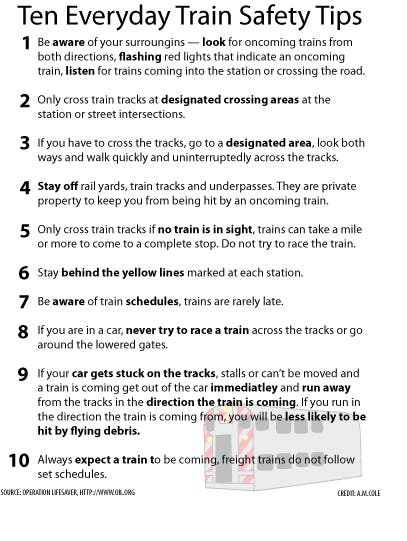
Editor's note: For more detailed statistics, train safety tips, a map of local train stops and more, check out the above graphics. Curious what local residents have to say? Watch our video.
Get more local news delivered straight to your inbox. Sign up for free Patch newsletters and alerts.