Business & Tech
Conney's Pharmacy Contends with Chains in Challenging Times
One of the few independent pharmacies in the area uses personal touch to maintain customers and deal with complications, such as federal healthcare policy.


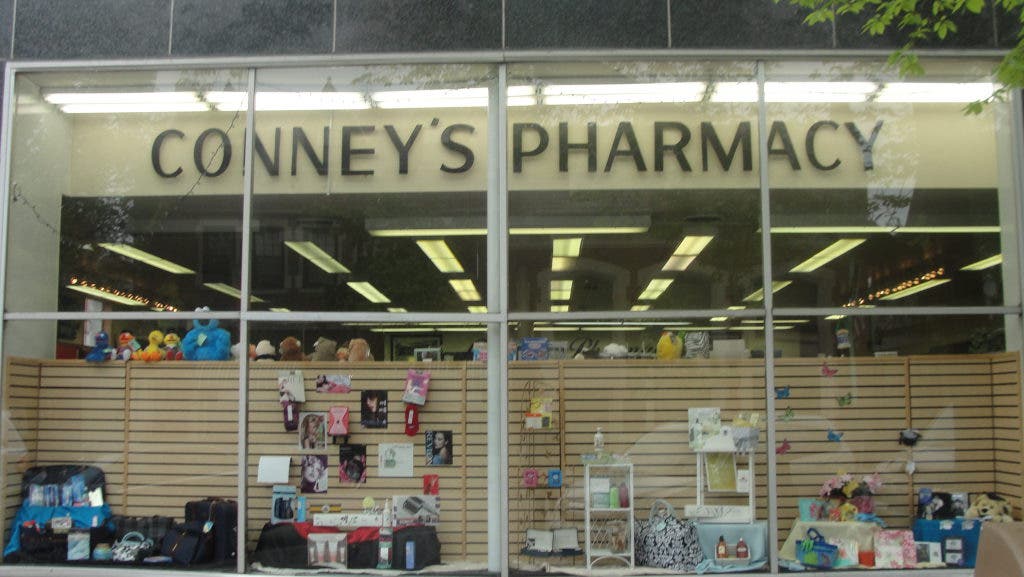
It could be a scene from a Norman Rockwell painting, a vestige of an earlier era, seemingly stamped out of modern society by chain pharmacies. A person stops by his neighborhood pharmacist, who knows the patient by name and who can suggest a specific medication tailored to the customer.
For Judith Shaw of Winnetka such a scenario has occurred for her at Conney’s Pharmacy for half a century.
“One time I had a sick child on a Sunday,” Shaw recalled Wednesday morning while browsing greeting cards. “I called an emergency number and the owner came down just for me. He gave me what I needed. They have never failed me one single time.”
Find out what's happening in Winnetka-Glencoefor free with the latest updates from Patch.
Stay connected with local news when you join our free daily newsletter.
, with a lineage in downtown Winnetka that dates back to the FDR presidency, is one of the last independent pharmacies on the North Shore at 736 Elm St.
Find out what's happening in Winnetka-Glencoefor free with the latest updates from Patch.
Like his neighbor just a few feet away, , Conney’s owner Mark Jacobs knows it is not easy for an independent business to maintain relevancy going up against chains, who often have a much larger selection on all types of merchandise.
“There is no question the chains have the ability to attract different product lines but Conney’s is able to find that niche that we can find product lines that are equally as effective,” Jacobs said.
According to the National Community Pharmacists Association (NCPA), there are 695 independent pharmacies remaining in Illinois, as of 2010. That's down almost 100 stores since 2007, when there were 785 stores. Nationally, numbers have decreased since the 1980s and 1990s when the big chains starting taking over the so called “mom and pop” drug stores. Today, the national number of independent community pharmacies ring up at 23,064 total.
The "Personal Touch"
Yet a few like Conney’s remain. What they lack in product lines, the independent stores try to make up with personal touch.
“At a big chain, you have to go looking around,” Shaw said. “Here everything is small. If I need something, they will order it.”
Jacobs, who has a staff of 18, tries to carry out the personal touch with all of his customers. He has a private consultation at the pharmacy and works with doctors as much as possible in his hopes that patients receive the best medication.
“Since 1988 I have owned my own business; I think of my customers as my family members and by doing that you try to select the right item and give the right advice,” he said.
One such personal touch is still delivering prescriptions for a small fee to as many as 24 zip codes around the area, stretching from Chicago’s North Shore all the way to Wheeling.
When National Policy Goes Local
With stories like Shaw and the efforts of Jacobs, it might be easy to think Conney’s has carved a niche in the Winnetka marketplace. That may be true, but complications, such as healthcare policy, can impede growth. For all the people who have ever had to question their health insurance company about coverage, those same battles are fought on the pharmacy end.
“The managed care programs and the pharmacy insurance are very dominating,” Jacobs concedes. Kevin Schweers of the National Community Pharmacists Association agrees that federal policy can affect payment for businesses.
“Prescription drug reimbursement levels from government and private third-party programs continue to decline,” said Schweers. “Reimbursement concerns continue as many states are grappling with large budget deficits and rising Medicaid costs as enrollment grows. Payment issues are more sensitive for independents as filling prescriptions accounts for over 90 percent of an independent’s revenue, whereas large chains are in the 60 percent range.”
In recent years there is also competition from mail-in options, and Schweers added that some insurance plans now have “closed” networks, which prevent people from using their neighborhood pharmacist as these networks tend to use the big chains.
Neighborhood Reward
With these realities in place, the independent pharmacy is not for the faint of heart today. But Jacobs, who grew up in Skokie and has owned and operated Conney’s since 1988, he still finds it to be a rewarding experience, knowing that he can help a lot of people.
“In pharmacy, you have more patient contact in numbers than compared to a physician,” he said. “We can see 50 to 100 people a day. A physician only sees 20-25.”
And when asked the awkward question of what he thinks Conney’s has meant for the community, there is a simple response.
“We’re the neighborhood community pharmacy,” Jacobs responds. “I think the people of Winnetka appreciate that.”