Schools
A Side of History: Eighth-graders Meet During Lunch for Advanced Project
A dozen students are studying the Treaty of Versailles as a challenge on top of the regular history curriculum.
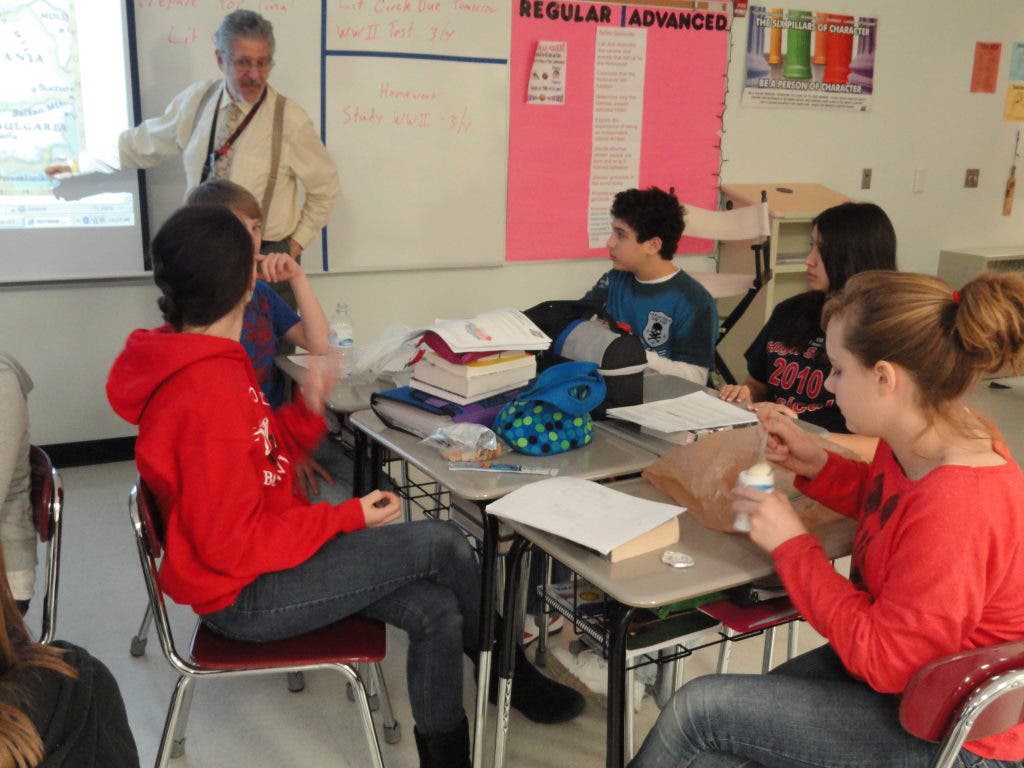

A dozen Yorkville eighth-graders recently spent their lunch time in their history classroom, discussing the League of Nations and how best to carve out new nations after World War I.
Should nations be created along economic, ethnic, religious or linguistic lines? student Amanda Armitage pointed to the United States’ multicultural make-up to argue against building nations by language groups.
“You can’t just say there’s a person who speaks Spanish here, this is now Mexico,” Armitage said.
Find out what's happening in Yorkvillefor free with the latest updates from Patch.
But leaving such things up to the residents themselves wouldn’t work either, Abbey Sprandel said.
“If you let the people decide, you’d have two or three hundred countries in Europe,” Sprandel said.
Find out what's happening in Yorkvillefor free with the latest updates from Patch.
The discussion stemmed from the book Paris 1919: Six Months that Changed the World by Margaret MacMillan. The dozen students are tackling the college-level book on top of the regular 8th grade history curriculum with a little direction from teacher Jeff Young. During the recent lunchtime discussion, the students created and answered their own discussion questions.
Young is using the book to challenge these students to think more critically and engage in a higher level of academic work. Among their first tasks were creating vocabulary lists, defining what background information they didn’t know and figuring out how they were going to research it.
“I never realized how important the Treaty of Versailles was,” May Priegel said. “I’d never even heard of it before, but you see how much of an impact it was.”
They also considered whether the reparations forced on Germany were fair and whether they contributed to Adolf Hitler’s aggression in World War II.
Armitage suggested a little compassion would have gone a long way in calculation reparation payments.
“Both sides were fighting in the war,” she said. “…They should have taken into account if the situations were reversed, what would we have wanted.”
But Sprandel wasn’t willing to blame those payments for World War II.
“I think Hitler would have started World War II anyway,” she said, “because he’s all crazy and wanted to take over the world.”
Participating in the special project are: Lucas Erb, Emilio Hospedales, Miranda Knox, Derek Lubecke, Rachel Strobel, Mason Dearborn, Henry Imburgia, Summer Lara, Carly Teeling, Priegel, Sprandel and Armitage.