Community Corner
Autism Speaks: An Iowa Family Hopes Others Can Learn from Its Journey
A West Des Moines couple wants to be a resource for other Iowa families when their children are diagnosed with autism, a disorder that can affect how children's speech and behavior develop.


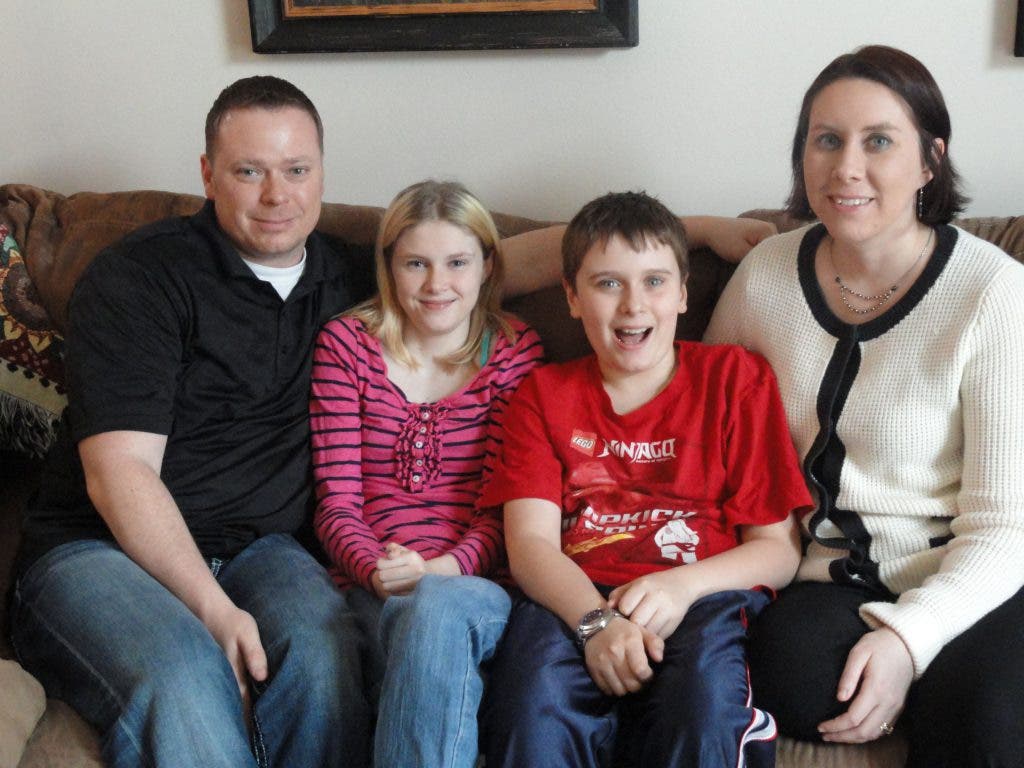
Seven years ago, when Jennifer Hahn took her 3-year-old son, Nicholas, to the doctor for a routine procedure, she heard the words that would forever change the lives of her and her family.
“Your son has autism.”
While time and certain resources have helped the Hahn family of West Des Moines, Jennifer, district systems coordinator at Ankeny Community Schools, now advocates for autism awareness and believes more can always be done for both children and families affected by the disorder.
Find out what's happening in Ankenyfor free with the latest updates from Patch.
“Your neighbor, someone you go to church with, your co-worker’s child could all be affected by this,” Jennifer said. “I always tell people that I feel like the window of opportunity is closing each year as my son grows older. If we don’t do something now, it’s only going to affect us more down the road.”
That’s why she is telling her story. April is National Autism Awareness Month. One in every 88 children have some form of autism, according to a 2012 study done by the Centers for Disease Control and Prevention.
Find out what's happening in Ankenyfor free with the latest updates from Patch.
Autism is defined as a complex developmental disability that typically appears during the first three years of life and affects a person’s ability to communicate and interact with others. There is no known single cause of autism, and no two cases are exactly the same.
In Nicholas Hahn’s case, he’s a typical 10-year-old boy in many ways. He’s tall, energetic and talkative, full of curiosity and eager to play with his friends and his three dogs.
Beneath the surface though, he and his family struggle every day. Order is important because Nicholas’ autism requires him to have things done a certain way. Good behavior isn’t always the norm as his parents try to teach him good social skills. Sometimes his language is a little colorful, his mother said.
It has been a journey, one his family didn’t plan for, but one that has taught them valuable lessons about love and never taking the small victories in life for granted.
Nicholas Hahn’s diagnosis
When Nicholas was a toddler he was developmentally on par with other children his age, his mother said. His speech continued to develop until he was about 24 months old, when it suddenly stopped.
The Hahn family, which also includes now 14-year-old daughter Natalie, lived in North Dakota for the first three years of Nicholas’ life. That’s where Jennifer and her husband, Rich, first talked to their doctor about their concerns.
“We were told a lot of things – he just has a sister who talks for him. He doesn’t need to talk. He’s just fine. He’s just a boy,” Jennifer said. “That was seven years ago though, when autism was not as prevalent as it is now.”
Once the family moved to Iowa, the Hahns took Nicholas to a doctor to get tubes put in his ears when the doctor told them he would not operate on the 3-year-old because “he had autism.”
It was the first time anyone had mentioned the possibility of autism to Jennifer and Rich. Regardless, it came as a complete surprise to their family.
“We probably made all the same conclusions others have – that our lives were over, that Nicholas’ life was over,” Jennifer said.
Learning to cope with a child with autism
Following Nicholas’ diagnosis, Jennifer and Rich researched everything they could on the disorder.
“That is the first thing I tell every mom to do,” Jennifer said. “Read everything. Find everything. Question everything.”
As she did more and more research, symptom checklists and warning signs suddenly made sense. Looking back, Jennifer knew there were signals there she may have missed.
“We cannot look at home movies because we are afraid of what we’re going to find, things that were blatantly in front of us that we will feel silly for not having seen,” she said.
The absolute best resource her family found, Jennifer said, was the Iowa Area Education Agencies. While the Internet was helpful, it was also what Jennifer described as a “scary place” for someone seeking accurate and helpful information.
One of those resources was Bindy Brown with Heartland AEA in Johnston. Brown gave Jennifer some advice, reminding her what she needed to focus on when the diagnosis seemed impossible to cope with.
“She told us she knew our hearts were broken, and while we didn’t know what the future held and that all our expectations for the future were crumbling down, it was not about us,” Jennifer said. “It was about Nicholas.”
Nicholas’ primary struggle is his behavior, which is one of three developmental areas primarily affected by autism. The others are speech and social skills.
Nicholas has worked with AEA staff in the Hahn home throughout much of his life. He has also attended a daycare where he worked with a speech pathologist, who taught him how to use words when he needed to communicate with peers and family members. The Homestead in Runnells has also provided support and help in developing Nicholas’ social skills.
His language flourished. While Nicholas’ speech and interactions are still a bit robotic, his mother said, he can converse with others and possesses manners better than most kids his age.
“I don’t know what we would have done without them,” Jennifer said. “It’s heartbreaking as a mom when other kids can tell he’s different, but we’re so proud of him for the things he can do.”
How it’s affected the Hahn family
Coping with Nicholas’ autism and the necessary demands that come with it has made for both bad and good days in the Hahn household. Raising a child with autism puts strain on all parts of a family, Jennifer said, from a marriage to friendships to day-to-day lives.
“On the bad days, I feel like my heart is breaking every single day...like I’m mourning for the loss of an unknown,” Jennifer said. “Sometimes it’s hard to get out of bed in the morning.”
But on the flip side, Jennifer said she truly believes she and her family are better people because of Nicholas and because of the challenges they’ve had to overcome in making sure he leads a happy life.
Jennifer said it’s also important for parents who have children with autism to remember the little things.
“If we did not have him in our lives, I think of what kind of self-absorbed, selfish people we would be and how we would take so much for granted,” she said. “My son is not dying, and I am thankful for that every day. He is able to give me a hug, tell me he loves me. Those are not gifts we are all given and I try to remember that.”
Advocacy
While Jennifer and her family are grateful for all the resources and people who have helped Nicholas, she knows more needs to be done to raise awareness and provide support to families grappling with autism.
Support for those dealing with the mental health component is among those areas.
Recently, the Hahn family has learned Nicholas also has a form of obsessive-compulsive disorder, which makes his therapy more challenging. The symptoms, at times, seem to overtake those of Nicholas’ autism.
While Jennifer said she feels there are good initiatives to provide respite for families and therapy for children, more could always be done.
“We are really dealing with the mental health piece,” she said. “And a lot of times, people don’t understand how to treat autism when it comes to mental health.”
Autism education also is important to Jennifer, who knows all too well the struggle parents go through to make sure their children receive the attention and support they need in the classroom and beyond.
To help that cause, Jennifer and Rich have shared their family’s story on Iowa Public Radio. Jennifer also volunteered once again to help organize this year’s Iowa Autism Speaks Walk, which will be held June 8 at Principal Park in Des Moines. Anyone who wants to can register and participate in the fundraiser event.
But ultimately, it’s about paying it forward and letting others know they are not alone when it comes to raising a child with autism.
“There were people there for us when we didn’t have anyone to turn to,” Jennifer said. “I want to make sure I’m there for others when they come out of the doctor’s office and wonder what they’re supposed to do next.”
COMING MONDAY: A look at resources in Iowa for families who have children with autism.
Get more local news delivered straight to your inbox. Sign up for free Patch newsletters and alerts.