Health & Fitness
Awfully Dry Lemonade - Genuine Faux Farm blog
We are painfully aware of how much we rely on good, clean water at the Genuine Faux Farm. But, what will happen if all of us don't think more about how we use our water?

I noted one image that caused me to look for the other image which got me to thinking. And we all know thinking is a DANGEROUS PASTIME.
The first image is a National Weather Service drought map. Our area is right on the tip of the orange/severe drought in northeast Iowa. In other words, not great, but it could be oh so much worse. But, the thing we need to keep in mind here isn't the fact that there *are* areas in a drought - that's almost always the case. It is the fact that *so much* of the North American landmass is in one.
Of course, the weather concerns me because I intend to (yet again) try to grow some delicious produce and raise some poultry this year. And, raising food requires water. Any given day on the farm illustrates for us exactly how important water is for our success. Every day we give our animals water, sometimes twice a day (or more) when it is hot, dry and windy. Water is important to keep our plants alive and growing. We need water to help clean produce, eggs and ourselves before we deliver to customers. Water is used to clean equipment and containers. Our extensive use of water concerns us, and we hope to continue making changes to improve our conservation of the water we use. And we do this because we feel we need to do our part to be responsible stewards of our resources.
How wonderful for us that we will try to be responsible. But, what happens when not enough of us are even thinking about being responsible with water use?
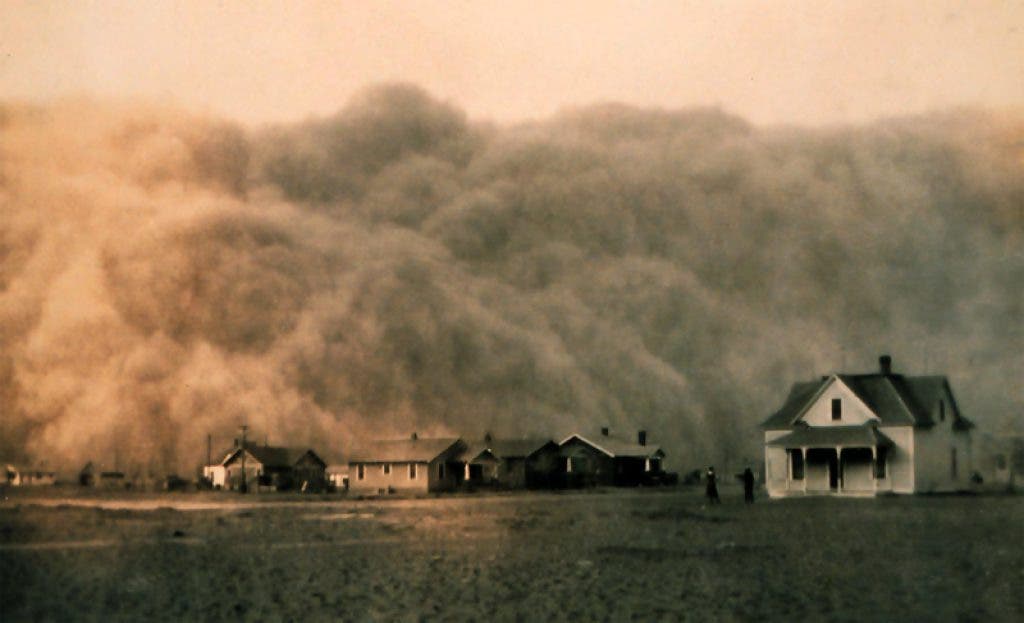
The second photo is a picture from the Dust Bowl (posted by the Leopold Center for Sutainable Ag). Pretty amazing. And, very frightening.
Nature will do what it does. Even if we are all being responsible, there will still be droughts, floods, fires and whatever else. But, when we are not watching what we're doing, we can take a natural event and help turn it into something exceptionally nasty.
Some things concern me that fall on a scale that I have no direct control over. For example, we have hydraulic fracturing (fracking) being used to recover natural gas. This process uses large amounts of water, often in areas that have very little left to give. Consider the Dakotas as a case study (reference the drought map please). We've been lucky to not have to deal with extreme water shortages and water wars in the United States. But, poor water use decisions may be changing all of this.
Then there is the case of corn ethanol. The cost for corn ethanol is being taken out of our hides by increased water use for corn crops in areas that are better suited to grow other things. Or, by the contamination of water through the processes used to grow the corn. Consider how much of our drinking water comes from our rivers - then realize that Iowa has some of most polluted waterways in the country. I thought the purpose of ethanol was to be better stewards of our resources? Apparently not. And, it gets a bit more disturbing when I realize that the pressure to grow corn has come from government subsidies for corn ethanol as well as subsidies for the corn commodity crop.
Perhaps we should also consider bare soil farming. If you drive down Iowa's roads in Winter, you might notice the snirt (dirty snow) in the ditches. This is an indicator of wind erosion of our farmland. Those who use no-till practices see less of this, but they are still losing soil. In fact, we are acting like we all want to see a repeat of the Dust Bowl. Are we really that enamored with tragedy that going to the movies isn't good enough now? It isn't that difficult to implement longer rotations (instead of corn-soybeans or worse, corn on corn) and it isn't hard to plant cover crops to help hold the soil.
So, how does it come to this? Does it really require regulation to force us to try to take care of our environment and our resources? Are humans really so greedy that we won't reduce our profit margin a bit in order to get something done right? Are we so inflexible that we can't adjust once we see a problem with how things are being done? Are we all just so lazy that we can't bring ourselves to do a little bit more in an effort to prevent catastrophe? Or, are all of these things so much more complicated than a single blog post can address?
Yes.
But, that doesn't mean we shouldn't still try to do something about it. I don't want to see a reenactment of the second picture. Do you?