Health & Fitness
Blog: How Farming Connects Us All: Gary Holthaus Reading at Cedar Falls Public Library
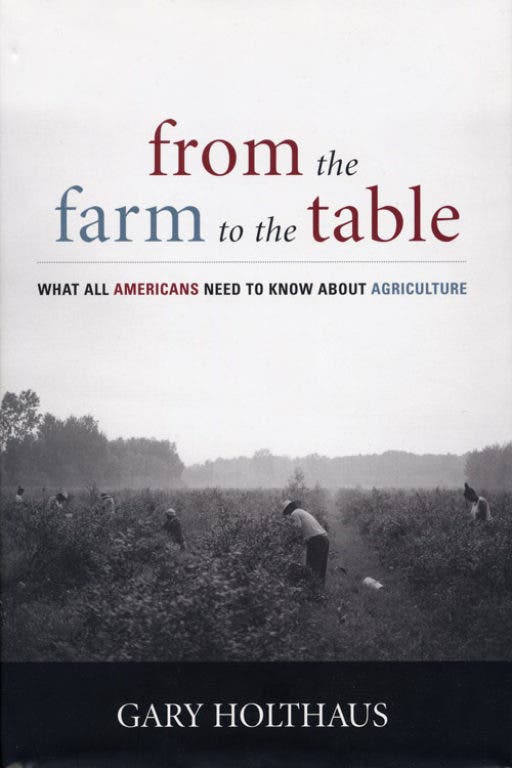
On Feb. 9th, author Gary Holthaus will present a reading and discussion of his book From the Farm to the Table: What Every American Needs to Know About Agriculture.
Through this blog, I hope to share some of my research and writings on the relationship between humans and land in Iowa.
This is an exploration that moves through corn fields and prairie grass, along rivers and sidewalks, all in order to better understand our place in nature as human communities. Who knows where else it will take us? For now, I would like to share an article I wrote to promote a reading this week at the Cedar Falls Public Library.
Two summers ago, I volunteered on a small organic farm outside of Iowa City. Before this, I had given little thought to agriculture. But in just one day of work and conversation, I began to awaken to the intricate complexities of agriculture in our country today.
Find out what's happening in Cedar Fallsfor free with the latest updates from Patch.
Perhaps it was all spurred by an observation from the farmer: “What’s natural about a sticker on an apple that says natural?” I have learned that when it comes to agriculture, we must consider both the enormous, such as the influence of transnational corporations, and the minute, whether it is a label on an apple or the micro-organisms necessary for healthy soil. The key is awareness.
On Thursday, February 9th at 7 p.m. in the Cedar Falls Public Library, author Gary Holthaus will present a reading and discussion of his book From the Farm to the Table: What Every American Needs to Know About Agriculture. This is an opportunity to learn how agriculture not only depends on farmers, agronomists, or the federal government, but everyone.
Find out what's happening in Cedar Fallsfor free with the latest updates from Patch.
It depends on what vision of agriculture we support as local communities. We cannot have a sustainable culture of any kind unless we have a sustainable form of agriculture. The vision of industrial agriculture, propelled by fossil fuels and expensive machinery, threatens any hopes for sustainability. Sustainability is not a chore but, as Holthaus writes, “An ethical, spiritual, and intellectual response to what we see around us.”
Emphasizing locally grown foods raised in communion with the land, From the Farm to the Table presents an alternative vision of agriculture. Holthaus even illustrates how this vision is specifically at work in the Cedar Valley, describing the work of former Cedar Falls councilman Kamyar Enshayan and the Buy Fresh Buy Local initiative.
We are told we need large-scale industrial agriculture to “feed the world.” But as Holthaus reveals, the increase in crop yields correlates with an increase in hunger on a national and global level. We do not seem to recognize, as Holthaus writes, that, “Our vaunted farm technology will never feed the world because our major grain traders will not sell to the hungry because the hungry cannot afford to pay.”
Industrial agriculture does not feed the world, but it does send topsoil and chemicals downstream at alarming rates, resulting not only in a loss of soil fertility and polluted waters in Iowa, but also a dead zone in the Gulf of Mexico. A supermarket crammed with food in every aisle is not an indicator of food security. Neither is what we often refer to as “economic health,” which only seems to refer to an industrial economy that is utterly unhealthy for the resiliency of land and community. Food does not come from a supermarket, but the land. And if we continue to disrespect the land, it will not come from bedrock either.
Through Holthaus, we learn that what we may need more than anything else in agriculture is not $500,000 tractors, the Frankenstein crops of the Monsanto seed empire or any other quick fix, but a love of land and place, where something like soil loss is a source of grief for farmer and city dweller alike.
We must challenge the language of land as just profits and sales.
Wendell Berry, a farmer and poet, writes, “There are no unsacred places;/ there are only sacred places/ and desecrated places.”
Sacred means holy, which in turn means wholeness or health. We can play a part in restoring desecrated places to wholeness and health. But if we do not treat the land as sacred, we eventually desecrate ourselves.
For more information, visit http://www.cedar-falls.lib.ia.us/archive/2012/february2012/Holthaus