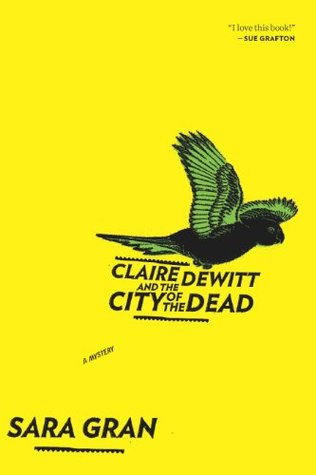
Thoughts on "Claire DeWeitt and the City of the Dead" by Sara Gran (Houghton Mifflin Harcourt, 2011, 273 pages)
Perhaps there is no better time than now for noir to take a serious hold on the American Imagination. Its very definition, "hard-boiled cynical characters and bleak sleazy settings," says much about the American psyche in the Twenty-First Century. Is not the current obsession among many with zombies a manifestation of the bleakness felt by Generation X and the Millennials toward the future? Crippling student loans. Bad economy. Bad jobs market with sub-par salary and small hope of advancement. Broken government. Cold, impersonal, manipulative relationships. Fear, both of what we know and what we don't know- a fear that results in meaner and coarser relations with our fellow humans.
Yes, the gutter politics and hostile worldview of noir, 'a la the Mike Hammer novels by Mickey Spillane, seems to be tailor-made for these times. And in "Claire DeWitt and the City of the Dead," author Sara Gran takes the noir novel and upgrades it for our times.
I first heard of Gran when I came across an audio review of her latest installment in the Claire DeWitt in Salon.com in which Laura Miller wrote:
"She’s a fortysomething, chemically adventurous, bed-hopping, gun-toting, hard-boiled, socially dysfunctional, existentially New Age Nancy Drew..."
With a description of such an offbeat character, I had to investigate further. At the time, the Cedar Falls Public Library didn't have a copy of the second book at the time "Claire DeWitt and the Bohemian Highway," but have since rectified that situation.
Just as well, I checked out "City of the Dead."
Miller's description is true. Gran is a great storyteller who not only updated the noir novel for our day and age, but at the same time created a character that adds a special twist to the stereotypical hard boiled noir detective. In that DeWitt is a woman? No. In that she is equally as mystical in her worldview as she is cynical. She relies on the I-Ching, dreams, and the teachings of Jacques Silette to interpret evidence and motivation. All of this while sharing 40's and smoking joints (both by herself and with underage suspects) without regard to whether the cigarettes are filled with Mexican Shake or Embalming Fluid. Not only that, she has recurring dreams about Silette and her mentor, Constance Darling
DeWitt winds up in New Orleans, post-Hurricane Katrina, after being hired by Leon Salvatore, who wants to her to investigate what happened to his uncle, Assistant District Attorney Vic Willing, a case that eventually turns into murder mystery. If that were the extent of the book, then it might have been good enough- after all most people enjoy a well written whodunit.
But in Gran's hands, the book is equal parts a meditation on death itself and a contemplation on what a mystery even is. Gran is particularly gripping when describing New Orleans and its inhabitants. I assumed going into the book that "City of the Dead" referred to the horrific events of Katrina and the shameful response by local, state and federal agencies. One particularly gripping passage concerned a character named DeShawn describing he and his family being left on the roof of a building in the aftermath of Katrina and the desperate feeling that nobody was coming to rescue.
To listen to DeWitt, who has experience in NOLA, the city was dead beforehand. Murders on a daily basis. Incompetent law enforcement. DA's at war with the police to the point where there are almost no arrests for murder and when there are, almost no punishment occurs. In Gran's New Orleans, life is cheap and nobody cares. Many of the residents of New Orleans in Gran's work (at least the characters in passing) seem to walk through their days in a haze. Not of cigarettes, drugs and booze, although that certainly plays a part, but more of apathy and hoplessness. Especially among the young, one gets the feeling that they are ghostwalking through life.
When Gran concentrates on the bigger players in the plot, particularly suspect Andray Fairview, veteran of the streets and the hard knock life even though he isn't even twenty, she draws a nuanced picture. Andray, Terrell, Mick, and other characters in Gran's story are not the characters of stereotypical steet hoodlums or frustrated middle aged men. They are fully realized characters with humanity and motivations.
As for Claire DeWitt, she and her hard-boiled mystique personality are just out of reach in this book. This is not a bad thing given the fact that this is the first in a series of books. I would probably complain if Gran decided to throw everything on the table regarding DeWitt.
I suppose the best thing that a reader can think regarding the first in a series of books is that the author has created a character worth following. Certainly Gran has accomplished this in DeWitt. I anxiously await her next adventure.
So does someone else appartly. The book has been checked out from the Cedar Falls Public Library and isn't due back until August 6th. Pity.