Community Corner
NASA Astronaut Peggy Whitson To Girls: Dream It, Then Achieve It
The Iowa native, who blasted record after record in space, is back on Earth encouraging girls and women to pursue careers in STEM fields.


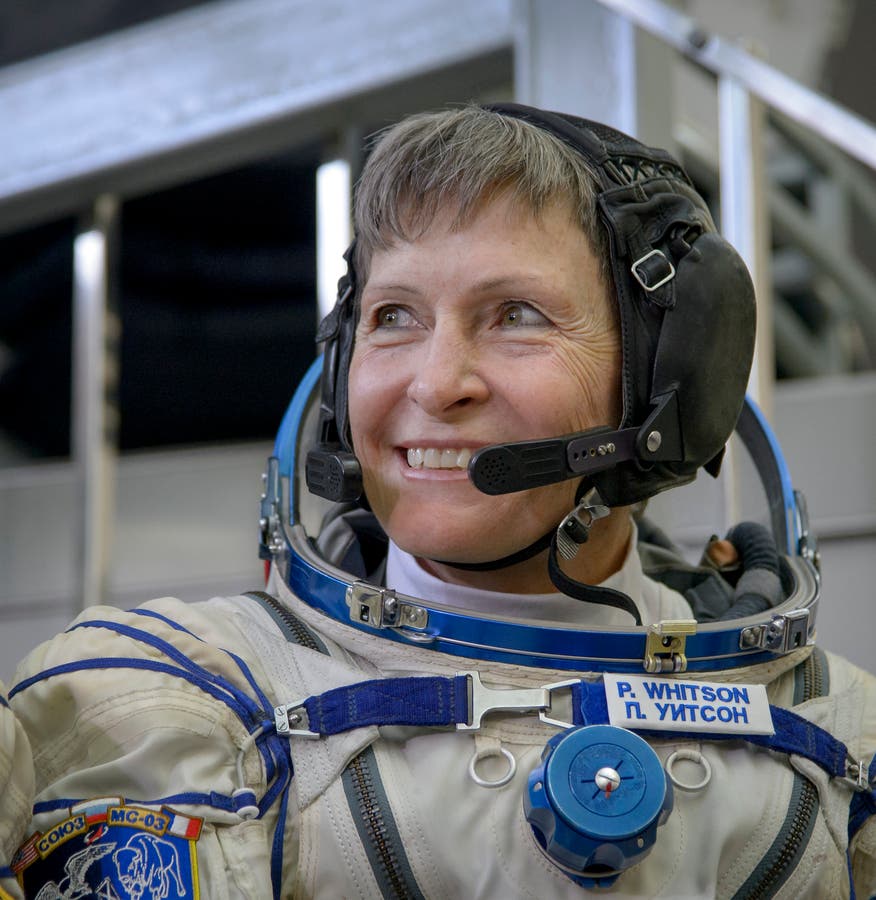
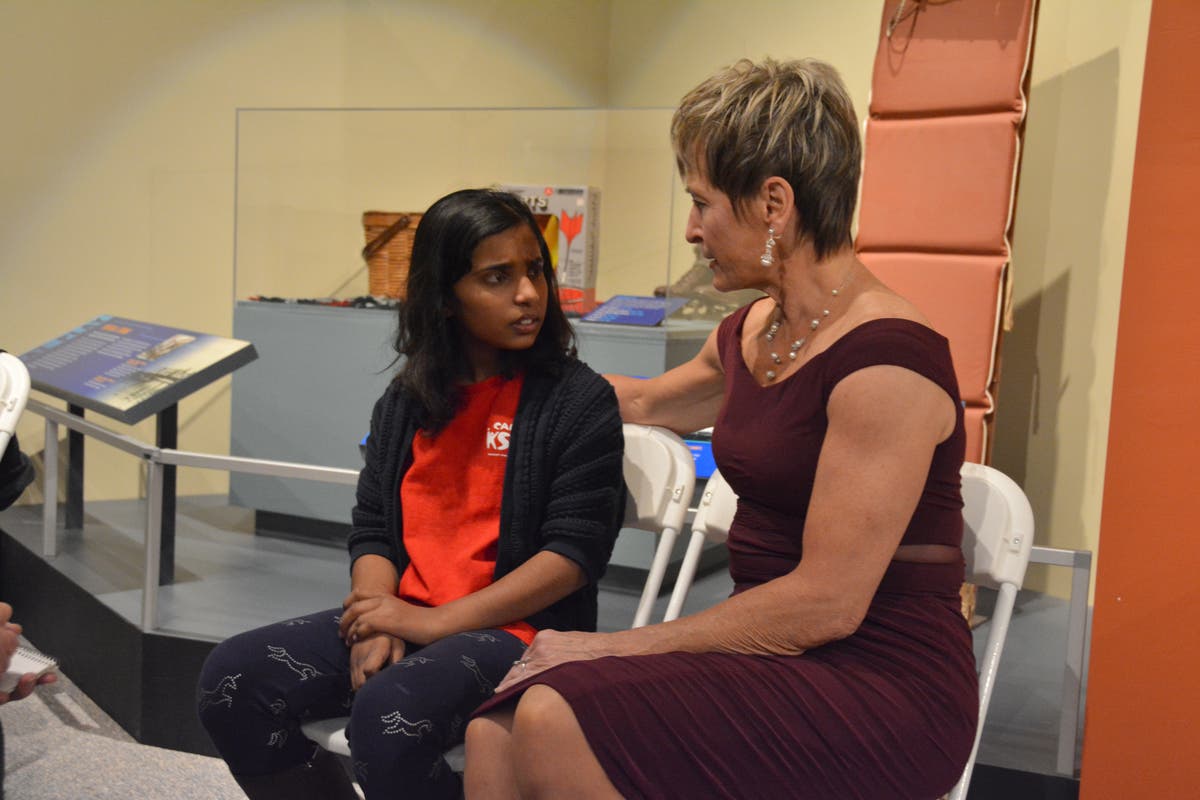
DES MOINES, IA — Sami Kopparapu wants to be an astronaut, the 10-year-old told Peggy Whitson, one of the most accomplished astronauts in NASA’s space program, as Whitson came home to Iowa Friday to give the keynote address at a gala for the state’s Department of Cultural Affairs. It was a big moment in the young girl’s life to sit down with Whitson, who had the same big dreams as a youngster growing up on a farm in southwest Iowa.
“I want to go to the moon,” said Sami, a fourth-grader at West Des Moines’ Western Hills Elementary School who attended a NASA space camp at Cape Canaveral, Florida last summer, makes model rockets and tunes into the NASA channel every chance she gets.
“I think if you find your dream, something that makes you excited and work hard at it — nothing is going to be handed to you — you can achieve it,” Whitson told Sami. “It’s going to take a lot of work, but you can do it.
Find out what's happening in Des Moinesfor free with the latest updates from Patch.
“Maybe you could be a rocket engineer,” Whitson said. “There are lots of things young ladies like you can do at Mission Control. You should know you can become that, or whatever you dream. It will take a lot of hard work, but you can do it.”
Hard work helped Whitson blast through record after record during her time with NASA. She has spent more time in space — 665 cumulative days — than any other U.S. astronaut, and more than any woman of any nationality. She was the first female chief of NASA’s Astronaut Office. She was the first woman to command the International Space Station, something she’s done twice. A 57, she is America’s oldest working astronaut. She has logged more time walking in space more than any other female astronaut, with a cumulative total of 32 hours and 36 minutes over 10 spacewalks.
Find out what's happening in Des Moinesfor free with the latest updates from Patch.
“Spacewalks are hard to beat,” she said, calling them exhilarating and offering enchanting views of Earth that NASA photos, as stunning as they are, can’t quite capture.
She’s humble and even modest about her accomplishments, but sets aside an inclination to eschew “the public relations thing” to inspire girls like Sami to pursue their dreams.
Whitson was a typical Iowa girl growing up on a farm near Mount Ayr and was about the same age as Sami when astronauts Neil Armstrong and Buzz Aldrin took their first steps on the moon on July 20, 1969. It was a seminal moment. Whitson knew then she wanted to walk in space, too.
In the 1960s, the idea was almost unheard of. Women who aspired to be astronauts were routinely sent rejection letters, simply because of their gender. But Whitson was undeterred, though it would be decades before she would take her first space flight.
She graduated from Mount Ayr Community High School in 1978, the same year Sally Ride became NASA’s first female astronaut. Whitson attended Iowa Wesleyan College and graduated with a bachelor of science degree in biology and chemistry in 1981, obtained her Ph.D. in biochemistry from Rice University in 1985, and then continued her post-doctoral fellow at Rice.
In 1986, she landed a job as a resident research associate for the NASA Johnson Space Center in Houston, and worked in various biochemistry and medical science research positions for a decade until, in 1996, she was selected as an astronaut candidate. Her first space flight was still years in the future — June 5, 2002, as flight engineer for the shuttle Endeavour. She spent 184 days in space on that mission.
“The novelty doesn’t get old,” Whitson said of space flight. “It is so foreign to everything we do.”
Functioning in a zero-gravity environment defied everything Whitson knew, though she had trained extensively for it. “You couldn’t lay a pen or pad down,” she said, pointing to a reporter’s tools. “It’s little things like that.
“It’s a whole new environment,” she said, laughing about looking in vents for lost tools, eating the same meals — though she is celebrated for adding pizzazz to astronauts’ standard freeze-dried meals by adding sauces — and living without flushable toilets.
While living and working aboard the ISS, the world’s only orbiting laboratory, Whitson and her crewmates conducted hundreds of experiments in biology, biotechnology, physical science and Earth science, including some on the effects of prolonged exposure to a microgravity environment on their own eyes, according to NASA. They also conducted a new lung tissue study that explored how stem cells work in the unique microgravity environment of the space station, which may pave the way for future stem cell research in space; an antibody investigation that could increase the effectiveness of chemotherapy drugs for cancer treatment; and the study of plant physiology and growth in space using an advanced plant habitat.
Coming back to Earth is difficult, too, with a period of adjustment that lasts from 24 to 36 hours. After months of weightlessness, Whitson said astronauts’ bodies “feel so heavy that even a notepad would feel heavy.” Oh, and “there’s a lot of puking involved,” she said.
On Earth, one of her greatest passions is inspiring girls like Sami to pursue careers in careers science, technology, engineering and math (STEM), and “make it not appear like it’s not a cool thing to do, that it’s not too nerdy or that it’s OK to be nerdy.”
With her accomplishments, she has removed gender from the conversation about who’s capable of becoming an astronaut and who isn’t. By early 2016, half of the astronauts in training were women, and they could be headed to Mars by the end of the 2030s.
Despite that women and girls are still dramatically underrepresented in STEM fields, holding less than one-third of jobs in scientific research and development fields worldwide.
But is America doing enough to encourage girls like Sami to pursue careers in STEM fields?
“We don’t have 50 percent women in science, so I’ll say no,” Whitson said. “When we do have 50 percent, I will say yes.
“Don’t be afraid to do something because you think it might not be cool,” she said, turning her attention to Sami. “Anything that you feel strongly about, that interests you and that you’re passionate about should be something you pursue.”
Whitson and the Soyuz capsule returned to Earth on Sept. 2 after 288 days in space — only one other American, yearlong spaceman Scott Kelly, has spent longer in space on a single mission. Described as the “human Ninja” by her colleagues, Whitson asked for more scientific research projects and scientists on the ground said it was difficult to keep up with her. She was supposed to return in June, but when an extra seat opened up, “she jumped at the chance to stay in orbit an extra three months,” The Associated Press reported.
There probably won’t be another space mission in store for Whitson, who lives in Houston with her husband, Clarence Sams, a biochemist who also works at Johnson Space Center there. Astronauts are exposed to higher levels of cancer-causing radiation without the protective atmosphere of the Earth, and she has likely reached the limit of what is considered safe.
So what’s next?
“I haven’t decided what I am going to be when I grow up — maybe Sami and I will figure that out,” she said, placing her muscled arm on the beaming girl’s shoulders.
See Also: NASA’s Peggy Whitson: 3 Quotes That Will Send You To The Moon And Back
Lead photo by Bill Ingalls/NASA via Getty Images/Getty Images News
Get more local news delivered straight to your inbox. Sign up for free Patch newsletters and alerts.