Politics & Government
Here Is How Legal Abortions Just Became Illegal In Iowa
Iowa "fetal heartbeat" law, signed Friday, sets up what abortion foes hope will be a Supreme Court showdown on Roe v. Wade.


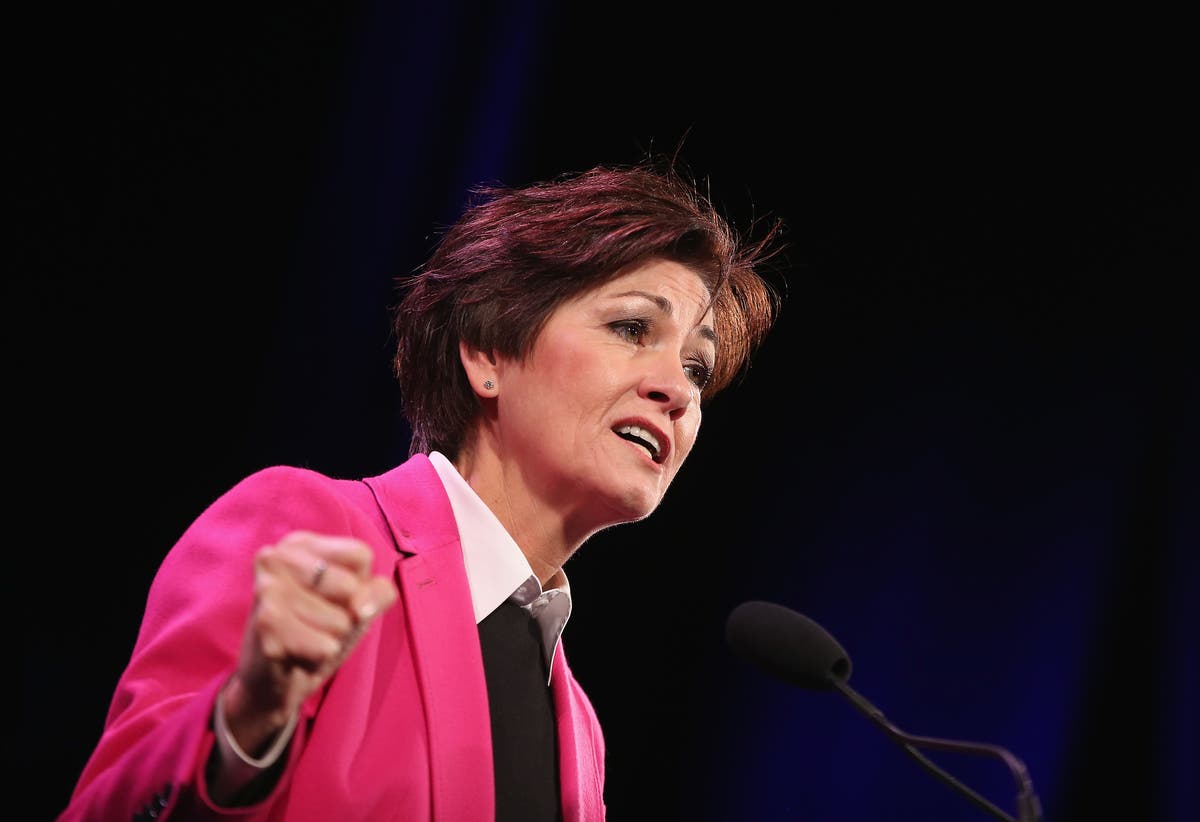
DES MOINES, IA — Iowa Gov. Kim Reynolds Friday signed a restrictive “fetal heartbeat” bill that makes most abortions illegal before many women know they’re pregnant. The staunchly pro-life Republican signed the bill as protesters outside the Capitol in Des Moines chanted "My body, my choice!" Earlier in the day, critics of the bill had begun leaving coat hangers — a vestige of back street abortions before the procedure became legal more than 40 years ago — outside Reynolds' office.
The law — the most restrictive in the country — is set to go into effect July 1 if it survives court challenges, which Planned Parenthood of the Heartland and the American Civil Liberties Union of Iowa began preparing after the Republican-controlled state Legislature sent the measure to Reynolds early Wednesday morning.
"We will challenge this law with absolutely everything we have on behalf of our patients because Iowa will not go back," Suzanna de Baca, president and CEO of Planned Parenthood of the Heartland, said in a statement.
Find out what's happening in Des Moinesfor free with the latest updates from Patch.
Reynolds acknowledged the law will face court challenges, but said, "This is bigger than just a law, this is about life, and I'm not going to back down."
The legislation requires physicians to conduct an ultrasound on women seeking abortions to test for a fetal heartbeat, which generally shows up around six weeks gestation. If the ultrasound detects a heartbeat, abortion is illegal. The new law does include exemptions for victims of rape and incest, and allows abortions during a later pregnancy stage to save a pregnant woman's life.
Find out what's happening in Des Moinesfor free with the latest updates from Patch.
Abortion foes such as Maggie DeWitte, who leads the group Iowans for Life, were ecstatic. DeWitte called Reynolds' move "historic," and said the governor is "following through on her pledge to the people of Iowa that she is 100 percent pro-life."
The bill is similar to laws in North Dakota and Arkansas that have already been struck down as unconstitutional by appeals courts. The decision by conservative lawmakers in Iowa to forge ahead illustrates the shrewd, slow-walk actics abortion foes are using to force a U.S. Supreme Court showdown on Roe v. Wade, the 1973 landmark ruling that legalized abortion.
The Supreme Court has declined to hear appeals of those rulings, but abortion foes are optimistic as President Trump appoints more conservative federal judges.
“We at the state legislatures, especially Republican-controlled legislatures, have a responsibility to kind of reload,” state Sen.Rick Bertrand, a Republican from Sioux City, told The New York Times. “We need to create vehicles that will allow the Supreme Court possibly to reach back and take this case, and to take up an anti-abortion case.”
The introduction of the fetal heartbeat bill in the conservative Iowa Legislature wasn't a surprise, but Reynolds' decision to sign it is, de Baca said.
“I think many of us still never expected that Governor Reynolds would so swiftly jump to sign a bill that is so clearly unconstitutional," de Baca told the Des Moines Register.
The ACLU of Iowa said the clear goal of "what is essentially a complete abortion ban for most women" is to overturn Roe v. Wade.
"It would take Iowa women back nearly a half-century to a dark era, a time where desperate women sought out or performed home abortions and died as a result," the civil rights group said, adding later:
"It’s especially disturbing that the passage of this bill comes at a time when Iowa legislators have also led a devastating assault on access to family planning and contraception, especially for poor and rural women. They are imposing their own strict religious and moral codes on the entire state, with tragic results."
As the legislative session winds down, lawmakers on Thursday added language to a budget bill that diverts about $130,000 in federal Community Adolescent Pregnancy Prevention funding away from Planned Parenthood of the Heartland, which provides the bulk of the abortions in the state. That comes after deep cuts last year that banned family planning grants to abortion providers.
“I have to say I am so disappointed,” Rep. Beth Wessel-Kroeschell, an Ames Democrat, told Iowa Public Radio. “Scientific sex education is one of the most important things we can do in terms of reducing abortions.”
Republicans have a lopsided majority in both chambers of the Iowa Legislature and Democrats were unable to stop the bill, but neither did they cast a single vote in its favor in either legislative chamber. Last year, Iowa Republicans swept a bill through the Legislature that banned most abortions after 20 weeks. The law is in effect, though a provision that requires a three-day waiting period before an abortion is tied up in a lawsuit filed by Planned Parenthood and the ACLU.
In House debate on the fetal heartbeat bill that began Tuesday afternoon and continued until nearly midnight, Iowa City Democratic Rep. Vicki Lensing said the bill “seems to second-guess a woman’s ability to make an unintended and difficult decision” and that she was personally offended by it.
“How dare we think that the privacy and decisions of a woman and her medical choices are up to us to determine?” she said.
The new law could also threaten the accreditation at Iowa's only training program for obstetricians and gynecologists. Lensing and Rep. Mary Mascher, another Iowa City Democrat, and Lensing raised the point repeatedly during floor debate that anyone who needs OG/GYN care could be affected. That could make it difficult for the University of Iowa to recruit and retain highly qualified medical professionals for its neonatal intensive care unit, potentially putting newborns and premature infants at risk.
The Iowa bill is among a flurry of anti-abortion legislation introduced across the country this year as abortion foes line up against a woman’s right to an abortion. Mississippi passed a law earlier this year banning abortions after 15 weeks of pregnancy, but it's on hold after a court challenge. The bills are “intentionally unconstitutional, and they’re being introduced in order to challenge Roe v. Wade,” Erin Davison-Rippey, the public affairs director for Planned Parenthood of the Heartland, said earlier this year.
“Politicians and special interest groups are weaponizing fetal heartbeat, which is by all accounts an arbitrary standard that bans abortion long before the point of fetal viability,” Davison-Rippey said in a statement in February, when the legislation was introduced. “These extreme attempts to ban abortion fly in the face of both medical and legal standards, as well as common sense and public opinion among Iowans, who overwhelmingly agree that abortion should remain safe and legal.”
The Iowa bill doesn’t set forth civil or criminal penalties, which staunch pro-life advocates had wanted. Neither woman nor doctors can be punished criminally or civilly, but doctors who ignore the law could face licensing issues with state regulators, DeWitte told WHO-TV.
Davison-Rippey said the law “will have a chilling effect on the practice of medicine.” Earlier, she had called it “intentionally unconstitutional” to test how far government can go to restrict abortions.
The Associated Press contributed reporting.
Photo of Iowa Gov. Kim Reynolds by Scott Olson/Getty Images News: 2018 file
Get more local news delivered straight to your inbox. Sign up for free Patch newsletters and alerts.