Politics & Government
2/24/2015 City Charter Meeting, Iowa City
Almost everyone at the city charter meeting 2/24/2015 at City Hall wants the city charter to change to become more democratic.
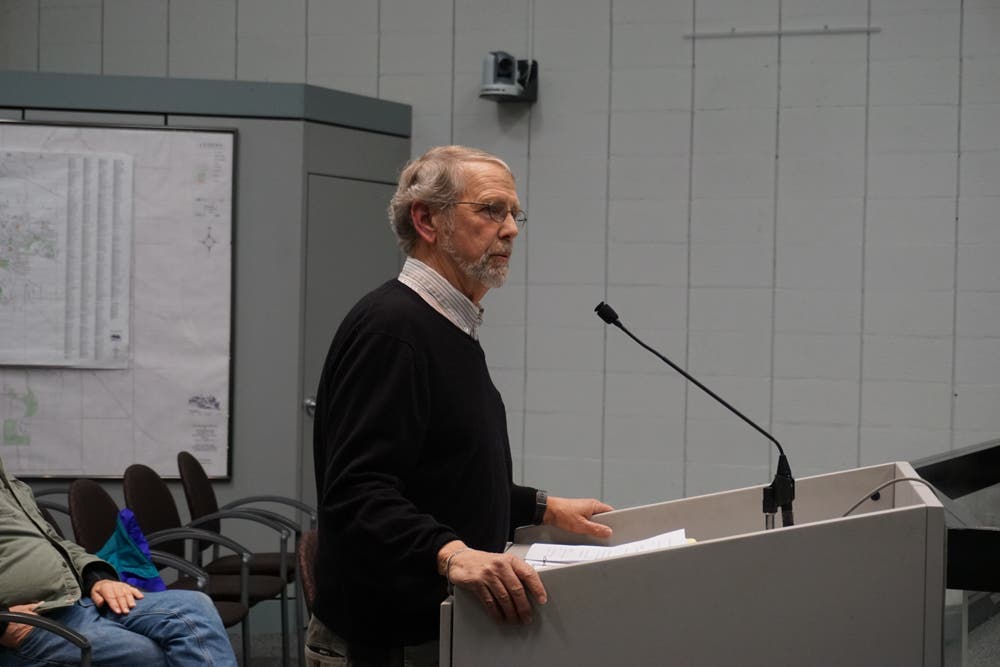


Captions: The first photo is of Shelton Stromquist, University of Iowa professor emeritus of history. The second photo shows Bob Elliott with his hand to his face in the foreground; Tom Carsner is in a plaid shirt with brown hair in the center background; and Caroline Dieterle, dressed in blue, sits to the right and has white hair. Unfortunately, at the moment I took the photo she turned away from the camera. The third photo is of Joseph Dobrian standing at the podium.
Tom Carsner, the first to speak at the 2/24/2015 City Charter meeting, said, “I started this process [of seeking to alter the City of Iowa City charter] because I felt that citizens feel left out. Voices aren’t being heard.”
Petition Requirements Changed:
Find out what's happening in Iowa Cityfor free with the latest updates from Patch.
Carsner commended the City Charter Commission for accepting a change in one of the four proposals for a more democratic city government. The signatures for petitions no longer have to be qualified electors (registered voters). Now, assuming the city council approves, petition signatures can be accepted if the signatories are eligible to vote as opposed to registered to vote.
However, the commission now wants to up the ante by increasing the number of signatures required to make a petition worthy of consideration and also insert an automatic increase in that number as the city’s population increases.
Find out what's happening in Iowa Cityfor free with the latest updates from Patch.
Ironically, a former City of Iowa City council invented an arbitrary percentage, 25%, which mandates a higher number of qualified electors required for a petition to be considered by the city council, although the Iowa Code requires 10%.
Carsner encouraged the commission to reconsider the number of voters required. He said it’s an issue that could be litigated. Later Aleksei Gurtovoy strongly suggested that litigation would be likely.
Bob Elliott, who did not seem to understand how petitions progress through the legislative process, stood up and protested that petitions would “tie the hands” of the city council, which of course could never be the case, since the city council has the power to vote the issue on a petition up or down. Another option would be for the city to put the proposed issue on a ballot and have the voters vote the question up or down.
Caroline Dieterle, Martha Hampel, Evan Fails, and others rebutted Elliott’s comments and denied that petitions, regardless of the petition requirements, could tie the city council’s hands.
Caroline Dieterle also pointed out that the red-lined [edited] version of the preamble to the city charter, which reads, “We, the people of Iowa City, Iowa, pursuant to the Constitution and statutes of the State of Iowa and the principle of self-determination, do hereby adopt this Charter and confer upon it the full home rule powers of a charter city. By this action we adopt the following principles:
“1. Resident participation on an inclusive basis in democratic self-government.
“2. The provision of service relating to the health, safety, and welfare of its residents in a fair, equitable and efficient manner.
“3. The conduct of city business in conformity with due process, equal protection under the laws, and those individual liberties protected by the Constitution of the United States, the State of Iowa, and local ordinances….”
Yet the city ignores state code regarding petition rules. (Chapter 362 of the Code of Iowa pertains to petitions.)
Regenia Bailey, a former city councilor, stood up to say that she likes the “poetic preamble, which is good in the context of the City of Literature.
“Good job of making residents feel a little bit more heard,” she praised the commission.
Direct District Elections:
Carsner also recommended direct district elections, as did Shelton Stromquist, a University of Iowa professor emeritus of history. Stromquist suggested that representation by district would provide better access to how people are governed. Councilors elected by districts are more accountable. Direct district elections also lowers the cost and the barriers to running for office since specific areas can be covered more easily than large areas.
Stromquist added, “In a city that’s increasingly diverse racially, ethnically, and classwise, it’s wrong to have elites govern. Government by elites disenfranchises poorer people. It’s a coded way to devalue the mingling of interests. That mingling of interests is a more democratic process which gives people a sense of empowerment.
“Elect all seven councilors from individual districts, not just three. That would create a more diverse and democratic council.”
Stromquist also advocated for a directly elected mayor, not a mayor voted on by city council members only, as is the case now.
“Get rid of powerful city managers,” he added. “The effect is to create another barrier.”
I couldn’t agree more.
Mary Murphy spoke about the need for a strong ethics and conflict of interest statement in the city charter. She said that Bozeman, Montana has one.
“Iowa City’s charter should reflect Iowa City’s values,” she said, “and this draft doesn’t go far enough. I’d like to address what is not included in the red-lined [edited] version of the city charter. As Iowa City grows and especially since Iowa City is accelerating its use of Tax Incremental Financing (TIFs), there is a greater potential for corruption.
“Iowa City’s charter should include a strong ethics and conflicts of interest provision to address the potential for corruption. This is especially important now that Iowa City is granting TIFs for residential housing, including TIFs to LLCs with anonymous members, so we don’t know who is the beneficiary of these TIFs.
“When TIFs are used for residential housing in other places, it is typically to make sure affordable housing gets built; Iowa City isn’t doing this. Instead, Iowa City is subsidizing well-off residents with sometimes a little workforce housing, which is for higher income individuals.
“Other progressive cities, such as Bozeman, Montana have included ethics and conflicts of interest provisions in their city charters. Iowa City should do this too.”
Not All Trust Democracy:
Joseph Dobrian [pictured above] spoke. “I distrust democracy. Democracy is a wolf and two sheep discussing breakfast. I want to keep the stupid people out.”
Of course, this begs the question of who the stupid people are and who decides who they are. However, I was there as an observer, not a speaker.
Final Thoughts:
For pathos, you can’t beat the sight of Aleksei Gurtovoy, a brilliant, thoughtful young man from Siberia who appears to believe he’s come to a democratic republic that actually functions as one. His confidence that the people will prevail over the powerful elites who run Iowa City is inspiring. Maybe he will file a lawsuit against the city.
After the meeting, which lasted from 6:30-8:00 p.m., several of us (Tom Carsner, Caroline Dieterle, Shelton Stromquist, and others) hung around to discuss Mary Murphy’s point about battling corruption with an ethics and conflict of interest clause in the city charter, which Karen Kubby took an interest in, as did the rest of us.
Kubby didn’t know if such a clause belonged in the city charter or in the city code. Mary Murphy, a licensed attorney, said Bozeman, Montana had theirs in the city charter, so it seems that we could, too. Corruption is absolutely a concern in Iowa City. No TIFs should be granted to LLCs with anonymous members. If that’s happening, that is indeed corrupt.