Politics & Government
City Council attempts to Balance Uses for Pedestrian Mall Tables
New permits won't allow selling or demonstrating products at Ped Mall tables, but banning tables from the mall did not fly with Council.
The Iowa City Pedestrian Mall has historically been a free-spirited place for people to gather, shop, listen to music, and exchange news and ideas.
So when the prospect of banning information tables was put before the Iowa City Council Tuesday night, the challenge for council members was to balance the idea of preventing the tables from taking up too much space in the Pedestrian Mall and competing with nearby businesses, while at the same time not overly restricting the freedom historically associated with the space.
Assistant City Manager Dale Helling said in an interview Thursday that balancing these two considerations with the Ped Mall tables isn't new.
Find out what's happening in Iowa Cityfor free with the latest updates from Patch.
“It goes way back to the late seventies and early eighties,” Helling said. “When the Ped Mall was first constructed, people wanted to pass out a variety of information, promoting causes, or to take donations – one was information tables – they had jewelry, crafts and that sort of thing that they were ‘not selling’ but taking donations for. We tried to limit it to nonprofits and charitable organization, but didn’t have the staff to follow up that they all were.”
The ordinance unanimously passed Tuesday sets up a permitting system for the Ped Mall, expressly forbidding any sales while at the tables even for nonprofits. The permits would allow individuals or nonprofits to use the tables for giving out information or gathering signatures.
Find out what's happening in Iowa Cityfor free with the latest updates from Patch.
Helling said the permit forms will be free and applying will be “a very simple process.”
Tuesday's vote was the first of three considerations the Council is required to approve before the ordinance is officially enacted.
The amended ordinance would also require speakers and musicians to obtain a permit for the use of amplified sound in the Ped Mall, restricting them to Black Hawk Mini Park and south of the fountain.
At Tuesday's meeting, there was some disagreement how the tables should be restricted, or if they should be restricted at all.
IRenew Director Steve Fugate addressed the council Tuesday after he was told he would have to wait until the permitting process was complete before setting up a small solar-powered cell phone charger for “renewable energy education” to save energy. Fugate argued this level of restrictiveness is not the direction the city should go.
“As Iowa City looks to rebrand itself and make downtown a more friendly place to be, we think what we’re doing – not selling anything, just offering free education – certainly seems to fit with where Iowa City wants to be,” he said.
Helling explained on Thursday that the new permit system doesn’t allow for demonstrations of a product because legally they need to distinguish between commercial and noncommercial use when permitting.
“He (Fugate) came in and asked for permission, and we were just in the process of changing it. First amendment rights allow them to carry them around and walk around anywhere, but if you want to set up a table and have more informational pieces, you still have an option for a table, but (for) no commercial use or demonstrating a product,” he said.
On the other end of the spectrum, Councilor Susan Mims offered up the idea of banning tables as an alternative to the use of permits, since city staff is spending a lot of administrative time dealing with requests for tables.
“We do have confined space down there, and the regulations are saying there is no solicitation at tables, there’s no commercial activity,” she said. “If people are simply handing out information, then what is the real need for tables? If we were to simply not allow tables at all, that saves staff time even more and people certainly can still do the kinds of activities in terms of handing out information down there.”
But one by one, the council leaned the opposite direction from Mims' proposal.
Councilor Regenia Bailey said she didn’t see the space as confined and would like to continue all activity, unless space becomes a problem.
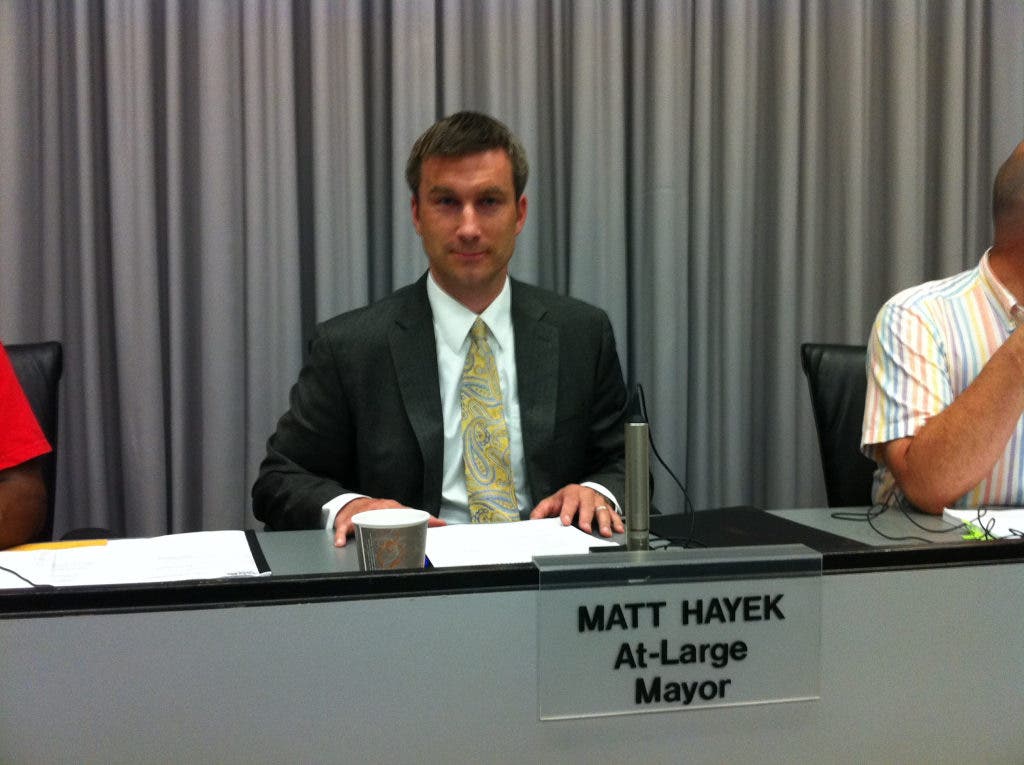
Mayor Matt Hayek said people should have the opportunity to sit at a table to give their information and not be restricted to handing out information on foot.
"The concept of a table or being able to have a table is symbolic,” Hayek said, calling it a “valued opportunity.”
Hayek went on to say two things about the ordinance gave him pause, restricting the number of tables allowed to four and the designated a specific area for the tables.
“I’m not sure we have a problem yet with an overload of tables,” he said.
Mayor Pro-tem Ross Willburn said allowing tables honors the tradition of the public forum for informational use.
“There are some folks that are passing out information but I guess looking at the other end, prefer to be stationary and not feel like they are imposing on people’s private space if they are down listening to music, so it allows for anyone who wishes to receive that information to come up and again, it’s striking a balance,” Willburn said.
City Attorney Eleanor Dilkes said if tables were going to be allowed on the Ped Mall, the ordinance was needed for staff to make decisions on what’s allowable and what’s not, rather than making those decisions “on the fly.”
“I’m comfortable with the way the ordinance is written if you want to allow tables,” Dilkes told the council. “And if you want to allow tables in a bigger area that’s fine, but I have some concern about just saying people can set up tables anywhere as long as it’s informational and you don’t need a permit because we’re already doing significant amounts of permits in the Ped Mall - it’s a very constrained space. There are lots of requests for space down there.”
Dilkes noted during special events such as Arts Fest and Jazz Fest, the permitting of tables wouldn’t apply.
“When you have the Jazz fest, those issues go away because the whole downtown is devoted to that,” she said. “The interests we have in regulating the Ped Mall are: to allow free flow of pedestrians, to promote economic vitality and not allow significant commercial competition with our businesses down there who pay taxes.”