Schools
Governor and Education Officials Talk School Improvement at Summit
The two day summit on education kicked off with several high profile speakers, including the U.S. Secretary of Education.


By Lynn Campbell
From IowaPolitics.com
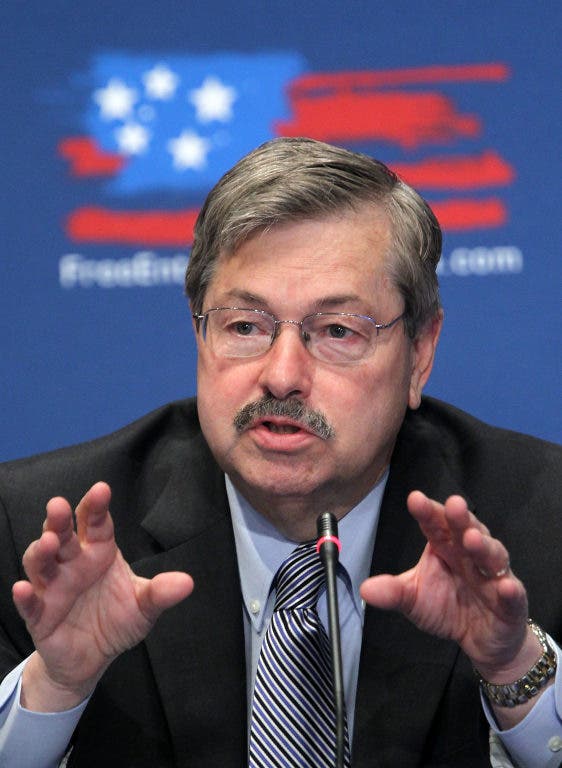
DES MOINES — Iowa again can be a world leader in education if it increases its academic standards, adopts more innovative approaches and elevates the expectations of teachers, U.S. Secretary of Education Arne Duncan and Gov. Terry Branstad said at the Iowa Education Summit on Monday.
"Charter schools can innovate in myriad ways. They can offer longer school days or years. They can focus on science or the arts or some other specialty," Branstad said. "Innovation should also mean figuring out how to provide more tailor-made opportunities for students by combining resources available in the traditional classroom with resources available online."
Duncan and Branstad cited statistics of how Iowa was once a leader in education. In 1992, no state scored higher than Iowa in fourth-grade reading and eighth-grade math, according to the National Assessment of Educational Progress, also known as "The Nation's Report Card," which determines what America's students know and can do in various subject areas. By 2009, Iowa was ranked in the middle of the pack at No. 27 and 28, respectively.
“The hard truth is that Iowa has started slowly slouching towards educational mediocrity,” Duncan told the 1,600 educators, business people, lawmakers and others attending the summit at Hy-Vee Hall in downtown Des Moines. “Over the last two decades, Iowa has stagnated educationally.”
Iowa’s achievements have leveled off because the state’s low academic standards have not prepared students for college and careers, Duncan said. He said Iowa also has lagged behind by having one of the weakest charter-school laws in the nation, and hasn't done enough to increase the effectiveness of educators.
“A couple very common themes among those high-performing countries: First of all, they’ve all elevated the teaching profession,” Duncan said. “In those countries, they generally have the top third of college graduates going into education. In Finland, it’s the top 10 percent.”
Duncan emphasized the need to invest in “talent” or great teachers and principals and pay teachers significantly more like other countries do. Iowa ranked 25th in the nation in fiscal 2008-09 with an average teacher salary of $48,638. That average had risen to $50,547 in fiscal 2009-10, according to the National Center for Education Statistics, the data-gathering arm of the U.S. Department of Education.
The U.S. education secretary suggested that Iowa schools could have longer school days, longer school weeks or longer school years for those students who need the most help. He said schools should more quickly embrace technology, such as giving school assignments on cell phones.
Those attending the summit appeared to be receptive to Duncan’s message.
“He’s exactly right. We do have to raise the standards, not only for our teachers, (but) for our students,” said Laurie Bennett, a curriculum director in the Pekin Community School District. “We truly do have to get away from the 8 a.m. to 4 p.m. (school day), 9 months (school year). And going back to the 3- and 4-year-olds, we have to start educating our students. It’s a whole different world. He was very blunt. We are behind.”
Bennett, whose rural school district is in Jefferson County in southeast Iowa, said she’s glad Duncan wasn’t “sugar-coating” the message about Iowa’s education system. She said she didn’t think any changes stemming from the summit would threaten teachers’ job security, “unless you’re a poor teacher.”
“It should be rude awakening to us,” Bennett said of the summit. “Hopefully, this summit is almost that ‘shaking’ factor that we need in education. Then I think we need to follow up with how — what’s the next step? Don’t just tell us that we are behind, because we know that.”
Yet state Rep. Mary Mascher, D-Iowa City, a retired teacher, said she was frustrated that Duncan and Branstad focused so much on the negative aspects of Iowa education rather than Iowa’s progress in implementing the Iowa Core Curriculum, the statewide academic expectations for K-12 students, and providing state-funded preschool to 4-year-olds.
“We are doing some things really well,” Mascher said. “Let’s celebrate and talk about the things we’re doing right, because I feel like oftentimes, that gets ignored. And although they talk a good game about supporting teachers, every time we come back with ‘we’re stagnant, we’re not doing a good job,’ you basically erode your support for the education community.”
Mascher said the summit’s messages don’t coincide with the legislative action of the 2011 legislative session. Lawmakers eventually approved no growth in school funding for the upcoming school year, and a 2 percent increase for fiscal 2012-13.
“You know, we have an educational summit in a year where we did zero percent allowable growth,” Mascher said. “That, to me, is just totally inconsistent.”
Get more local news delivered straight to your inbox. Sign up for free Patch newsletters and alerts.