Politics & Government
Governor Branstad Gets Passing Budget Grade By State Auditor
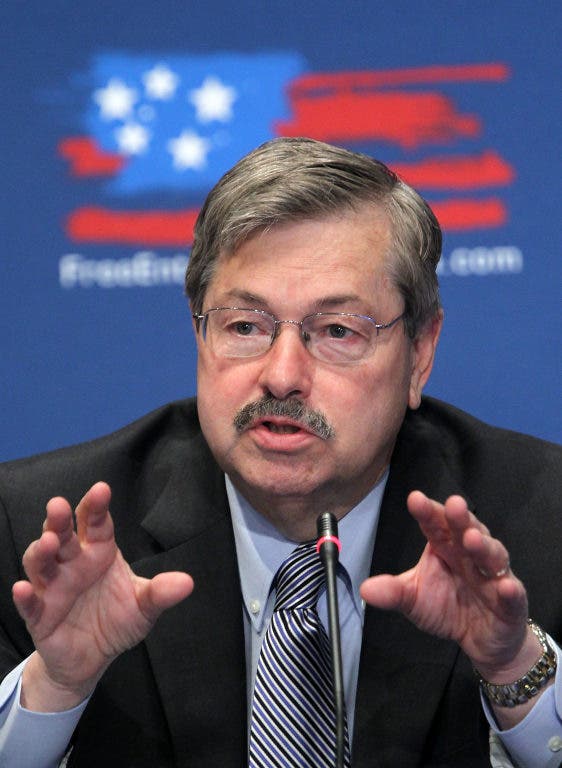
State Auditor David Vaudt, a Republican who endorsed Branstad, said Monday there is still more work to be done, but he applauded the progress that has been made so far. Democrats argue against deeper spending cuts to schools, health care and jobs.


By Lynn Campbell
IowaPolitics.com
DES MOINES — Despite all the talk by Republicans about fiscal responsibility, the state of Iowa is still spending more money than it’s taking in for the fiscal year that began July 1, State Auditor David Vaudt said Monday.
The fiscal 2012 budget, approved by state lawmakers and signed into law by Gov. Terry Branstad, spends $1.04 for every $1 of available ongoing revenue, Vaudt said in a review of the budget released Monday. However, that's an improvement from the $1.14 in spending for each dollar of revenue in fiscal 2011.
“We’re not all the way there,” said Vaudt, a certified public accountant. “We want to actually follow my rule No. 1, which is ‘don’t spend more than you take in.’ However, making progress from $1.14 down to $1.04 is definitely a huge step in the right direction.”
To make up the difference between what the state spends and what it takes in, lawmakers used one-time pots of money, like pulling from the state’s economic emergency fund to pay for disaster recovery.
But Vaudt said one of Iowa’s most notable signs of progress is that the state budget used only $53 million in one-time money for ongoing expenses this year, compared with $638 million last fiscal year.
Branstad notes improvement in 'budget mess'
Branstad campaigned on fiscal responsibility last year. Iowa voters in November decided to return him to office and oust one-term Democratic Gov. Chet Culver. They also gave Republicans a 60-40 control of the Iowa House.
The governor said Monday that there’s “no doubt” the state budget for this fiscal year is better than last year, when Democrats controlled the Legislature and governor's office.
“I think it was dramatically improved,” Branstad said. “You know, we inherited a budget mess where they used a lot of one-time money for ongoing expenses, purposely underfunded things like indigent defense … and I think we made dramatic progress on changing that and making sure that we have something that’s sustainable for the long term.”
The state is required to provide an attorney for defendants who can't afford one. Additional money to pay for "indigent defense" got caught up in a political struggle at the Iowa Capitol in April, leading to major financial problems for some attorneys statewide who weren't paid for months.
Iowa Republican legislative leaders have touted that the fiscal 2012 budget only spends $5.9 billion from the state’s general fund, or 95 percent of state revenue.
But Vaudt said due to spending outside of the general fund like a $106 million health-care trust fund, “true total expenditures” this fiscal year amount to more than $6.4 billion. That’s up about $133 million from the nearly $6.3 billion spent last year.
“They’re telling you only about their checking account,” Vaudt said of lawmakers, noting that spending also comes from other sources. “That distorts those comparisons.”
Economy improves; spending gap shrinks
Yet Iowa’s spending gap between expenditures and revenue decreased to $224 million this fiscal year, from $760 million last year, Vaudt said. That’s a reduction of $536 million, or 70 percent.
During this time, the auditor’s figures show that the state’s ongoing tax revenue increased from $5.5 billion to $6.2 billion.
“If you look at Iowa’s revenue growth projections, we essentially are getting back in fiscal year 2012 back to pre-recession times,” Vaudt said. “In my analysis in talking with other state auditors, many states aren’t projecting to get back to pre-recession levels until at least fiscal year 2013 and maybe beyond.”
Vaudt's budget review doesn't explain the reasons for the economic recovery.
But Holly Lyons, director of the Legislative Services Agency's fiscal services division, said this spring that Iowa has seen strong growth in the personal income tax, as well as the sales and use tax. Lyons is one of three members of the Revenue Estimating Conference, which makes the official prediction of state revenues. In March, the conference increased its prediction by $86.9 million.
Democrats said Monday that the state’s economic recovery and their own work to reorganize state government deserve the credit for Iowa’s improved fiscal outlook. While Republicans now control the Iowa House and governor’s office, Democrats remain in control of the Iowa Senate with a slim 26-24 majority.
“Iowa’s budget is on the right track, thanks primarily to our state’s on-going economic recovery, a recovery that is stronger than that of most other states,” said Iowa Senate Appropriations Chairman Bob Dvorsky, D-Coralville. “Another factor in our improving budget is last year’s work by Democrats to cut costs by streamlining state services, resulting in the first substantial reorganization of state government in nearly 25 years.”
Dvorsky said the auditor’s report shows Democrats were right to block Republican demands for “deep, damaging cuts” to schools, health care and jobs.
Vaudt, the state’s chief taxpayer watchdog, maintained that his analysis of the budget is objective and nonpartisan, despite the fact that he’s a Republican who endorsed and campaigned for Branstad last year.
“There is no such thing as Republican numbers. There is no such thing as Democrat(ic) numbers. There are just Iowa numbers,” Vaudt said. “Governor Culver, if he had put through this budget proposal, my comments would have been exactly the same.”
Branstad said he has a lot of confidence in Vaudt and “we’re willing to accept whatever constructive criticism he may give us.”
Get more local news delivered straight to your inbox. Sign up for free Patch newsletters and alerts.