Schools
Iowa City School District May Hire Consultants to Help Them Out of Third High School Limbo
With the district in an epistemic quandary over the truth behind its enrollment and capacity numbers, a mild consensus is reached by school board members on the way forward.


The Iowa City School District community and administration have a lot of building improvements on their wish list for the next few years.
Roughly $94 million worth of improvements to be exact.
What's clear is to do all of these projects, the school district will likely have to bond for at least $37 million in addition to the School Infrastucture Local Option sales tax money (SILO) it will have available by 2017.
Find out what's happening in Iowa Cityfor free with the latest updates from Patch.
Beyond that, a whole lot remains in doubt.
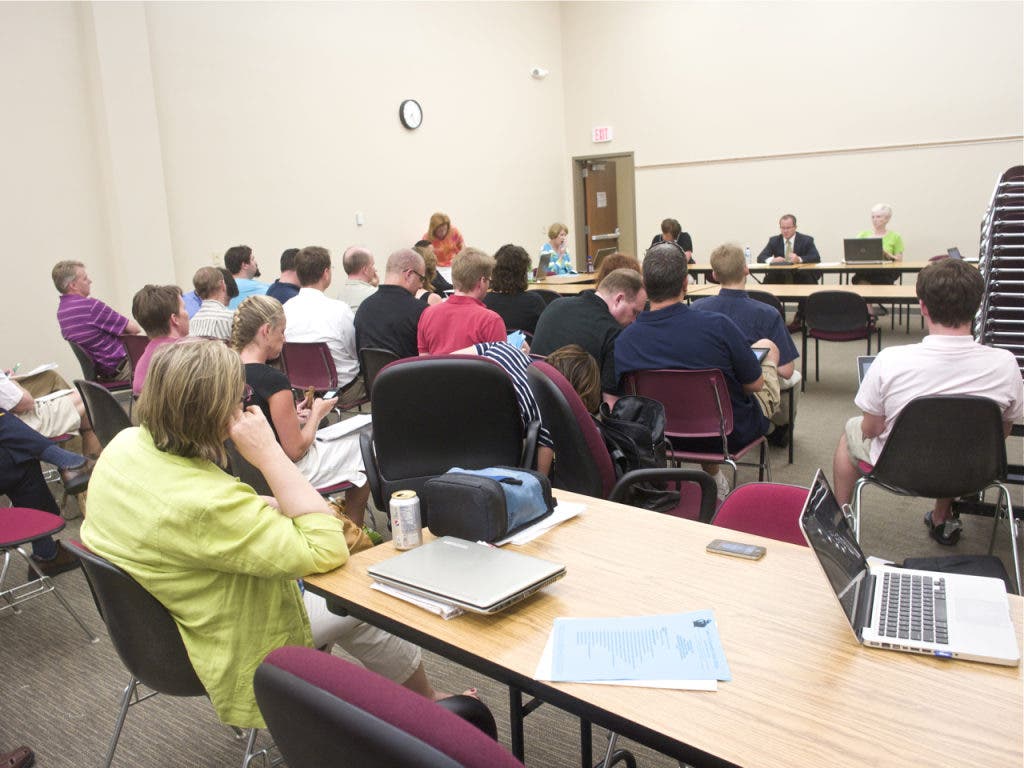
In fact, doubt was the theme at Tuesday night's Iowa City School Board Facilities Committee Meeting, where the school board was scheduled to discuss such hot-button issues as the third comprehensive high school, elementary overcrowding, and the district's troublesome grandfathering policy.
Find out what's happening in Iowa Cityfor free with the latest updates from Patch.
Instead, much of the discussion centered on how little faith the board has in the district's current numbers.
"I'm still not quite believing the numbers," said Karla Cook, a school board member. "As someone who taught in the district, I swear those numbers were never right at any time. I would really like to have someone to check those."
With this in mind, Iowa City School Superintendent Steve Murley recommended that before the district attempts to solve its building problems, it should reassess the accuracy and validity of both its building capacity numbers and its enrollment projections.
To do so, Murley recommended using SILO money to hire outside consultants to map the space of the district's school buildings, and another group of consultants to check if the University of Iowa Geography Department's projections are accurate measures of enrollment growth.
"It will allow us to measure twice and cut once so we can make sure that we're making decisions based on good data," Murley said.
The space utilization would allow the district to measure capacity in the district's buildings and establish a standardized baseline that would allow the capacity of different buildings to be fairly compared. Capacity is currently determined using a formula that includes the number of rooms in a building, subtracting the spaces used for programming such as the arts or special education.
Murley said the cost of this more advanced room mapping, requiring the consultant to walk through each building and digitally map it with software, would be approximately $120,000 in SILO funding. The enrollment projections from an outside source would cost somewhere between $16,000 and $25,000.
Some school board members expressed concern that hiring these consultants would delay decisions for problems that need solutions soon, as the board waits for the information to come in. Murley said that some work, such as looking for land to purchase for a third high school, could go forward before the final numbers would be delivered to the board.
Trigger Points, Timing, and Why These Numbers Are Important to the New Building Discussion
Among the projects on the immediate wish list for the school district: a third high school (or additions to and High Schools) to relieve growing overcrowding at the high school level, new elementary school buildings in the north and south parts of the district, and an addition to crowded Penn Elementary to deal with the same problem at the elementary level.
A slight majority of the school board members spoke Tuesday in favor of building a third high school -- eventually. But many of these same board members expressed more urgent concern about crowding at the elementary school level.
"I think we need a new high school eventually," said board president Marla Swesey. "I'm not picking up that we need it right now."
Meanwhile, in 2010 the school board set trigger points that directed a future board to begin work on planning a third high school once the following two conditions were met: when the current sixth grade enrollment hits between 900 to 925 students and when the total high school enrollment is projected to exceed 3,750 students three years before the school would be built.
The 3,750 number is based on how many students City and West High Schools theoretically have the capacity to handle.
When new enrollment projections in April showed the district hitting one of those trigger points, community members challenged the results. The numbers used in these projections were called "actual enrollment," which includes special education children that were excluded from the "regular ed enrollment" numbers formerly used in projections by the district when the board was making this decisions. (I explain why )
The point was raised by community members that if the triggers were set by regular ed numbers, when the actual enrollment numbers were not yet the standard, this should mean that the district should use the lower regular ed enrollment numbers to judge whether the district had met its triggers.
The district was also criticized for not utilizing its building capacity to the maximum degree, and critics questioned whether or not the district's capacity formula really provides an accurate depiction of a building's capacity. In other words, what does that 3,750 number really mean?
This is important because if the lower regular ed number is used, and more capacity is unearthed by outside analysis, the district may have some time before the high school triggers are met, allowing it to focus on meeting other pressing needs first. It will also provide a true, data-based tipping point for when the district needs to seriously consider committing to whatever it chooses to do to solve the overcrowding problem at the high school level.
With the old triggers and new enrollment projections effectively mismatched to a confusing degree, the district is in need of a standardized pool of data. And that is where the consultants are supposed to be of assistance.
School board member Jeff McGinness said that the next major step for the school district to take is to clear up the confusion about what enrollment numbers the district is looking at when it comes to the triggers.
"At some point we have to decide what numbers should we use to compare to the triggers," McGinness said.
A Little Bit of Consensus
If there was anything the school board members all seemed to agree on is they weren't prepared to make any strong decisions on the building very soon.
School board member Patti Fields said she was tired of returning to the same themes in the third high school discussion, but that more information was needed before a decision could be made.
"It seems like we need more data," Fields said. "We can discuss this in the abstract over and over again."
The board members in attendance mostly agreed that the solution at the high school level should be a third comprehensive high school. Cook and McGinness did express some reservations about the idea, though.
McGiness, who said he was bothered that the could mean larger class sizes district wide.
"That's something that hasn't really been talked about yet," he said.
And Cook, who said that an enrollment of roughly 1,800 was her ideal for high schools in terms of the depth of offerings a school that size can provide, didn't seem convinced the three high comprehensive high schools was the best direction.
She said although she did not want to overturn the ruling of a previous board, she'd like to see more options.
"I've only been able to see the third-high school scenario," Cook said.
Board member Tuyet Dorau argued that regardless of the exact enrollment and capacity numbers being unknown at this point, the school board should either commit to the idea of a third high school or commit to having high schools with 2,000 students or more.
For her, the latter size was too large of a school, and the high school level is already reaching inching close to its trigger point of overcrowding.
"I think we're there right now," Dorau said.
The board will next discuss these issues at future facilities and board meetings. The next school board meeting could also see a visit from the consultants recommended by Superintendent Murley, so the board can vote on whether to proceed with hiring them or not.
Get more local news delivered straight to your inbox. Sign up for free Patch newsletters and alerts.