Schools
It's Audits Before Plaudits for the Iowa City School District
The school board listened to presentations on two separate audits. Board members and faculty vowed to make the necessary changes.


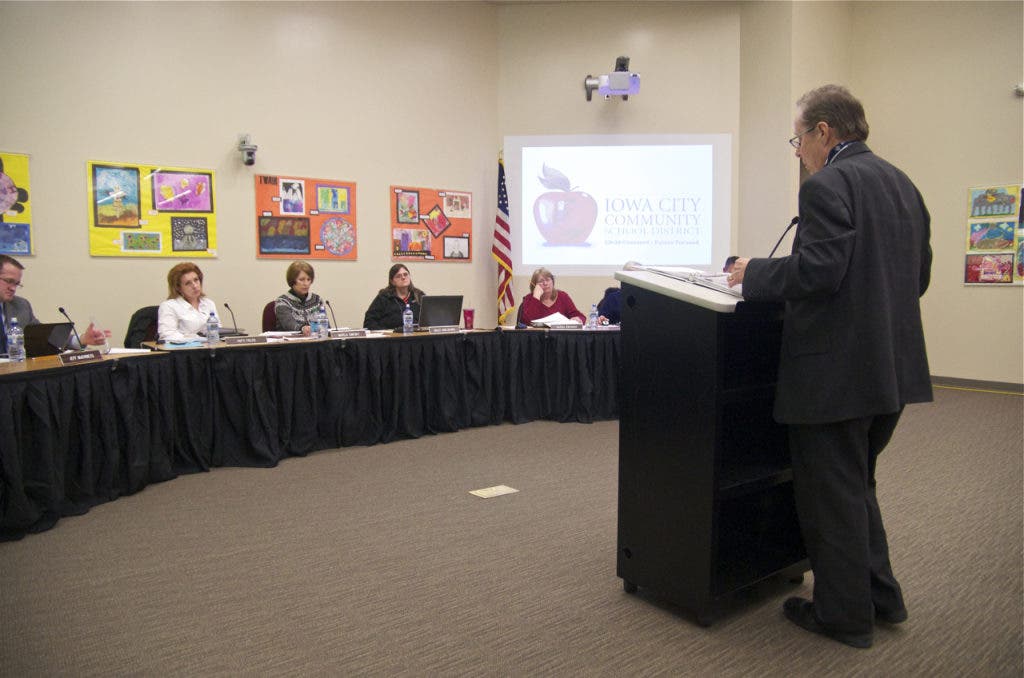
It's appropriate that Tuesday night's Iowa City School Board meeting was the first of the year:
It's rare that you get a preview of a good portion of the next year's work in one meeting.
Find out what's happening in Iowa Cityfor free with the latest updates from Patch.
The board members listened to the contents of two lengthy self-imposed, third-party administered audits that while highlighting the district's educational excellence, also eviscerated its current operational structure. The two audits, one conducted by Synesi Associates, out of Wilmette, Ill., the other by Dell Computers, found significant flaws in the district's accounting, record keeping, human resources, management, payroll, budgetary, physical plant, lunch and technology systems.
The Synesi audit was requested by the district after a series of financial management embarassments over the last year. It is available in full on the district's website. This and other snafus preceded last week's by Paul Bobek, the district's central financial officer and executive director of administrative services.
Find out what's happening in Iowa Cityfor free with the latest updates from Patch.
The suggested remedies for these problems, supported unanimously by administration and school board members alike, will lead to a fundamental revamping of how the district operates. These changes could take years and thousands of dollars to fully implement. Some of these changes, in fact, are in the process of being made already.
Iowa City Superintendent Steve Murley said that he and his administrative team are up for the challenge, which they will accomplish, he said, without significantly changing staffing levels.
"We anticipate, to the extent that we can, to work within the resources that we have," Murley said.
Murley said his team is working to develop both a way of attacking the challenge to the district, and also providing metrics so the district's process can be judged. This could be presented to the board as soon as next meeting.
Appropriately, like many New Year's resolutions, these changes will be painful to stick with, but they've need to be made for a long time.
What is the Challenge?
Phil Hansen, of Synesi, perhaps described the district's problems best when listing the shortcomings of the current physical plant.
"This system is still being run like you're kind of a small school system, and you're not that small any more, you're larger," Hansen said. "People are working hard, but we have to look at efficiency and effectiveness."
Some of Hansen's criticisms of district operations:
A lack of transparency, poor communications within departments and between departments, a lack of open bidding for goods and services, an antiquated accounting system with writing done by hand and insufficient redundancy, technology gaps between schools, a challenged lunch program, unclear expectations and, above all--
No standard operating procedures.
"It's not like you're over administrated here," Miller said, noting that the district has a small administrative staff for its size. "It's a matter of having the procedures in place to make sure your staff can work effectively and smoothly."
Dell's audit, presented after Synesi's, focused on the district's technological shortcomings. Blake Chism, of Dell, suggested the district develop a plan that the district can work toward when implementing technology, increasing the bandwidth throughout the district and hiring more technical staff to help make sure systems operate properly.
In this way, when the district is trying to solve a problem, such as a disparity of technology in one building versus another, it can do so while moving toward a discernible goal. Right now, he said, the district's technology organization seems to have little rhyme or reason to it.
"There are things that happen for no reason, and there are things that happen multiple times for the same reason," Chism said. "If you implement these initiatives you will become a more simplified environment."
He said this, in a nutshell, would help the district provide a base for future technological improvements to be built upon.
"A lot of the recommendations here are getting you ready for that (next step)," Chism said.
Solutions?
Speaking of next steps, if the district follows the suggestions of the two audits, part of the necessary changes will be changes of culture and changes of resources.
Hansen suggested solutions to these problems for the district could be solved by regulating the systems that produce the culture of the district. These include introducing open bidding to the physical plant to decrease skepticism of its workings, involving multiple share holders in the budget process so they are aware of the justification for decisions before they are made, and developing standard operating procedures across the district.
"People thrive on procedures," he said.
The other step involves resources, and how they are allocated, from staffing to electronic investments.
Two major decisions on the resource front will be made in the coming months.
The first is how the district will replace its departing central financial officer, human resources director and lunch program coordinator, along with many others who .
The second is whether or not the district will follow Hansen's suggestion to implement Enterprise Resource Planning (ERP), a very expensive and ambitious piece of operational software that will transfer the district's analogue accounting and record keeping system into a digital platform.
Before implementing an ambitious software system, it would be helpful to, as Chism put it, establish a base of hardware and manpower support to help operate it.
Murley said he is has already spoken with vendors regarding the ERP software, and the board will have a clearer picture of the cost after more of those discussions take place.
Since it is budget season, Murley said he would also be presenting the board members with financial numbers that would help them make their decisions on what to implement, and when.
The plans, as a whole, will all become clearer at future meetings, he said.
"I think what we'll be define for you, and what you'll be able to hold us accountable for, is to be able to see systemic progress and operational changes," he said.
Get more local news delivered straight to your inbox. Sign up for free Patch newsletters and alerts.