Schools
Murley's Consulting Work Dealt with in Mock Trial
ICCSD board president Chris Lynch invited district attorney Joe Holland to approve Supt. Steve Murley's outside consulting work.
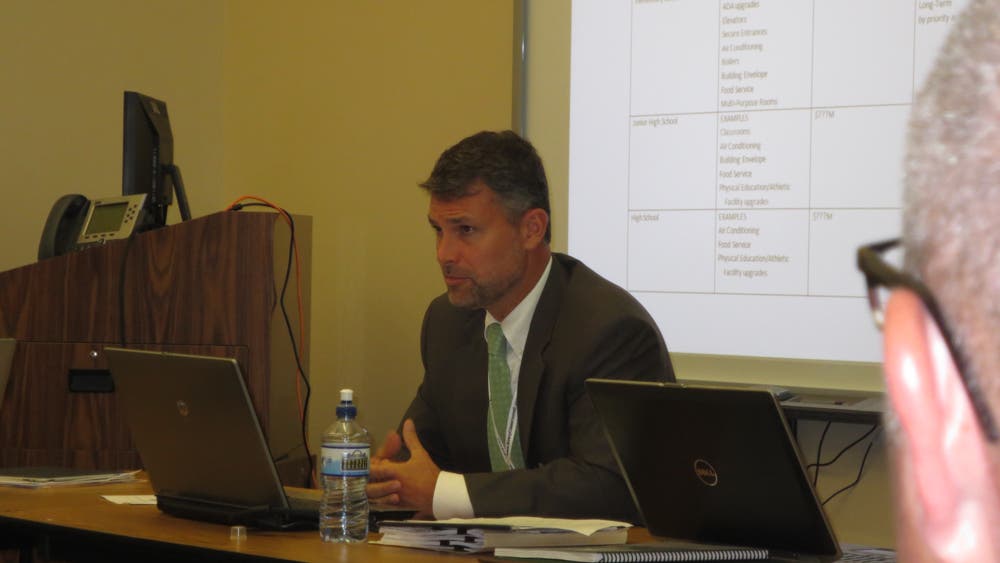

Caption: Left: Iowa City Community School District Supt. Steve Murley; right, ICCSD Board Director Chris Liebig, also a University of Iowa law professor.
The mainstream media became aware of Iowa City Community School District Superintendent Steve Murley’s consulting work with an ethically challenged corporation with the acronym SUPES after Word Press blogger Mary Murphy read a Washington Post article about Barbara Byrd-Bennett, 66, who ran the Chicago Public Schools until this past spring amid allegations of corruption. Byrd-Bennett will or has pled guilty to federal charges that she gave a no-bid $20.5 million contract to a former employer in exchange for future employment and a $250,000 kickback for two relatives.
Byrd-Bennett was charged Thursday with 15 counts of mail fraud and five counts of wire fraud. Also facing federal charges are Gary Solomon, 47, and Thomas Vranas, 34, co-owners of SUPES Academy, a for-profit company that trains principals and administrators.
Find out what's happening in Iowa Cityfor free with the latest updates from Patch.
Murphy put that article together with some research on Steve Murley, and wrote a fine blog post on the ethical dilemma of allowing a superintendent to be paid for working for educational product vendors.
The Iowa City Press-Citizen then had a story on the issue and quoted Mary Murphy at length.
Find out what's happening in Iowa Cityfor free with the latest updates from Patch.
At the November 24, 2015 ICCSD board meeting, board president Chris Lynch brought up Supt. Murley’s contract and discretionary days, during which he consults for outside agencies, including vendors doing business with school districts. Lynch stated that his objective was to bring the discussion to closure.
Lynch said he’d like to state what the discussion is and is not.
“It’s not a performance review [of Supt. Murley]. If it were, Steve requested a closed session. It will be a narrow discussion. It’s also not a contract strategy session. Steve’s performance review happens within a February to June timeframe. Appendix 2 outlines how we do performance reviews. Steve’s contract is up in June.
“I want to clear up a few things to help bring this to closure. [Board president Chris Lynch then asks Supt. Steve Murley a series of questions:]
Question to Steve Murley: “Are you an owner of SUPES, Synesi, or Prozac [sic]? [Actually, the name of the company is Proact.]
Response from Steve Murley: “I am not.”
Question to Murley: “Are you a managing director in any of these companies?”
Response from Murley: “I am not.”
Question to Murley: “Do you have equity in any of these companies?”
Response from Murley: “I do not.”
Question from Chris Lynch to Joe Holland, district attorney: “So Joe, what’s the definition of a conflict of interest?”
Response from Joe: “As a general proposition, a conflict of interest occurs when someone has a personal stake in the outcome of an event or an occurrence which is in the scope of their employment and not to the benefit of their employer. I think that’s the context you’re talking about with the school district.”
Question from Chris Lynch to Joe: “Based on your knowledge, do you think Steve have a conflict of interest?”
Response from Joe to Lynch: “I’ve been sort of on the periphery of this since last spring when some of these issues started to come up. Based on what I know, I’ve not seen any conflicts of interest or any evidence that Steve did anything inappropriate. But my perspective on this has been somewhat limited.”
Chris Lynch to the board: “Any further discussion?”
Director Phil Hemingway: “One question I have regards this third company, the Education and Research Development Institute. Can you provide us with any kind of a list of products, goods, and services that they provide? They may come before us in the future.”
Supt. Steve Murley: “Most of what is presented to me and other superintendents is brainstorming, not actual content or [finished] products. Most of the stuff [we see] is stuff they’re planning to bring to the market.”
Director Chris Liebig (also a law professor at the University of Iowa): “I do think at some point we should think about whether going forward, we should do different things. Set aside for now whether the contract has been correctly followed in the past. I’d prefer more documentation in the future. I think it would be better for Supt. Murley not to check just with the board president but with the whole board.
“It would concern me if we voted for a board contract if the superintendent only reported to the board president . . . It’s a weird situation because normally Steve is our arms and legs and he vets stuff, but we can’t ask him to do it for us [when we’re talking about his approval of vendor contracts he may be involved with as a consultant].
“I want to see travel receipts and travel expenditures.
“Do we want our superintendent working for other companies on or off district time?
“. . . It seems the plan is to bring superintendents together with vendors in a way designed to help the vendor. If we want to do that, we could do that on our own dime. But if the vendor is paying the superintendent, that’s awkward, appearance wise. We need a policy decision.”
Board president Chris Lynch: “So you want [the] policy and governance [committee] to take a look at this?”
Director Liebig: “Yes.”
Director Phil Hemingway: “I agree with Chris [Liebig]. I know the Gazette had a breakdown of other superintendents doing the same thing . . . I think it would be helpful to know how the superintendent feels [his work for outside companies] helps students in the classroom and [how] this enhances their educational experience.”