Politics & Government
O'Malley Knows How to Achieve Cleaner Water
Oysters and blue crabs were dying in the Chesapeake Bay. Martin O'Malley teamed up with state and federal agencies to clean the water.
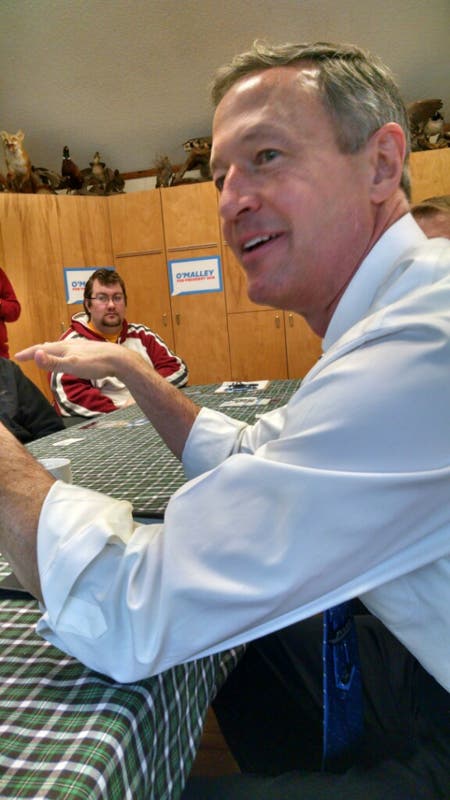
Citizens and Martin O’Malley staff congregated in the Sun Room of the Indian Creek Nature Center at 6665 Otis Road in little Bertram, Iowa. Martin O’Malley came in and right away wanted a cup of coffee. He reminded me of the text on my Iowa Citizens for Community Improvement cup, which I completely concur with: “We talk. We act. We get it done. People before profits, politics and polluters.*
*Coffee before everything.”
Gov. O’Malley greeted his supporters and staff. Then we sat down at a long rectangular table. He sat down next to me at the center of the table and began talking to us about how his predecessor, former Maryland Gov. Harry Hughes, who served from 1979-1987, and he, governor of Maryland until 2015, with his team of state and federal workers, managed to clean up the Chesapeake Bay. The Chesapeake Bay is dear to O’Malley’s heart, since he grew up near the bay and paddled every estuary, river, and creek that ran into the bay as a kid.
Find out what's happening in Iowa Cityfor free with the latest updates from Patch.
The rock fish, oysters, subaquatic grasses, and oysters in the bay were dying due to pollution. There was a dead zone in the middle of the bay. Nitrogen, phosphorus, and other pollutants contaminated the water to such an extent that living creatures were no longer able to prosper or even survive. Population surrounding the bay kept increasing, so as efforts to clean the water mobilized, pollution increased with the growing population.
The oysters that were on life support acted as filters to clean the water. So did the subaquatic grasses.
Find out what's happening in Iowa Cityfor free with the latest updates from Patch.
“We brought forward Baystat,” O’Malley stated. “We took 36 actions including measurements so that we could determine outcomes and progress toward goals, including septic systems, storm water runoff, the amount of nitrogen in the bay, the amount of phosphorus in the bay. We had to make sure that pollution was decreasing and the numbers of oysters, blue crabs, and subaquatic grasses were increasing.
“We set deadlines for ourselves. People worried, ‘What if you don’t meet the deadlines or the goals you set?’ I said, ‘What if we exceed them?’
“We met every three weeks to assess our progress by measuring it.
“Inmates built oyster cages. The flush fee went from $2.50 a month to $5.00 a month. It helped us clean the water. We planted trees. The University of Maryland Center for Environmental Studies helped us. We succeeded in greatly reducing the amount of nitrogen and phosphorus in the Chesapeake Bay. (Gov. O’Malley had charts and graphs, but I didn’t get all the numbers down.)
Gov. O’Malley made clear that as president, he wouldn’t do what Gov. Terry Branstad (R-IA) is proposing that we do: Take money from education and spend it to clean up the water.
Iowa Senator Rob Hogg (D-Cedar Rapids) was there. He’s planning to run against Republican Sen. Chuck Grassley (IA) if he wins the Democratic primary, which he is expected to do. Press from ABC, NBC, and the Des Moines Register were also there.