Arts & Entertainment
Johnston's Jessica Pray Share Why University of Iowa Feels Like Home
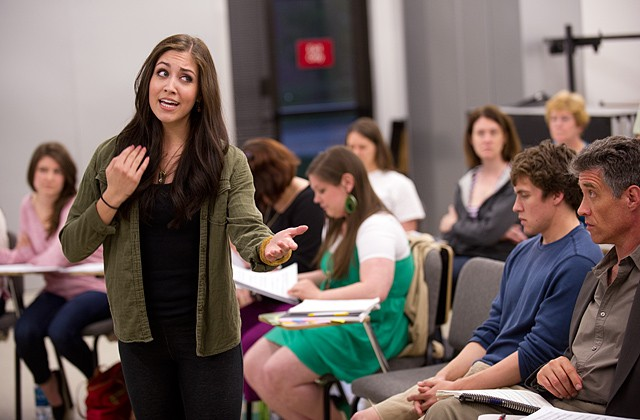
The Johnston High School graduate plans to pursue a career in opera, but is also majoring in ethics and public policy. The U of I encourages arts majors to plan for a way to make a living.


BY: LIN LARSON
For Iowa Now, a University of Iowa website
Jessica Pray wanted to sing, but she also wanted something more.
The Johnston native attended high-school summer camps at music-centric institutions like Oberlin College and Conservatory. Their focus seemed confining, their size and intensity a little off-putting.
Find out what's happening in Johnstonfor free with the latest updates from Patch.
She found the perfect alternative in her own back yard.
“I wanted to exercise more than just my voice,” she says. “I came to Iowa and knew I belonged here.”
Find out what's happening in Johnstonfor free with the latest updates from Patch.
For more than a century, the University of Iowa has offered people like Pray a chance to realize their potential. The university’s literary standing is widely known, but its visual and performing arts programs earn similar acclaim. They draw top faculty and visiting artists, and routinely make lists of the nation’s best.
Just as important, these programs enrich the experience of nonmajors—a product of the longstanding belief that the arts are a key component of a university education.
Iowa’s dedication to the arts remains clear today, as the university builds new facilities for the School of Music, School of Art and Art History, and Hancher, revitalizing its campus infrastructure, its opportunities for students, and its global reputation.
Early days“There’s an unusual commitment to the arts at Iowa, certainly a stronger commitment than you find at most public universities,” says Alan MacVey, director of the UI Division of Performing Arts, which includes the UI School of Music and departments of Theatre Arts and Dance.
That commitment started to take shape soon after the university’s 1847 founding. Campus clubs fostered artistic study and expression, while arts classes appeared as early as the 1880s. Formal programs in visual and performing arts began to coalesce just after the turn of the century.
A fine arts department combining drawing, painting, and art history was organized around 1906, the same year a local music school affiliated with the university. Phillip Greeley Clapp built the latter into a full-fledged music department starting in 1919.
Theatre took root in the early 1920s, with the arrival of Edward Charles Mabie, who unified campus theatre clubs and expanded academic programs in what was then called the Department of Speech.
In 1929, a School of Fine Arts attempted to pull all of these programs together. That structure ultimately proved untenable, but Iowa’s visual and performing arts programs had come into their own.
Pioneering ideas“Our programs have graduated students who went on to run many others,” MacVey says. UI graduates took Iowa innovations to other institutions, cementing the place of the arts in higher education.
Among these innovations was the belief that artists and scholars should work side by side and learn from each other.
“The notion of bringing together the humanities and studio arts programs goes back to at least the mid-1930s,” says John Beldon Scott, director of the School of Art and Art History.
The “Iowa Idea,” as it would be called, is most commonly applied to the visual arts, but it aptly describes the philosophy alive in other fields that unite the full range of creative work, history, and critical analysis under a common umbrella.
“The arts have the capacity to connect disciplines across our universities.”—Alan MacVey
In addition, Iowa famously pioneered the embrace of artistic achievement as grounds for advanced degrees. In 1922, the university established that works of music, visual arts, or literature could fulfill the thesis requirements for a master’s degree—a revolutionary move.
Iowa’s first master’s degrees for creative work recognized a pair of symphonic compositions in 1925 and a painting in 1926. A 1931 poetry collection earned the first master’s for creative writing.
Soon, the Master of Fine Arts (MFA) degree became the standard for graduate study in the arts. Exactly who invented the MFA—the UI or Yale—is open to debate, but Iowa holds an indisputable place in the history of arts education.
A campus for the artsNew organizational structures, expanded degree options, and a higher profile for the arts inspired a drive for new facilities in the 1930s.
“Imagine proposing a new campus dedicated to the arts in the middle of an economic depression,” says Scott. “It took a great deal of vision and determination.”
The Art Building and Theatre Building opened on the west bank of the Iowa River in 1936. A 1960s-1970s building boom grew the arts campus, adding the Museum of Art, Voxman Music Building/Clapp Recital Hall, and Hancher Auditorium.
The latter facility realized a 1930s-era vision for a large performance hall and began drawing top music, theatre, and dance events to the UI and Iowa City. Companies like the Joffrey Ballet would become frequent Hancher guests and collaborators.
The riverfront provided a unique location for the collected programs, but record flooding in 2008 threatened the arts campus like never before.
"We’ve seen tremendous institutional support in the wake of the flood, with a lot of synergy and community. It’s what I love about this environment."—David Gier
Hancher, the original Art Building, and the Voxman/Clapp complex were more than 50 percent destroyed, reaching the Federal Emergency Management Agency’s threshold for replacement. The Theatre Building, Museum of Art, and Art Building West—which had opened just two years prior—sustained heavy damage.
Staying strongIn the five years since 2008, art and music programs have found temporary homes, while Hancher and the Museum of Art have sponsored events and exhibits in alternative venues. University, state, and federal leaders have partnered on flood mitigation measures and plans for new facilities.
The can-do response to the crisis is an inspiration and a testament to the Iowa idea.
“No one blinked,” says David Gier, director of the School of Music. “We’ve seen tremendous institutional support in the wake of the flood, with a lot of synergy and community. It’s what I love about this environment.”
Visual and performing arts enrollment continues to be strong among both arts majors and students in other fields who take arts classes to fulfill general education or elective requirements.
The notion that fine arts should comprise a component of general education also hails from the mid-20th century and the university’s first core curriculum. Today, all undergraduates in the College of Liberal Arts and Sciences complete at least three semester hours in literary, visual, or performing arts, and use arts courses to satisfy requirements in other areas.
In addition, students from any field can join the university band, string orchestra, choir, Hawkeye Marching Band, and other ensembles in the School of Music. Nonmajors and community members regularly take part in open auditions for Department of Theatre Arts productions.
“We absolutely serve the university community as a whole, and in fact the larger community,” MacVey says.
Top-flight arts programs also draw plenty of double majors—including Jessica Pray, who is mixing vocal performance with a second major in ethics and public policy.
“A lot of people really want to use their lives to make or study art, but also want another way to make a living,” says art and art history’s John Beldon Scott. “At Iowa, students can concentrate on two very different things.”
New directionsAs their new buildings take shape, arts faculty, staff, and students are pushing the bounds of their disciplines and prompting audiences to see the arts—and the world—differently. No surprise, given their work is all about creation.
“From the beginning, our department was completely committed to new work, and you see that across the board in the performing arts,” MacVey says. “We’re a leader in both academic and cultural terms.”
"Contemporary art is all about bringing media together." — John Beldon Scott
Of the 25-30 plays produced by the theatre department, about two-thirds are new. Likewise, the School of Music’s Center for New Music showcases contemporary compositions, while the Department of Dance’s annual Dance Gala introduces audiences to new choreography and artists.
In the visual arts, plans for a new facility are tearing down both conceptual and literal barriers.
“Contemporary art is all about bringing media together,” Scott says. “In the old Art Building, each medium was almost hermetically contained in its own space. The new building will embody the idea of mixing media and, of course, contributing the humanist perspective from art history.”
Similarly, Iowa’s arts programs are working together to chart common directions. MacVey and Chuck Swanson, Hancher director, chair an arts advancement committee that’s taking a holistic look at missions, structures, and potential collaborations.
A digital arts initiative being developed with support from the Office of the Provost offers one example. The project would create a cluster of faculty interested in intersections of technology, music, visual arts, and performance.
“We’re on the cusp of something new that goes beyond buildings,” MacVey says, noting that the university is also a partner in the Alliance for the Arts in Research Universities based at the University of Michigan.
“The arts have the capacity to connect disciplines across our universities,” he says. “We’re identifying the kinds of projects that do just that.”
Technological, economic, cultural, and other factors also are transforming how the UI prepares young artists.
“A lot of what we teach is timeless,” says music’s David Gier. “But digital technology, for example, changes how students create and disseminate their work. We want to ride that wave.”
It’s possible to find students who are deeply engaged in music, but in completely nontraditional ways—say the digital composer who’s never touched a conventional instrument.
“This student may be the Mozart of the middle-21 st century,” Gier says. “Do we have a place for her or him?”
“Even without permanent facilities, arts students here seem to thrive. There’s something special about this place.” — Jessica Pray
Also a factor: the changing role of cultural institutions. One can no longer assume that artists will find long-term positions with universities or existing companies. Many individuals will create their own way.
The College of Liberal Arts and Sciences and its Division of Performing Arts offer a Certificate in Performing Arts Entrepreneurship, and UI programs are recruiting artist-mentors who’ve developed independent initiatives. MacVey emphasizes that an arts education also is great preparation for work beyond the arts.
“Our students leave with qualities that are very desirable in a creative economy,” he says. “In fields like theatre, students learn to work in teams under deadlines, to create and complete projects. They learn to get things done.”
Jessica Pray wants to perform, but she feels prepared for whatever comes next when she graduates in 2014.
She hopes to start by entering opera competitions, earning the money and reputation necessary to join a company and gradually move up. Her sister Jennifer, a principal dancer with Ballet Minnesota, has followed a similar route.
It’s possible, she says, that the challenges of the last few years have reminded the university community of the values and character that make Iowa’s arts programs strong.
“Even without permanent facilities, arts students here seem to thrive,” she says. “There’s something special about this place.”
Get more local news delivered straight to your inbox. Sign up for free Patch newsletters and alerts.