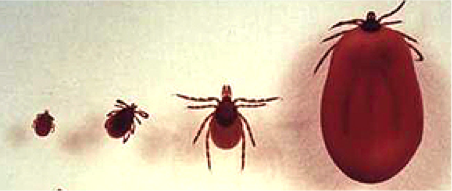

The ticks are out in massive numbers this spring. And with ticks comes the worry about Lyme disease. While Iowa is not a high-Lyme state, it is still possible to contract Lyme disease. Here is a quick review of ticks and Lyme disease. Lyme disease is spread by a certain type of deer tick called Ixodes scapularis. These ticks have 3 stages to their life-cycle: larva, nymph, and adult. Most cases of Lyme disease result from nymphal ticks, which are most active in late spring to early summer. While adult ticks can transmit the disease, they are less likely to bite humans, and are more noticeable due to their size, therefore are more quickly removed. A tick must feed on you to transmit infection. A tick that’s walking around, or easily removed is not yet attached. The length of time of attachment is also important. It is rare to transmit the disease within the first 48 hours of attachment (about 1% chance). As a feeding tick becomes engorged with blood, the chance of transmission becomes higher. The organism that causes Lyme disease lives in the ticks gut, and has to migrate up to its saliva glands during feeding for transmission to occur. If you find an engorged tick on your body or in your home, the risk is higher. Once full (usually over 72 hours), the ticks will fall off. If you discover a tick attached to your body, you want to remove it immediately, but in the correct way so as not to leave the mouthpieces embedded in the skin. 1. With tweezers or fingers protected by cloth, grasp the tick as close to the skin as possible. 2. Pull straight up gently but firmly, using steady pressure. Do not jerk or twist. 3. Do not squeeze or crush the tick, as its fluids may contain infectious agents. 4. Clean the skin with soap and water 5. If any mouthparts remain, leave them alone and the body will push them out spontaneously. Do NOT try to dig them out. 6. Observe the area of the bite for the next 30 days for the classic “target” or “bullseye” rash. Note, a slight reddening or irritation of the skin at the area of the bite is normal. Other symptoms of early Lyme disease, that occur much less frequently than the bullseye rash, include fatigue, loss of appetite, headache, muscle or joint aches, fever, and swollen lymph nodes. If you find an engorged tick, or believe it has been attached for >72hrs, then visit your doctor immediately. A preventive dose of antibiotics can be given in certain situations to decrease the chance of getting Lyme disease. If a tick bite occurred weeks ago, and you start to develop a rash, also see your doctor, and treatment for early Lyme disease can be initiated. A blood test at the time of a bite, or even at the time of the development of the rash will NOT be useful, as it takes about 2-6 weeks following symptoms for blood tests to turn positive.