Politics & Government
Senate District 22 Election: Schneider, Adams Differ on Same-Sex Marriage
The Republican candidate favors letting Iowans voted on same-sex marriage, while the Democrat says there are no degrees of equality.


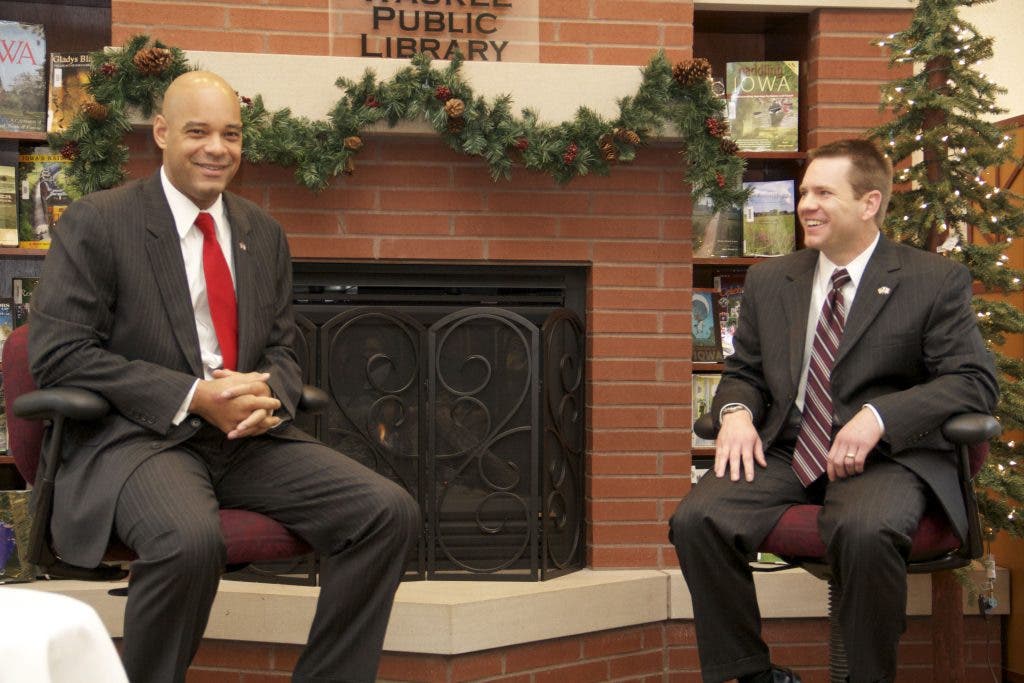
If there’s an issue that illustrates the difference between the two candidates who want to represent Senate District 22, it’s same-sex marriage.
Republican Charles Schneider and Democrat Desmund Adams square off Tuesday in a special election to represent the district, which includes Waukee, Clive and part of West Des Moines. Schneider replaces Sen. Pat Ward, who died in mid-October, on the Republican ballot.
At a forum on Saturday, the only joint appearance by the two candidates in advance of Tuesday’s election, the candidates were asked about judicial retention, a normally procedural vote that became a hot-button issue after the Iowa Supreme Court’s unanimous Varnum v. Brien decision legalizing same-sex marriage.
In 2010 three Iowa justices were voted off the court. In November, Justice David Wiggins was retained.
Both Schneider and Adams said Iowa’s retention system works well and they favor retaining it. But that’s where their agreement ended.
Schneider favors allowing Iowans to vote on a constitutional amendment on the question of whether individuals of the same gender should be allowed to marry.
“People feel they didn’t have a say in the process of approving same-sex marriage,” he said. “It’s a difficult issue for me and I know it probably is for several other people.”
At the forum and in an interview with Patch, Schneider declined to say how he feels about the issue, other than that Iowans should be allowed to vote on it.
Adams was resolute, citing Iowa’s rich civil rights history dating back to before statehood when a slave named Ralph Montgomery was captured in Iowa by slave-catchers in the early 1830s, but was declared a free man in the Iowa Supreme Court’s first decision.
“I believe equality is equality,” Adams said. “I don’t believe there are degrees of equality.
“This is not something we need to vote on. It has been handled in the Legislature and by the state Supreme Court. The next level is the U.S. Supreme Court.”