Schools
This Physics Lab Instructor Wants You To See The Stars
Paul Howells, a lab instructor for the physics department, is a founding member of Southern Maine Astronomers.
Published January 15, 2021 by Rebecca Goldfine
This Physics Lab Instructor Wants You to See the Stars
Published January 15, 2021 by Rebecca Goldfine
Find out what's happening in Portlandfor free with the latest updates from Patch.
Paul Howells, a lab instructor for the physics department, is a founding member of Southern Maine Astronomers (and a published photographer of the cosmos). With his group, he's trying to keep Maine's skies dark.
Find out what's happening in Portlandfor free with the latest updates from Patch.
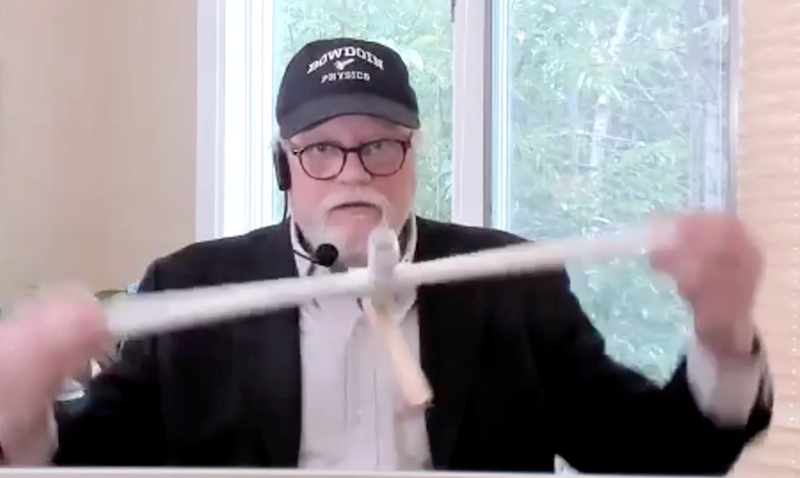
Paul Howell, demonstrating an inertia gadget he invented for his physics lab. He is also an astro-photographer and supplied the photos for this story.
"We work on dark sky advocacy," Howell said in a recent interview about Southern Maine Astronomers (SMA), a nonprofit for amateur and professional astronomers he helped launch in 2004. One of its objectives is to promote an appreciation for astronomy through public outreach (with stargazing parties, for instance) and education.
One of its successful endeavors has been a stargazing curriculum for elementary schools. After learning a bit about the Universe in class, children gather close to their school to look at the constellation Orion—named after the huntsman in Greek mythology—and mark the number of stars they can see within the hunter's body. They then compare their findings with other schools, and "many from the more light-polluted regions express dismay over the condition of their skies," Howell said.
Within SMA, Howell belongs to the dark sky committee, which encourages communities to pass light ordinances to mandate star-friendly outdoor lighting. Outdoor lights are the biggest source of light pollution, and SMA recommends towns and businesses install LED bulbs with a yellow or orange hue, and to use fixtures that don't spill light upward.
"You can save a lot of money getting a better fixture that doesn't spew light up into the trees, which doesn't do much for anybody," Howell said. "This is where light pollution is coming from, and it's completely wasted energy."
Photo by Paul Howell: "Messier object M13 is an example of globular clusters of stars. M13 orbits our galaxy, the Milky Way, and like most galaxies, the Milky Way has many such companions. Globular clusters are very old, almost as old as the Universe itself!" — Paul Howell.


Howell said his group has asked Brunswick to adopt dark sky standards, and has had success convincing some architects associated with local projects to use yellowish LED lights outside.
A problem a well-meaning town can make is to select energy-efficient LED bulbs for street lights that emit a bluish light. Bulbs with a color temperature between 2000 kelvins and 3000 kelvins—the measurement of color temperature in lighting—cast a more orange-yellow hue. The higher the color temperature, the more bluish-white the light is.
"A lot of towns over the last few years have replaced the bulbs in their streetlamps with LED bulbs that are heavy with blue," Howell said. "This has been found to be disruptive to circadian rhythms and melatonin production." Melatonin is a natural hormone that helps regulate sleep.
Besides losing sleep, people miss something elemental and sublime when they can't see a dark sky gleaming with stars, planets, and the Milky Way. "We get a lot of tourism in Maine, and one thing that almost everyone from Massachusetts and south wants is to see the stars," Howell said.
Howell lives in Harpswell, which is an ideal place for stargazing since it's a long peninsula jutting far out into the sea. (For those who don't live in Harpswell but are nearby, he recommends stopping by Bowdoin's Schiller Coastal Studies Center on Orr's Island on a clear night.)
"It’s really hard to build streetlamps in the ocean," Howell explained. "The whole Atlantic Ocean has zero light pollution, and the farther you get away from the light pollution of Brunswick, the closer you get to the inky blackness of the ocean."
Photo by Paul Howell: "Stars live, and then stars die. Some go out with a bang as a supernova. About 15,000 years ago a nearby star did just that. Using optical filters that isolate hydrogen (red) and oxygen (teal), this image shows the expanding aftermath," Howell writes about his photo.


This press release was produced by Bowdoin College.The views expressed here are the author’s own.