Community Corner
Expose The Secret Double Life of Donated Textiles 11/15
Textile recycling keeps billions of pounds of waste from landfills


For this year’s National America Recycles Day on November 15, don’t forget about the importance of reusing and recycling textiles. According to the Secondary Materials and Recycled Textiles Association (SMART), a global organization of companies involved in the reuse and recycling of textiles and related secondary materials, the average U.S. citizen throws away 81 pounds of clothing each year. Why does this matter? Ninety-five percent of textiles, even if they are worn out or torn, can be recycled – yet only 15 percent get donated/recycled, with 85 percent of used textiles ending up in landfills.
A common misconception about textile recychttps://i.imgur.com/ZgZukUk.jp...ling is that the only option is to donate clothing that can be re-worn. In reality, donated textiles are given a “second life” in many ways. Nearly 100 percent of donated textiles are recycled into three grades: 45 percent usable clothing, 20 percent fiber conversion grade and 30 percent wiping cloth grade. That means 50 percent of donated textiles are not used as secondhand clothing – instead, they are transformed into items such as wiping cloths, pillow stuffing, household insulation, car seat stuffing and more.
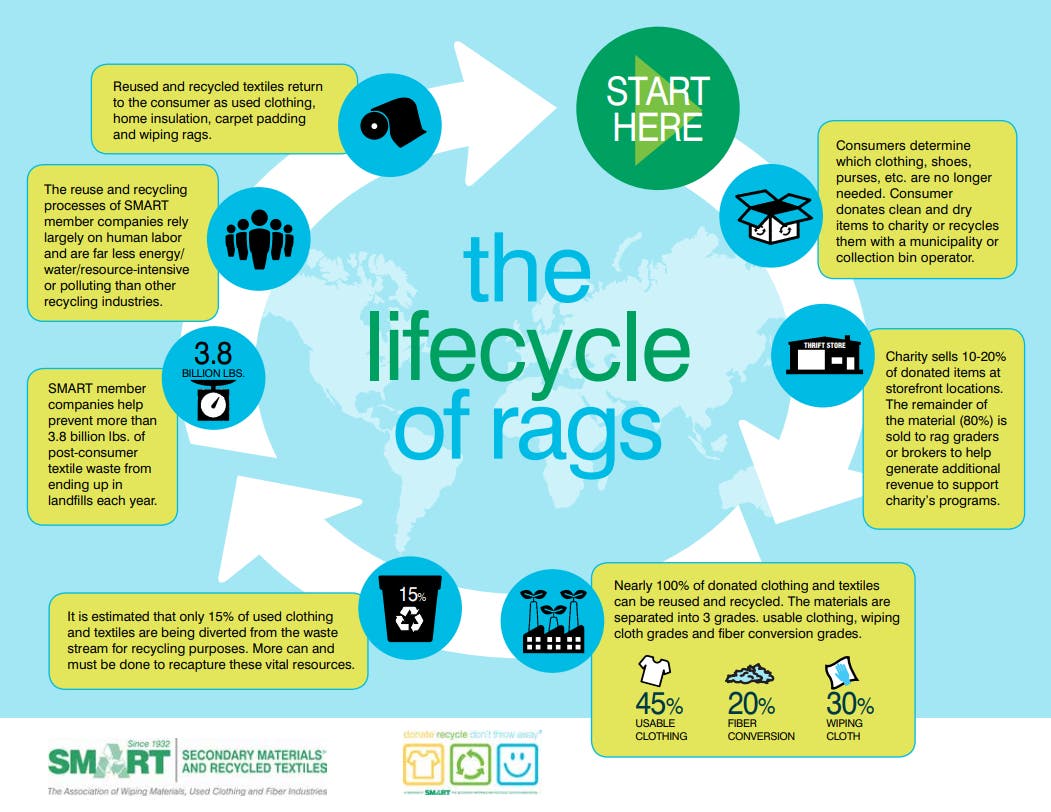
Have you used a wet wipe at your favorite barbecue restaurant? It may have been created with recycled non-woven textiles! This niche recycling industry takes “seconds” from mills producing “firsts” such as napkins and paper towels – for example, the trimmings from your carefully sized napkins, and re-purposes them into a variety of wiping materials for janitorial companies, hygiene brands and more.
Find out what's happening in Aberdeenfor free with the latest updates from Patch.
Any clothing, household textile or commercial linen textile, as long as it is dry and has no odor, can be reused and recycled. Even if the item is stained, torn, overly worn or out-of-date, do not throw it away; it has a use in the textile recycling industry. Only items that are wet (mildewed) or have been used with a solvent-type liquid such as gasoline or Goof Off) cannot be recycled.
To find the closest SMART member near you to recycle your textiles and for more information on SMART, visit www.smartasn.org. Please direct media inquiries for SMART to Andrea Lynn at 410-420-2001 or by email at andrea.lynn@fallstongroup.com.