Community Corner
SIGN: Old Post Road/Cokesbury College
What bits of this school did people collect, even after the turn of the 20th Century?


This week’s stop on our tour finds us, yet again, in the bustling metropolis of Abingdon.
With the Revolutionary War over, the people of Harford County began looking forward.
Illiteracy was rampant. As of 1800, it was estimated that only about a half of the population could read.
Find out what's happening in Aberdeenfor free with the latest updates from Patch.
In 1783, the Methodist Church decided at their yearly conference that Abingdon would be the site for the first-ever institution of higher learning constructed by that denomination.
The Rev. Thomas Coke and Bishop Francis Asbury were instrumental in the creation of the school. The idea was Coke’s, and Asbury raised funds as he spread the word as a circuit-riding preacher.
Find out what's happening in Aberdeenfor free with the latest updates from Patch.
The college was named for these two men, in the form of their combined names, thus Cokesbury. To see what the school once looked like, click here.
At the time, Methodism was a burgeoning religion in Maryland. In 1773, there were 500 followers and by 1800, there were more than 13,000, which amounted to 8 percent of the population.
This site in Abingdon was chosen for several reasons. Coke is credited with having said, “The place delights me more and more, the waterfront forms one of the most beautiful views in the United States,” according to C. Milton Wright’s Our Harford Heritage.
As the Baltimore area had the greatest concentration of Methodists, and Abingdon was on the Philadelphia stagecoach line, it was a logical and accessible place for such a college.
Also, having only been laid out in 1779, Abingdon was a town on the rise, with land for sale. Plus, the new Cokesbury Memorial Methodist Church had been built in the town in 1783. In 1784, Coke bought six acres adjoining the church on which to construct the college.
Native son and then-governor was a supporter of the project, which probably didn’t hurt the cause any.
Cokesbury College was a private school, built primarily to educate the sons of preachers, although others were welcome, including orphans.
This was no one-room schoolhouse, by any means. Built of brick, it measured 108’x40’, and the building had three stories. A fence surrounded it.
Interestingly, the college had a 6-foot square pool for bathing.
“One pupil was permitted to bathe at a time and only for one minute with a master always being present. Bathing in the Bush River was strictly prohibited,” according to Wright. No reason was given. Bathing at that time did not mean recreational swimming.
When Cokesbury College was under roof, the first preparatory school class began with 15 students under the tutelage of a Quaker.
With the 1787 appointment of the first official headmaster, the Rev. M. Heath, the attendance began to swell. There were now 25 students and three teachers.
The curriculum was grounded in the classics, teaching English, Greek, and Latin. However, logic, rhetoric, history, geography, astronomy and natural philosophy were also taught.
This college was about as no-nonsense as one could be. Students were awakened at 5 a.m. and were in bed at 9 p.m., seven days a week. They attended eight classes a day, from 7 a.m.-4 p.m.
For the sake of recreation, students were permitted to study architecture, woodworking or agriculture. There was a garden plot on which the students were free to grow whatever they liked.
Nothing that even looked like play was allowed.
One of the college’s philosophies was that, “those who play when they are young will play when they are old.”
Despite the strict discipline, or perhaps because of it, the enrollment continued to grow. In 1788, there were 30 students. By 1791, there were 70 young men attending the school.
However, the school had its problems. Finding good teachers was the greatest obstacle. And, although tuition was $16.88 per pupil, with an additional $60 for boarding, money became an issue.
By 1794, Cokesbury College was $6,000 in debt, according to Wright.
In that same year, the Maryland Legislature approved the conferring of degrees even as the Methodist Church gave up control of the college when it applied for an Act of Incorporation. The school was now public and open to any male.
Oddly, there is no mention of the school having had graduation ceremonies, nor the conferring of any degrees until this time.
On December 5, 1795, the college was destroyed by fire. Arson was suspected, but never proven.
The school was never rebuilt, probably because of the previously mentioned problems that plagued it.
The bell from Cokesbury College found a new home at Goucher Hall in 1885. It’s rather ironic that the bell from a male-only school should end up at what was then a female-only school.
Even as late as 1901, “the bricks are sought and carried away as relics,” according to History of Harford County Maryland, by Walter W. Preston, which was written at that time.
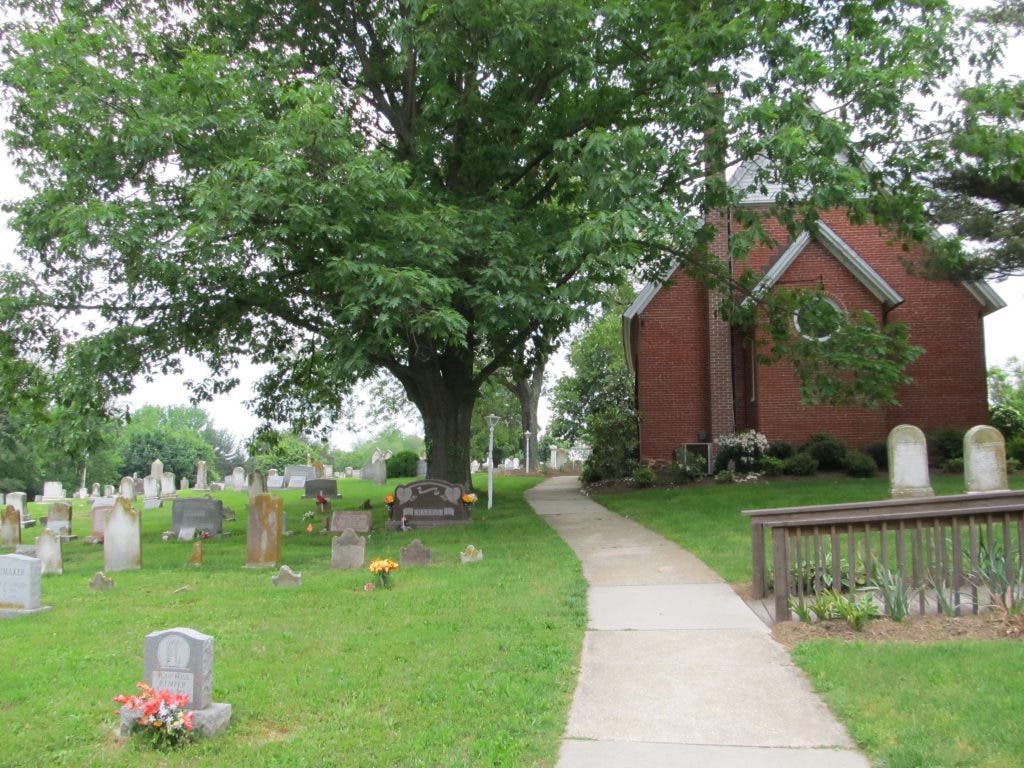
So ends the saga of a very ambitious educational endeavor that had a relatively short life span. Nothing except a sign at the Cokesbury Memorial Methodist Church marks the place where this school once stood.
Cokesbury College was located on land behind what is now McComas Funeral Home. The marker is located on the corner of Route 7 (which was once called Paca Street) and Cokesbury Road (once called Prospect Street), on the property of the funeral home.
The marker was erected by the Gov. William Paca Chapter of the D.A.R. of Harford County Maryland, in 1930.
Join me next week on the last stop of our tour as we visit the historic Calvary Church.
Where did they get the nails to build this church?