Community Corner
The Wayback Machine: The Empire Begins
George Washington Baker created a canning empire.


George Washington Baker (1815- 1888) was the father of canning in Harford County, in more ways than one.
Before becoming a canner, Baker was a carpenter who was also involved with the lumber trade. He, “cut and shipped lumber to the chair manufacturers in Baltimore,” according to an article by Richard F. Cronin, in The Harford County Directory of 1953.
Baker later became a dairy farmer. He, “shipped the first milk to Baltimore, receiving 35 cents a gallon for it, in 1858,” Cronin’s article stated. So, it’s fair to say that Baker recognized the potential for money-making endeavors via the railroad.
Find out what's happening in Aberdeenfor free with the latest updates from Patch.
The importance of the railroad to the economy and growth of Aberdeen cannot be overstated, and we’ll explore that subject in the weeks to come. For now, suffice it to say that it made all the difference in the world to the local farmers and canners for getting their product to market, not only to Baltimore, but nationwide as well.
Baker became interested in growing berries, such as dewberries and blackberries. He shipped, “carloads,” of these to the canning houses in Baltimore, along with peaches and tomatoes.
Find out what's happening in Aberdeenfor free with the latest updates from Patch.
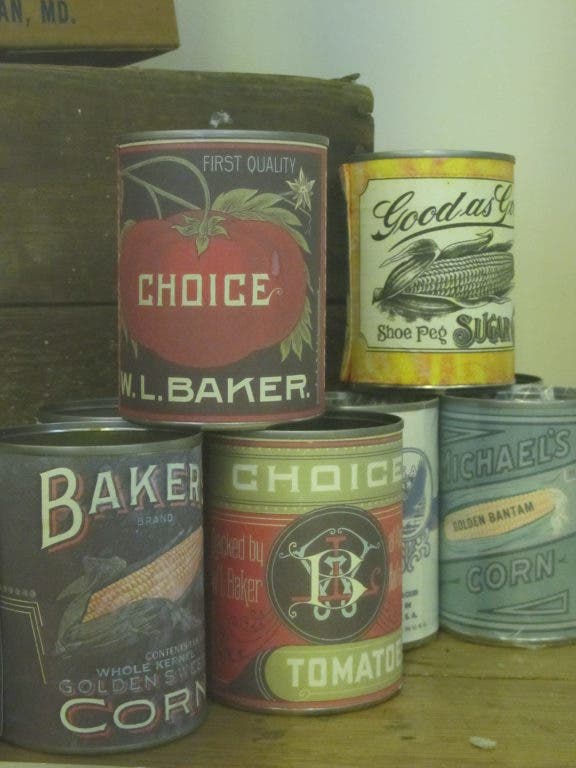
In 1867, Baker had an, “aha!” moment and built the first canning house in Harford County, where he began canning the fruits himself. This effectively spawned the birth of a new industry, as well as an empire that would last for generations to come.
Not content to rest on his laurels, Baker experimented by canning sweet corn, for which the area would become famous. The corn was readily available and grew especially well in the local climate and soil. However, when it was cut from the cob, it would turn dark in a matter of minutes and came out of the can black. Not exactly the most appetizing color for any food.
Baker then experimented in the kitchen of his house, which is still standing and located just to the right of the Park and Ride by the HEAT Center. In 1874, he perfected sweet corn canning so the vegetable came out of the can nice and tasty with its natural color.
Exactly how he managed this when others had failed must have been a well-kept trade secret, because there is no information readily available on his process. As a home canner, I can only speculate that it may have involved blanching the corn briefly in boiling water while it was still on the cob. But, that’s only an educated guess.
Bernie Bodt noted in a lecture at the Historical Society of Harford County that canning houses were highly secretive places. Not just anyone could get in, lest competitors became privy to certain processes and practices.
Following Baker’s successful experiments in the canning of local sweet corn, he shipped 900 cases in that first year. By 1884, 120,000 cases of corn left Baker’s cannery for the nation’s dinner tables, according to Cronin.
Over the course of the years, Baker came to own over 3,000 acres, 2,000 of which were used to grow sweet corn.
Canning caught on and many farms in the county had their own canneries right on the farm. In the 1880s, Harford County was home to more than 180 small and large canneries, according to Cronin.
Having the canneries on the farm cut transportation costs, but the product could be packed as soon as possible following harvesting, eliminating spoilage and damage that would have otherwise occurred during the shipping process. Plus, the middleman or broker was taken out of the equation.
Local canning houses also were able to broker their own deals with growers, thus being assured of the required type and amount of produce, and at a set price.
Not all of the vegetables that were canned in Aberdeen came from this area. Some produce came from the Eastern shore, and some local produce was shipped to Delaware to be processed.
According to an unnamed “old-timer” in Cronin’s article, “in the [eighteen] nineties, two horse wagons were lined up for almost a mile and a half waiting to be unloaded into warehouses or cars at the P. B. & W. Railroad.”
Baker and his wife, Elizabeth, nee Greenland, had 15 children, nine of which survived. Five of his sons followed in his footsteps, and in fact, outshone their father. They inherited the canning business when Baker died in 1888.
Next week, we’ll find out what those fabulous Baker boys did with their father’s business.