Politics & Government
Advocates Say They Have ‘Remedy' To Protect Voting Rights In Maryland
The push for the Maryland Voting Rights Act comes as the federal Voting Rights Act is increasingly under attack.
February 12, 2026
Daryl Jones thinks that “something is wrong in Maryland,” a state where more than half of all municipalities had prominent populations of color in 2024, but nearly a quarter had all-white governments, according to the American Civil Liberties Union.
Find out what's happening in Across Marylandfor free with the latest updates from Patch.
But Jones, board chair of the Transformative Justice Coalition, also thinks he knows the “remedy” — a state version of the federal Voting Rights Act of 1965, which voting rights advocates fear could be gutted this summer by the U.S. Supreme Court.
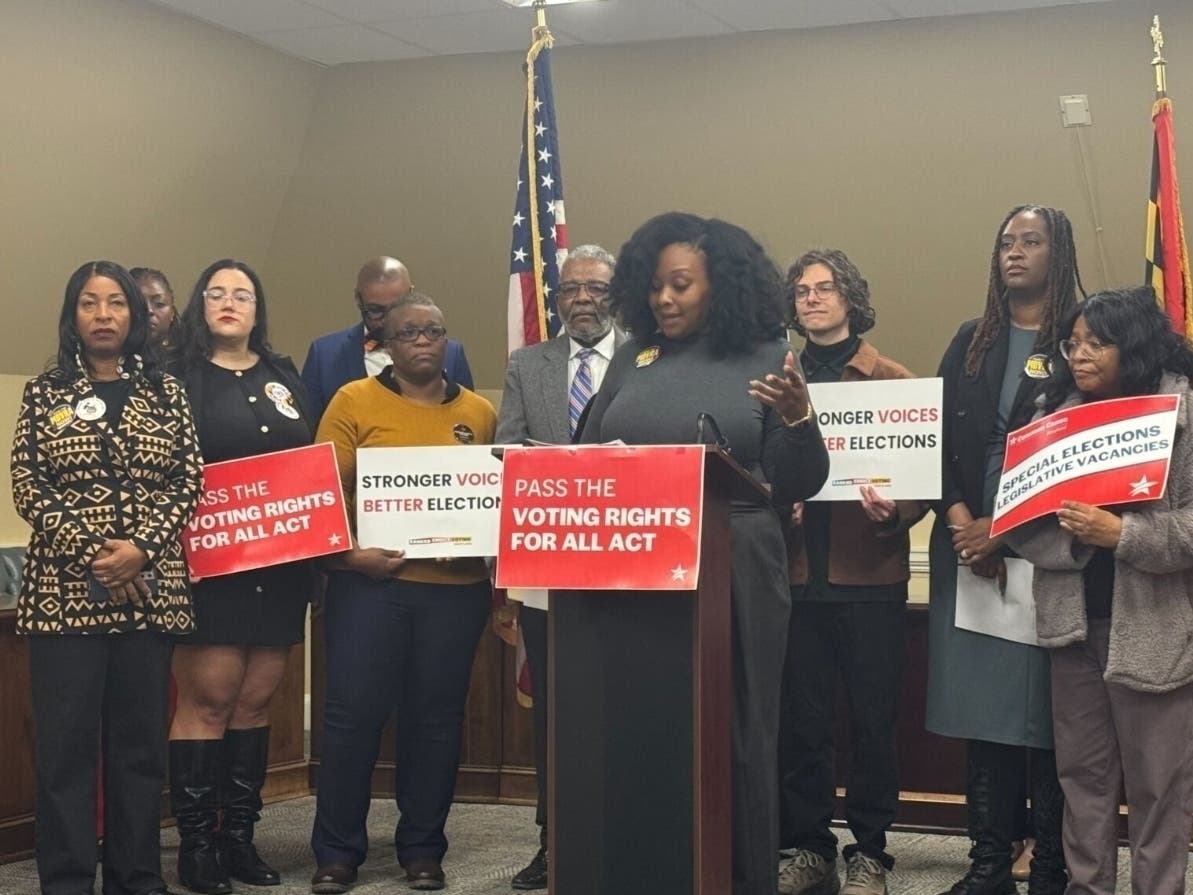
Jones joined other members of Everyone Votes Maryland, a grassroots voting rights coalition made up of advocates and lawmakers, who came to Annapolis Wednesday to lobby for a packet of bills that they say would ensure fair treatment of voters in state and local elections.
Find out what's happening in Across Marylandfor free with the latest updates from Patch.
The Maryland Voting Rights Act (MDVRA) is actually a package of four bills, that aim to prohibit “acts of intimidation, deception, or obstruction” against voters based on their race, color or national origin, prevent the “dilution” of votes, among other protections. The bills were first introduced in 2025, but only one, guaranteeing language assistance in elections, was passed. The others were reintroduced this year, but the coalition warned that the General Assembly is running out of time to pass it.
Monica Cooper, executive director of the Maryland Justice Project, said the MDVRA comes at a crucial turning point for elections in this country, as President Donald Trump has made repeated calls in recent weeks to “nationalize” local elections, following years of his unsubstantiated claims of “rigged” election processes across the country.
“I’m afraid that we may not get to see another election,” Cooper said. “I’m afraid that this is the very last time lawmakers in this city, this state, this country, have an opportunity to extend those voting rights to people who just might save this nation.”
Members of the coalition also advocated for Senate Bill 241, which would allow formerly incarcerated Maryland citizens to regain their right to vote.
Cooper, formerly incarcerated herself, views increased restrictions on who gets to vote, on both a state and federal level, as a “familiar playbook” to disenfranchise Black Americans.
“The history of the right to vote is rooted in the transatlantic slave trade. As the slaves came out of slavery into freedom, the question for the country was who deserved the right to vote,” Cooper said.
“And we have seen [efforts] from after Reconstruction to disenfranchise African American voters,” she said. “They were lynched. They were intimidated at the polls. They had all of these things that they had to deal with just to get to the 1965 Voting Rights Act.”
The U.S. House on Wednesday narrowly approved the Safeguard American Voter Eligibility (SAVE) Act, to require proof of citizenship to register to vote in federal elections. The Brennan Center for Justice estimates that 21 million Americans lack access to documents that can prove citizenship, including a REAL-ID-compliant ID, a passport, or a government-issued photo ID. Even women who changed their legal last name in marriage are potentially at risk of losing their vote, Jones said.
And the U.S. Supreme Court is expected to rule this year in a Louisiana case that could further erode protections of the federal Voting Rights Act, which the court has steadily weakened in recent years. The court will soon determine whether or not Louisiana’s new congressional map, which added two majority-Black districts in 2024, is illegal. If the court determines it is, racial protections in congressional redistricting could become much more difficult nationwide.
“The current federal administration is trying its best to shut even more people out,” Joanne Antoine, executive director of the nonprofit organization Common Cause Maryland, said at Wednesday’s event. “Too many Marylanders feel powerless right now, like their vote and their voice, they feel like that doesn’t matter. That silence comes at a dear cost.”
In 2021, the NAACP sued the Baltimore County Council, claiming its enacted redistricting plan diluted the strength of Black voters. The plan would have given seven out of nine country districts a majority white voter base. At the time, Baltimore County was about 57% white.
Maryland Sen. Charles E. Sydnor III (D-Baltimore County), who was a part of the lawsuit, said that bills like the MDVRA will hold counties accountable when creating voting districts.
“With this type of law in place, local and municipal governments…they’re going to have to take note that they have to do right by the communities they represent,” Sydnor said Wednesday.
Monica Brooks, the president of the Wicomico County chapter of the NAACP, said that when she ran for county council in 2022, she was one of three Black women vying for the District 1 seat in the Democratic primary, believing it was their “only chance” to get a Black representative on the council. After their NAACP chapter filed a lawsuit, there now exist two predominantly Black districts in the county.
“With this kind of legislation, we know and believe this is going to give opportunity for everyone to have a fair fight, and they don’t have to fight alone,” Brooks said.
Del. Stephanie Smith (D-Baltimore City), an MDVRA sponsor, said this legislation extends beyond presidential administrations and that she would have advocated for it regardless of Trump’s continued crackdowns on elections.
“We’ve been putting bills in like this for three years,” Smith said. “Sometimes people only have either … courage when their backs are against the wall, but they were already backing up and didn’t realize it.”