Politics & Government
Advocates: Services, Workers At Risk From Second Year Of Developmental Disabilities Budget Cuts
The Moore administration budget again targets more than $150 million in proposed cuts to the DDA.
February 2, 2026
Baltimore County resident Tracie Feron is the mother of 29-year-old Connor Feron, who has autism and other medical conditions that require round-the-clock care.
Find out what's happening in Across Marylandfor free with the latest updates from Patch.
She said residential facilities in the area have rejected Connor because they cannot provide the care he needs. He uses a Medicaid waiver that lets him and his family hire support personnel instead to assist him in his home.
But a recent proposal to cut funding from the state agency that oversees Conner’s services may put those supports at risk. Gov. Wes Moore’s fiscal 2027 budget proposal, released this month, calls for $150 million in “cost containment” measures in the budget for the Developmental Disabilities Administration.
Find out what's happening in Across Marylandfor free with the latest updates from Patch.
Reductions in spending on provider wages is just one of the proposed cuts. Feron and her son both worry about what will happen if wages drop too low to attract qualified candidates.
“It takes a village to support him,” she said. “What happens when that village is gone?”
It’s a concern shared by thousands of people with developmental disabilities and their families as they eye the DDA cuts in Moore’s budget. The administration includes a series of “cost containment” measures it says are needed to help curtail what officials call “unsustainable” spending from the agency.
The DDA administers Medicaid waivers that let Marylanders with developmental disabilities receive a wide variety of services, from live-in caregiver support to transportation, respite care, employment services and more.
Moore’s fourth budget uses cuts and fund shifts to close the $1.5 billion budget gap
Through reductions in spending on wages for specific service personnel and a cap on how much the state will provide for each personal budget, the governor hopes to reduce $150 million in state spending from the DDA.
But advocates note that the Medicaid waivers primarily are split between state and federal funding, meaning a state cut triggers a similar reduction in federal dollars, so that a $150 million cut in general funds is closer to a $300 million cut overall when factoring in federal match dollars.
“These proposals will have severe consequences,” said Alicia Wopat, president of the Self-Directed Advocacy Network of Maryland.
It’s the second year state officials have looked at cuts to the DDA for potential savings.
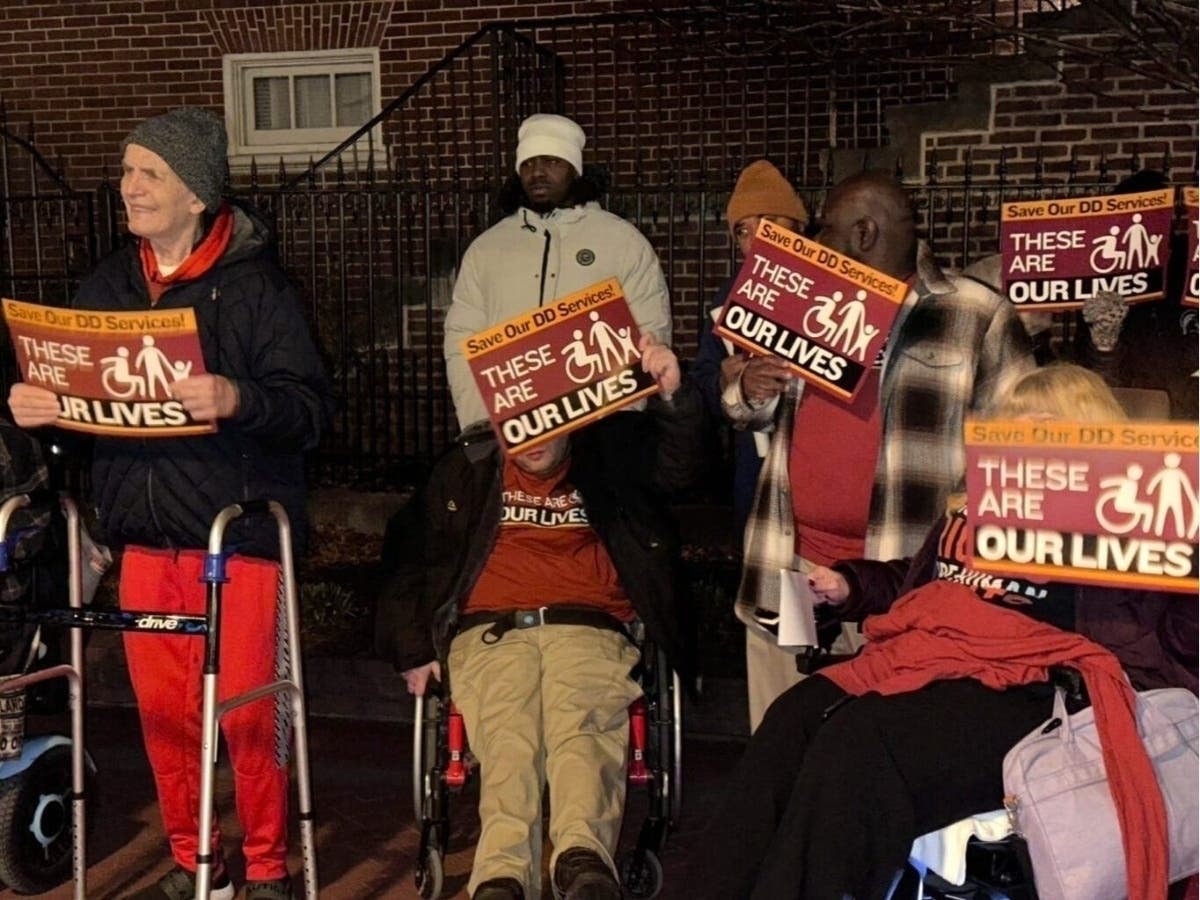
Last year, Moore’s initial budget slashed DDA funding as the state looked to close a $3 billion budget gap, prompting an outcry from advocates. Hundreds of people with developmental disabilities, their families and caretakers rallied in Annapolis on a cold January evening, with additional advocacy efforts throughout the session.
After significant discussion, lawmakers and the administration restored much of the proposed reduction, though there was still a $164 million cut to the agency for fiscal 2026.
Now, the administration is looking to tap DDA funds again.
Laura Howell, CEO of the Maryland Association of Community Services, says that communications with the health department about the budget challenges at the DDA have improved since last year, but she is concerned about how the current budget proposal could impact access to services.
“They’ve (state officials) been very engaged with members of the DD coalition,” she said. “We’ve had multiple meetings, they very much want to continue discussions during session on a routine basis. They are very open to questions, feedback, alternative proposals.”

From left, Maryland Association of Community Services CEO: Laura Howell, The Arc of Maryland Executive Director Ande Kolp and People on the Go of Maryland Executive Director Mat Rice, testify in 2025. (Photo by Danielle J. Brown/Maryland Matters)
Announcing the budget proposal earlier this month, acting Budget Secretary Yaakov “Jake” Weissmann said the administration was taking a “balanced approach” to the DDA cut, but was not “wedded to it as the only solution.”
“This is a tough issue, but it’s one that we must tackle in a collaborative and bipartisan manner,” he said. “Making this program more sustainable, so families in the future can rely on this, is essential.”
There are two ways to receive services from the DDA. According to 2024 data, about 16,800 people received services from a community provider, an established organization that provides disability care, while another 3,600 people chose the self-directed model, where the waiver recipient or their family hires individual employees for services.
State officials say the DDA has struggled to keep up with spending at the agency due to “unsustainable” program growth in recent years, an issue that has now spanned two health secretaries.
The Department of Health said that cuts are necessary to protect “the future existence of the … program.”
“Maryland’s goal is to have a sustainable, accessible, equitable, and effective program of meaningful services that promote community living through both self-directed and community provider delivery models,” the department said in a statement Friday. “We continue to be mindful of our mission to serve Marylanders with intellectual and developmental disabilities while meeting federal requirements, preserving the future of the program, and mitigating affordability challenges.
But with more than 20,000 people on waivers, advocates for the developmental disability community say that some of the state’s largest budget cuts come down on the backs of the highest-need people.
“It’s almost 20,000 people, a small group of Marylanders, targeted for the second year for substantial reductions,” Wopat said. “Every individual person with a developmental and intellectual disability is different from the other ones … The impact on these people will be huge.”
Self-directed personnel wages
Last year, officials blamed part of the unsustainable program growth on higher enrollment in self-directed services, which grew over 30% in both 2023 and 2024.
How did we get here?: Analysts, officials unsure how disability agency overspent
Howell said that officials want to reduce the wages that self-directed service providers, who are currently allowed higher pay than those who work in community provider settings, receive. The rate reduction would bring the self-directed and community providers' wages closer to parity, officials say, saving the state around $62 million in fiscal 2027.
Wopat argues that self-directed personnel need additional funds to do the same work because they are not get the benefits that a community provider may be able to offer its employees.
“Self-directed staff have already left, over cuts made to wages last year,” Wopat said.
Feron from Baltimore County can attest. She said a special educator who had worked with her son for more than 20 years decided to resign, due to the cuts last session. Many people also argue that costs to the state for self-directed individuals may actually be lower than those of community providers.
“We are supporting our loved ones in the homes, providing brick and mortar and all of the supplies and all of the meals, etc., at no cost to the state,” Feron said. “Why do they keep coming after the most vulnerable?”
Dedicated hours for community providers
At the budget announcement, Weissman said that the state is taking another look at a proposal from last year to ensure “better enforcement of the dedicated hours policies,” which refers to community provider staff who provide one-on-one support due to an individual’s high medical or behavioral needs.
Howell says the state believes it can save some $54 million through the “better enforcement” of dedicated hours policies, which will likely result in fewer people qualifying for those additional supports.
“It has become increasingly difficult to get dedicated hours approved in the last two years. We’ve seen people losing approval of dedicated hours who absolutely need them,” Howell said.
“This affects people with more significant disabilities, higher-intensity support needs,” she said. “That’s a real concern, because if people need dedicated hours to be safe and they can’t access them, then what happens?”
Limits on personal budgets
The last cost containment strategy would place a $500,000 cap on how much in state funds each person with a DDA waiver can receive for their “personal budget,” which varies greatly depending on need. The state would need to provide a process for granting an exception for those who need additional funds.
“That’s clearly a big budget,” Howell said, but warned that the cap would again hit those with higher support needs.
Hundreds of developmental disability advocates rally against DDA budget cuts
“Some people might cost $20,000, some people might cost $700,000. It depends on what level of support they need,” she said.
Howell said that 824 people currently cost the state more than $500,000.
“People in the self-direction model or the provider model, generally, do not spend all of what is budgeted,” she added, noting that having a higher budget gives flexibility to families and individuals who already face significant challenges.
Meanwhile, Howell argues that some of the rising costs in DDA services is simply because more people with developmental disabilities are living longer, which is “a great thing.”
“It’s largely due to no longer living in institutions, but living in the community has correlated with better health care, better life quality and longer lives,” Howell said. “That is fantastic, but it does mean that it costs more.”With over 70 days left in the 2026 session, both advocates for both self-directed and community services plan to be very engaged with budget conversations as the days go on.
“We’ve had some really wonderful supporters in the legislature and I don’t expect that to be different this year, although I think we all need to acknowledge the state’s financial woes,” Wopat said. “But the fact that there’s such a small number of people with such a great need — I am hoping legislators will be able to figure out the budget.
She said it is hard to express “the level of concern and stress that participants and their support teams are feeling now.”
“Their jobs are being threatened. Their services are being threatened,” Wopat said. “I think it’s pretty – I mean, I think I’m going to say a simple word – it’s pretty awful.”