Politics & Government
Artifacts Found At Harriet Tubman Site Link To Africa, Enslaved People
Maryland Gov. Wes Moore announced the discovery of a home where enslaved people lived on the Thompson Farm, Harriet Tubman's birthplace.


MARYLAND — The discovery of a home where enslaved people lived on the Thompson Farm, the Eastern Shore birthplace of famed abolitionist and Underground Railroad leader, Harriet Tubman, was announced this week. At the site, researchers found artifacts that link bygone residents to Africa, Maryland Gov. Wes Moore said.
Tubman was born a slave, Araminta Ross, in March 1822 on the Thompson Farm near Cambridge in Dorchester County, Maryland. She used the Underground Railroad to escape to freedom in the North in 1849, then used it to help others gain their freedom. She also actively spied against the Confederacy during the Civil War.
Tubman overcame abuse, war, chronic illness and extreme injustice to make her mark on American history as a suffragette, an abolitionist and a Civil War veteran.
Find out what's happening in Across Marylandfor free with the latest updates from Patch.
Maryland Department of Transportation Chief Archaeologist Dr. Julie Schablitsky and her team have been searching for the homes of those enslaved on the Thompson Farm for more than two years. At one time, more than 40 enslaved people lived there.
Beneath layers of soil, archaeologists uncovered a substantial brick building foundation of the home. The excavation also revealed hundreds of artifacts, including a West African spirit cache. The cache, found during excavations last year, included a glass heart-shaped perfume bottle stopper, a white ceramic dish, and a copper alloy button. Enslaved people are believed to have placed the cache in front of the home’s fireplace to protect the occupants from negative spirits, a news release from the governor's office said.
Find out what's happening in Across Marylandfor free with the latest updates from Patch.
“That’s when I found this cache of artifacts and I knew at that time we had something important here, that this was connecting these people to their lineage in Africa,” Schablitsky told The Washington Post. “… We found Africa on Maryland’s Eastern Shore.”
The diligent work and discoveries unearthed by the archaeologists is important to descendants of the Tubman family, and the country.
“Such painstaking work excavating and reassembling the shattered remnants of such a nuanced and, for far too many, nightmarish past, act as a bridge to both self-empowerment and transcendence for an oppressed people, and of much-needed heightened awareness, empathy understanding, and personal growth by the community—and indeed, the nation at large,” said Douglas Mitchell, Ben Ross’s great-great-great-grandson. “To underestimate the value and the importance of Dr. Schablitsky’s work here is to underestimate the capacity and the will of the human spirit for redemption, renewal and self-empowerment.”
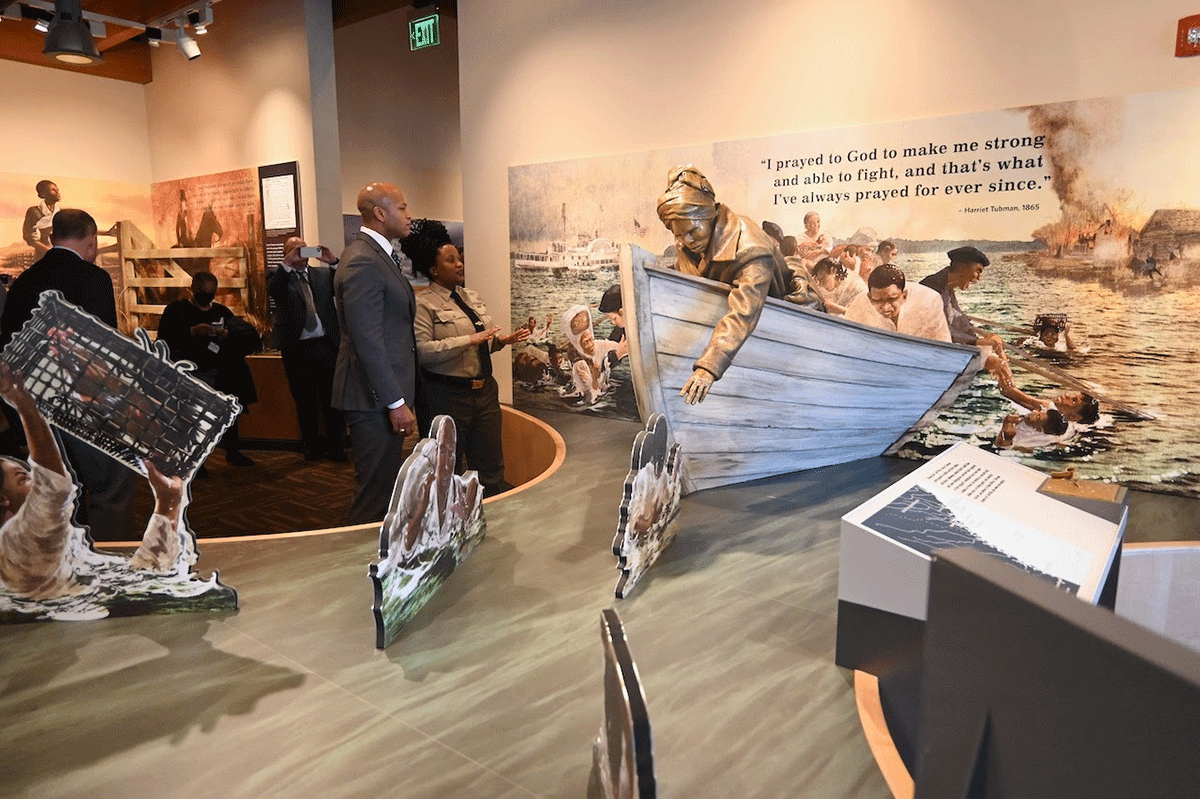
Moore joined local, state and federal partners at the Harriet Tubman Underground Railroad Visitor Center in Dorchester County Tuesday to announce the house's discovery. Finding the structure — believed to be that of an enslaved overseer, possibly Jerry Manokey — follows the April 2021 news of the discovery of the home of Ben Ross, Tubman’s father.
“Harriet Tubman’s birthplace is sacred ground, and this discovery is part of our ongoing commitment to preserve the legacy of those who lived here,” Gov. Moore said. “The find reveals untold stories of the past that help us both understand the history we share and inspire us to make a better future.”,>
,>
Related: Finding Harriet Tubman's Early Home Part Of MD Underground Series
Last summer, when state officials unveiled artifacts found at the cabin site owned by Tubman's father, Schablitsky said the abolitionist would have spent time there as a child.
And "she would've come back and been living here with her father in her teenage years, working alongside him. This was the opportunity she had to learn about how to navigate and survive in the wetlands and the woods. We believe this experience was able to benefit her when she began to move people to freedom."
“Archaeologists are able to discover artifacts, each one representing a piece of a puzzle,” said Tina Wyatt, Harriet Tubman’s great-great-great-grandniece and Ben Ross’s great-great-great-great-granddaughter. “When gathered together, studied, and analyzed, we are then able to provide an important tangible experience, allowing a real-life connection between ancestors and descendants.”
The findings will soon be on display at the visitor center. Maryland Department of Transportation archaeologists will continue their research on the Eastern Shore this spring and summer and plan to revisit both Ben Ross’s homesite and the overseer’s quarters.
$20 Bill Debate
After a four-year delay by the Trump administration, efforts to put Tubman on the $20 bill have resurfaced as President Joe Biden's appointees head federal agencies.
The move to replace President Andrew Jackson on the front of $20 bills with onetime slave Tubman in 2020 was put on hold while Donald Trump was in office.
Preserving Tubman's Legacy, Early Years
Sharing and telling the story of Harriet Tubman has been a multi-year partnership between local, state and federal agencies, including the Maryland Department of Transportation, the Maryland Department of Natural Resources, the Maryland Department of Commerce, Dorchester County, the U.S. Department of Transportation Federal Highway Administration’s National Scenic Byways Program and the U.S. Department of Interior’s National Park Service and Fish and Wildlife Service.
The partnerships have led to international recognition of the Harriet Tubman Underground Railroad Visitor Center, Harriet Tubman Underground Railroad Byway, and the Eastern Shore as must-see destinations.
“This discovery is further validation of why Maryland is ‘The Most Powerful Underground Railroad Storytelling Destination in the World,’ a distinction that builds on the remarkable history of our state,” said Maryland Commerce Acting Secretary Kevin A. Anderson. “Through her powerful legacy, Tubman inspires thousands to visit Maryland each year to learn more about her life here.”
“As stewards of our state’s natural spaces and many of its cultural and historic treasures, we are always pleased to present new discoveries that yield more knowledge about the life and world of Harriet Tubman,” said Acting Maryland Department of Natural Resources Secretary Josh Kurtz. “We want to thank Dr. Schablitsky and her team for their great work in helping our rangers bring to life the incredible history of Harriett Tubman.”
Since opening in 2017, the Harriet Tubman Underground Railroad Visitor Center has welcomed 350,000 guests from all 50 states and more than 60 countries and territories, averaging about 70,000 visitors annually. The visitor center is honoring the famed abolitionist with a series of events on Saturdays in February during Black History Month. Learn more about the programs here.
Get more local news delivered straight to your inbox. Sign up for free Patch newsletters and alerts.