Politics & Government
Battles Over Data Centers Intensify In The State House And Communities
Activists launch petitions against proposed data centers as lawmakers work to regulate them.
April 20, 2026
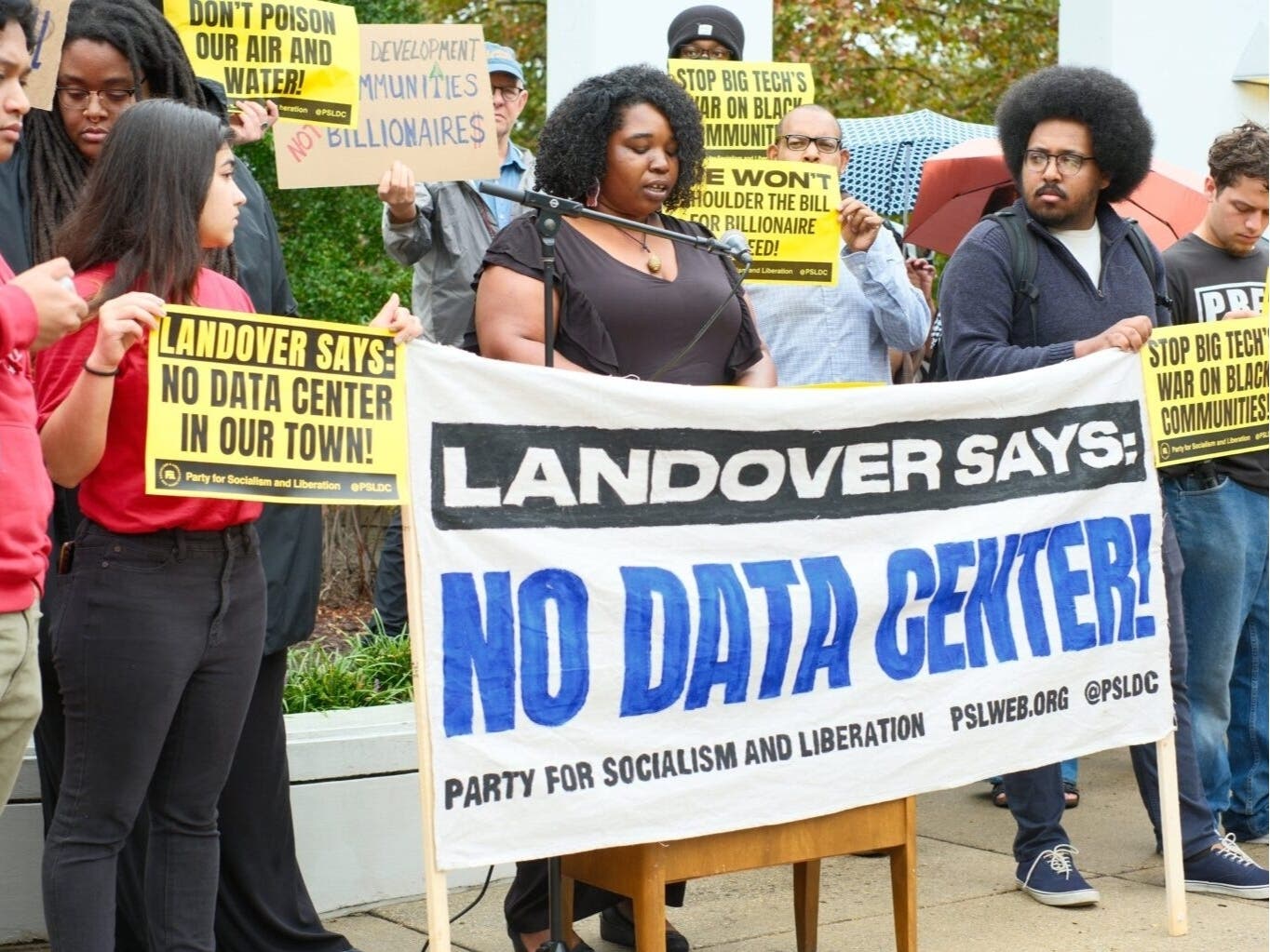
Taylor Frazier McCollum had never gotten deeply involved in local politics until she learned of plans for a data center at the site of the former Landover Mall. She started a petition to fight the proposal and just two weeks after posting it on Instagram, more than 20,000 people signed it.
Find out what's happening in Across Marylandfor free with the latest updates from Patch.
Frazier McCollum, whose family lives less than a mile from the site in Prince George’s County, said she’s worried about the noise, light and environmental impacts, which she called “war weapons.”
“We already deal with so many issues with pollution and things of that nature inside the Beltway,’’ Frazier McCollum said. “It would be unfortunate to bring even more of that to our community.”
Find out what's happening in Across Marylandfor free with the latest updates from Patch.
Across Maryland, activists and data center supporters are battling over where and how proposed facilities will be built. Meanwhile, in the State House, lawmakers this session debated how to regulate them and the possible impact they could have on the electric grid. State Democratic leaders, including Gov. Wes Moore, have backed efforts to govern them.
“I’m not saying data centers shouldn’t be built in Maryland, but if they are going to be built, we need more safeguards,” said Del. Julie Palakovich Carr (D-Montgomery).
At least 17 bills related to data centers were introduced this session, according to the General Assembly. Of those, only two passed.
Many states don’t report losses from data center tax breaks, study says
One of the bills, the Utility RELIEF Act, aims to hold utilities and data centers accountable, strengthen the long-term reliability of the state’s energy system and expand clean energy, said House Speaker Joseline Peña-Melnyk, who introduced the legislation.
“Electric demand is rising rapidly — driven in part by the growth of data centers and the digital economy,” Peña-Melnyk, D-Prince George’s and Anne Arundel, said at a press conference in March.
The bill passed on the final day of the legislative session and sent it to Moore, who is expected to sign it.
Lawmakers want “real path” for data centers
Moore has said he would support data center projects if they hire local workers and support their own power needs.
“Data centers are done dictating what rules they will follow,’’ Moore told reporters last week, at a news conference about the Utility RELIEF act. “Under this law, data centers will pay for the grid upgrades that they need, and not the people of the state of Maryland.”
The bill would also expand the data centers that qualify as a “large load customer,” an entity with high energy demands and subject to stricter regulations.
The bill also incentivizes data centers to bring their own new clean energy, adhere to an energy efficiency program and give some protection to ratepayers, Mariah Davis of the Marylanders for Data Center Reform Coalition said during a webinar earlier this month.
The coalition and some lawmakers supported other bills that would have further regulated data centers, including one proposed by Palakovich Carr that aimed to repeal tax exemptions for data centers. Del. Lorig Charkoudian (D-Montgomery) had introduced legislation she said would have allowed “good” data centers that create their own power to “jump ahead in the line” of data centers to be built.
Both bills failed.
There’s a “real path” for getting the “good stuff” out of data centers without harming communities, the planet or ratepayers, Charkoudian said.
‘We’re going to be in for a fight’
Supporters of data centers point to economic benefits.
Kelly Schulz, CEO of the Maryland Tech Council, said some benefits of data centers include job creation, local tax revenue, the likelihood of innovation and the importance “to move forward in a technology-centered society.”
The council has promoted data centers through its coalition, the Data Center Alliance of Maryland.
Schulz said the council’s goal is “to educate people on what actually happens in the data center world,” and help them understand “the good, positive things that do come out of data centers.”
Elizabeth Bauer, a community activist in Frederick County, called the council’s position that property values near data centers rise “hogwash.”
“I just can’t imagine that having a data center near your house is going to increase your property value,” she said.
Bauer said state legislators should consider more than just generating revenue. “It’s all about the revenue, but they’re not paying any attention to the expenses that go along with it,” she said.
Frederick County issued an ordinance in January allowing data centers to be built on rural legacy and priority preservation land, Bauer said. Bauer and Envision, an activist group, organized a petition to allow citizens to vote on the ordinance. The petition has more than 20,000 signatures, according to Envision’s website.
“Our farmers are being attacked in so many ways by the state of Maryland,” Bauer said.
Schulz, who said she was placed on a work group for an ongoing data center construction project in Frederick County, said the local government will reap benefits.
The county “will receive estimated amounts of over $200 million annually in tax revenues from that one project,” she said. That’s about 40% of the county’s overall budget, she said.
Bauer said she expects a legal battle with Frederick County over the referendum.
“We’re going to be in for a fight,” she said.
Meanwhile, Frazier McCollum, the activist from Prince George’s County, said she wants politicians to pay attention to the 23,000 people who signed her petition.
“We are going to use our voting power to vote for those that support our cause, which is to put a moratorium or ban data centers for a longer period of time statewide,” she said.
— Capital News Service reporter Sam Gauntt contributed to this report. Capital News Service is a student-staffed reporting service operated by the University of Maryland’s Philip Merrill College of Journalism. Stories are available at the CNS site and may be reprinted as long as credit is given to Capital News Service and, most importantly, to the students who produced the work.
Maryland Matters is part of States Newsroom, a network of news bureaus supported by grants and a coalition of donors as a 501(c)(3) public charity. Maryland Matters maintains editorial independence. Contact Editor Steve Crane for questions: scrane@marylandmatters.org. Follow Maryland Matters on Facebook and Twitter.