Community Corner
Chesapeake Crab Population Rallies A Bit From Long-Term Slump
But female crabs, key to reproduction, continue to decline.
By Timothy B. Wheeler, Bay Journal, Maryland Matters
May 28, 2026
The dredge survey conducted last winter by the Maryland Department of Natural Resources (DNR) and Virginia Institute of Marine Science found that the Chesapeake Bay’s crab population — especially the young crustaceans — have rebounded from a protracted slump, despite an unusually harsh winter.
Find out what's happening in Across Marylandfor free with the latest updates from Patch.
The survey, which samples 1,500 sites throughout the bay and its rivers from December to March, estimated the overall population at 349 million crabs this year. That is a 46% increase from the 2025 total of 238 million. The new figure remains just below the long-term average.
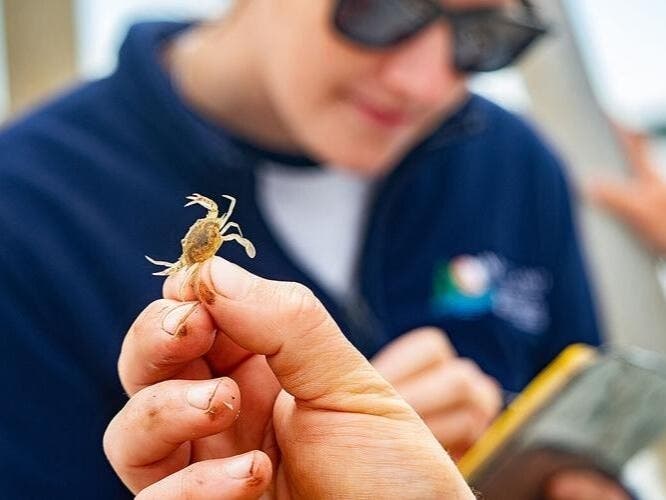
Two-thirds of that total, about 228 million, were juvenile crabs, a 121% increase over last year’s tally. The 2025 survey recorded the second-lowest abundance of young ever found.
Find out what's happening in Across Marylandfor free with the latest updates from Patch.
Adult male crabs also recovered from last year’s record-low level. The survey estimated 37 million “jimmies,” as watermen call them, a 42% increase from 2025.
But the number of spawning-age females, the linchpin of the overall crab population, hit its lowest level since 2014. The survey estimated 81 million of them, a 25% decrease from 2025 and the third straight year of decline.
Though far below their desired abundance, females — or “sooks”— are still numerous enough to produce a bumper crop of offspring, given the right environmental conditions. But their decline is getting close to the threshold fishery managers have set for imposing new harvest restrictions.
The survey, which Maryland and Virginia have conducted jointly since 1990, is widely regarded as a barometer of the bay’s crab population — and a forecast of the commercial and recreational harvest for the coming season. Crews drag a dredge across the bottom to collect and record the sex and size of crabs found slumbering there during cold weather.
“It’s very encouraging to see higher levels of blue crabs and juveniles, especially after a few years of lower juvenile recruitment,” said Mandy Bromilow, DNR’s blue crab program manager. “However, we’ll still have to remain vigilant about the population, given that we have seen declines since 2011.”
Last winter, with colder-than-normal temperatures, proved harder than usual on crabs slumbering on the Bay bottom. The survey found that about 20% of adult males and 12% of adult females died, roughly double the average overwintering mortality of the past three decades. Yet crabs have rebounded in the past, managers noted, after similarly large winter die-offs.
With these results, the overall population and number of young reached their highest levels since 2019. The following year’s survey was the beginning of a multiyear slump, which prompted scientists to launch a comprehensive study of the bay’s crab population and what might explain its subpar abundance.
Blue crab reproduction varies from year to year because of several factors, including weather, ocean conditions, available nursery habitat and predation by fish and even other crabs. But despite ups and downs, the number of young crabs seen by the annual surveys for more than a decade has lagged well behind what scientists expected, given the harvest limits adopted in 2009 to maintain a robust stock of female crabs to produce new generations.
That long-term assessment, a draft of which was recently released, found that the bay’s crab population has declined by about half since 2010, with no clear explanation. It found that the growing population of invasive blue catfish in the bay was not the main culprit, estimating that they are consuming only about 8% of the little juvenile crabs.
While this year’s survey might suggest the bay’s crab population is on the mend, Mike Wilberg, who led the team of crab researchers doing the stock assessment, cautioned against easing harvest limits.
“My main takeaway from this assessment is that now is not the time to liberalize regulations,” said Wilberg, a fisheries scientist with the Chesapeake Biological Laboratory of the University of Maryland Center for Environmental Science.
The winter dredge survey results have done nothing to change his view, he said. The annual tally has shown increases in juvenile crabs before, he pointed out, yet they didn’t make it to maturity for reasons that remain unclear.
“The survey has uncertainty,” he added, “and I would want to make sure the increase is real.” To feel confident of a turnaround, he said he would want to see several years of robust juvenile numbers accompanied by increases in older male and female crabs.
The Chesapeake Bay Foundation said the winter survey showed a “promising bump” in the number of juvenile and adult male crabs, despite a long-term concerning trend for the population.
“This could be a preview for bountiful crabbing businesses and crab feasts this summer,” Chris Moore, CBF’s Virginia executive director said.
“However, the Bay’s important adult female crabs experienced another year of decline. And there’s still immense uncertainty surrounding the health of blue crabs in the Chesapeake Bay,” Moore said.

No bigger than a fingernail, little juvenile crabs staged a big comeback in the 2026 winter dredge survey, from their second-lowest level ever in 2025. (Photo by Dave Harp/Chesapeake Bay Journal)
Maryland Matters is part of States Newsroom, a network of news bureaus supported by grants and a coalition of donors as a 501(c)(3) public charity. Maryland Matters maintains editorial independence. Contact Editor Steve Crane for questions: scrane@marylandmatters.org. Follow Maryland Matters on Facebook and Twitter.