Politics & Government
Environmental Advocates Seek Wider Cleanup After Potomac River Sewage Spill
DC Water officials say that further overflows may still occur until a temporary solution is completed, likely in mid-March.
March 4, 2026
The cleanup of the massive sewage spill in the Cabin John area of Montgomery County needs to be much broader than what the owner of the ruptured pipe has proposed, environmental groups say.
Find out what's happening in Across Marylandfor free with the latest updates from Patch.
So far, DC Water, the public utility that owns and operates the sewer line, has pledged to concentrate its efforts in the immediate area of the spill and a few dozen yards offshore into the Potomac. Several advocacy groups are demanding more to be done.
“This region is subject to combined sewage overflows all the time, of course,” said Evan Quinter, water quality coordinator for the Potomac Riverkeeper Network. But the Potomac Interceptor break, he added, was “at this intensity and scale that we have never really seen before. So, I think it warrants a response that is matching the crisis.”
Find out what's happening in Across Marylandfor free with the latest updates from Patch.
The pipe collapsed on Jan. 19 just east of the Capital Beltway, between the Potomac and the Clara Barton Parkway. Untreated sewage gushed out uncontrollably for nearly a week until workers rigged up an emergency diversion. As much as 300 million gallons of waste ultimately escaped, according to the Maryland Department of the Environment.
No drinking water has been impacted by the spill, authorities say. The region’s water intake pipes are located at Great Falls upstream from the collapse site.
DC Water officials say that further overflows may still occur until a temporary solution is completed, likely in mid-March. A permanent fix won’t be in place until about nine months after that, they say.
The Potomac Interceptor carries sewage for 54 miles from the Dulles Airport area in Northern Virginia to the Blue Plains Advanced Wastewater Treatment Plant in Southeast D.C. While the cause of the collapse is still under investigation, DC Water officials say the disaster is a reminder that much of the area’s infrastructure is aging.
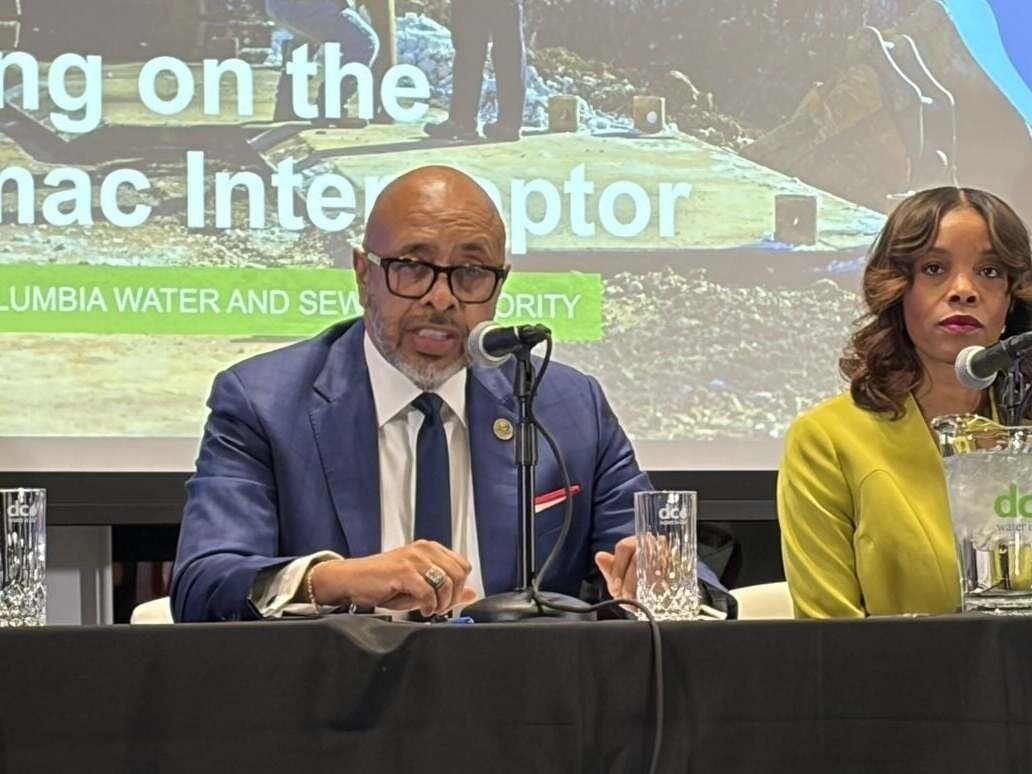
“The Potomac Interceptor is more than 60 years old, and its failure underscores the need for sustained investment,” said DC Water CEO David Gadis at a meeting hosted at the utility’s D.C. headquarters on Feb. 25, more than a month after the spill. A panel of officials with the utility and the District of Columbia government addressed the situation.
Gadis pointed out that the utility was already planning a 10-year, $625 million upgrade to sections of the line, including the site of the rupture, to prevent just the kind of failure that occurred.
“Going forward,” he added, “we are committed to looking at all sections of … the Potomac Interceptor and also reevaluating their structural and integrity to ensure an event like this one does not happen again.”
A group of 14 Democratic House members from the region signed a Feb. 24 letter calling on the Republican-controlled Congress to authorize funding for the Potomac Interceptor modernization project.
President Donald Trump approved D.C. Mayor Muriel Bowser’s request for federal disaster assistance last month, ushering in the support of Federal Emergency Management Agency equipment and personnel. The move also allows the federal government to pay up to 75% of repair costs. DC Water estimates that fixing the pipe and cleaning up after the spill will cost $20 million.
As of early March, DC Water had yet to finalize a cleanup plan. But at the Feb. 25 meeting, utility representatives said they were looking forward to it being completed soon. They had retained an environmental consultant to assess site conditions, and they were working with state and federal authorities on the methods and scope.
The first phase of the rehabilitation is expected to address what officials are calling the “uncontrolled flow areas.” That includes the drainage channel next to the rupture site, the small tributary it flows into and the narrow portion of the Potomac River between the shoreline and Swainson Island, said Amanda Zander, DC Water’s environmental oversight manager.
Then, the cleanup will turn to the C&O Canal. While work has been underway on the emergency fix, the utility has been diverting the sewage around the broken section of pipe by pumping it into and out of an ordinarily dry section of the canal.
The canal, a historic park operated by the National Park Service, is a popular destination for hiking, biking and fishing.
“We understand how important this area is to everyone and how much people are going to want to recreate, especially if we get into warmer months,” Zander said, adding that the rehabilitation will include restoring the historic lock at the site.
The U.S. Army Corps of Engineers has installed “diversions” around the rupture site to keep stormwater runoff from causing more overflows. Workers are also installing a pump at the head of the Potomac tributary to block any sewage from making its way into the river, Zander said.
Meanwhile, environmental groups called on DC Water to include their input in the rehabilitation plan. And they pushed for the final version of the proposal to go farther – literally.
“I am surprised that the remediation plan does not go beyond Swainson Island or where the sewage has directly entered the Potomac River,” Quinter said after the meeting. “It does not seem to be addressing the impacts upon the Potomac River.”
DC Water should gather experts to determine how far the cleanup should reach, he said, adding that the economic impacts to the charter boat and seafood industries likely will extend far downstream.
The utility still hasn’t answered some basic questions about the remediation, said Katie Blackman, vice president of strategic programs and partnerships for the Potomac Conservancy.
“It’s so hard to comment on because we’ve gotten the beginnings of plans, but we have not seen specific plans for how they’re going to address this long term,” she said. “What’s going to happen with soil remediation along the C&O Canal? What’s going to happen with these bacterial levels in sediment? How is this going to affect fish populations?”
More than a month after the spill began, E. coli levels had returned to the typical range in the river, officials said. The D.C. Health Department on Monday lifted an advisory that had urged the public to avoid recreational contact with the water. The longstanding legal prohibition on swimming in the Potomac remains in place.