Politics & Government
Hurry Up And Wait In The Senate, Debating Charlie Kirk, And Bouchat's Last Bill, In Political Notes
After announcing last year that he would not seek reelection, Del. Christopher Eric Bouchat announced that he planned to run for governor.
March 17, 2026
In retrospect, they might wish they had allowed for a day’s delay.
Find out what's happening in Across Marylandfor free with the latest updates from Patch.
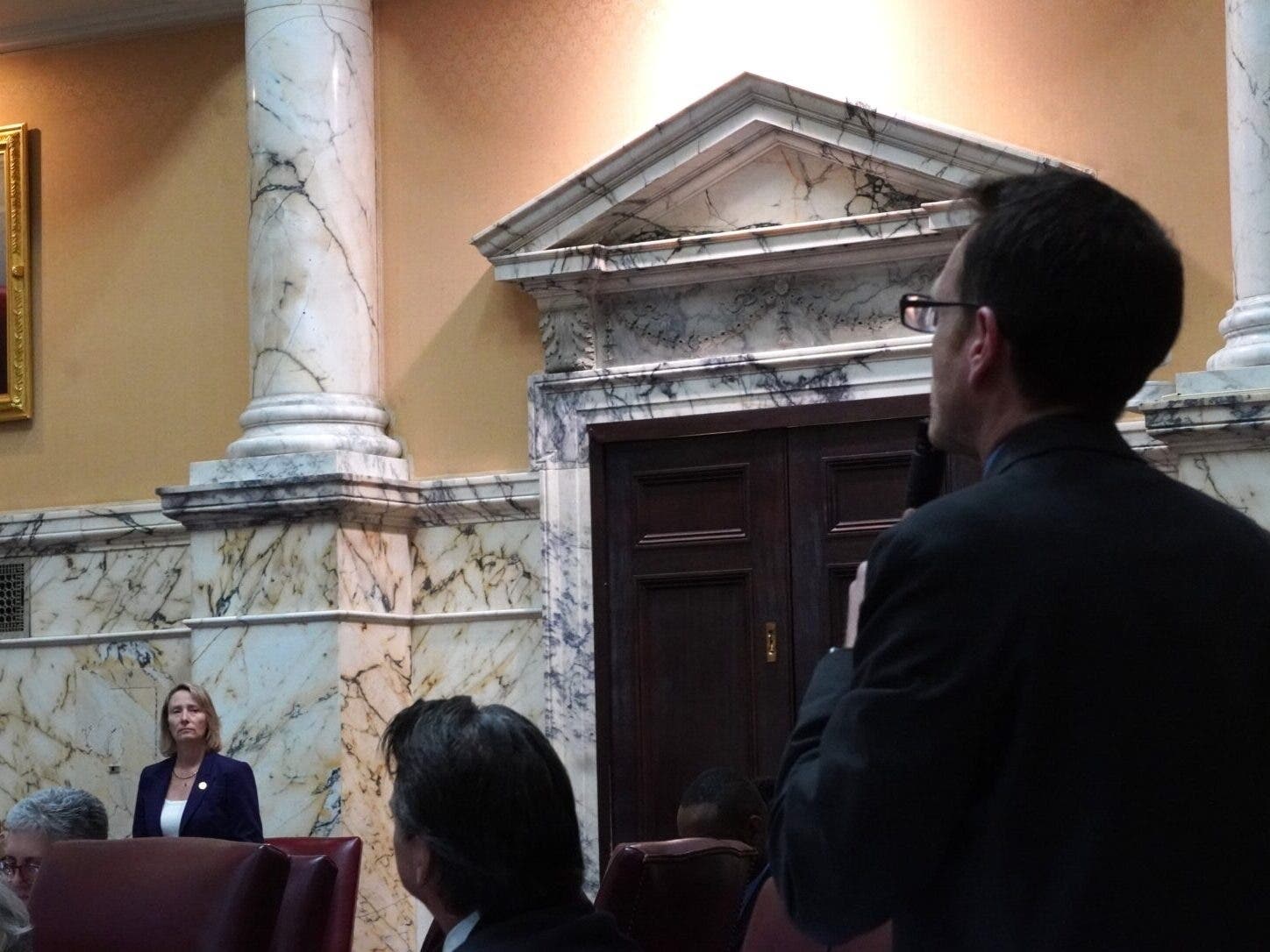
When they gathered Monday night, most senators probably thought the biggest item on the agenda in the mostly empty State House — emptied by Monday’s storms, which caused visitors to stay away and the House to cancel its session for the day — would be the budget bill, which was presented by Budget and Taxation Committee Chair Guy Guzzone (D-Howard) before being put on hold for a day.
That took just a shade over 9 minutes.
Find out what's happening in Across Marylandfor free with the latest updates from Patch.
For the next 45 minutes, senators were held captive by questions over Senate Bill 334, a measure that would outlaw the sale of “machine-gun convertible pistols” in the state.
The debate began when Senate Minority Whip Justin Ready (R-Frederick and Carroll) asked to hold the bill for a day so that Republican senators could draft amendments. It was impossible to do so Monday, they said, because the amendments office was essentially closed by the threatened storm.
Sen. Sara Love (D-Montgomery), the lead sponsor of the bill, objected to the delay, noting that “this bill was posted last Wednesday, so they [Republicans] have had quite a bit of time to work on amendments.”
So the questions began.
The bill would ban the sale of handguns with “cruciform trigger bars” that allow a gun to be converted to automatic fire using “common household tools.” But Ready noted that it’s already illegal to convert semiautomatic weapons into automatic weapons, and asked, “So this bill makes it more illegal?”
“Not exactly,” Love said. “Law enforcement is finding more and more of these guns. So, the fact that the switch is illegal and to convert the gun is illegal is not getting at the root of the problem. The root of the problem is that this particular design is so easily convertible and … that’s why we need to address it.”
Sen. Mike McKay (R-Western Maryland) asked if anyone had asked for an attorney general’s opinion on the bill, Love said she had requested a confidential opinion, as any lawmaker can. McKay said the letter should have been shared with the Judicial Proceedings Committee, of which he and Love are members, but asked, “Did that confidential letter say that it was clearly unconstitutional?”
“It did not,” Love said.
“What did it say, please?” McKay asked.
“It said that this bill was not clearly unconstitutional, and that it was clearly defensible under the Second Amendment and under Supreme Court precedent,” Love said.
McKay renewed the request to delay the bill, saying senators should have a chance to see the attorney general’s letter, but Senate President Bill Ferguson (D-Baltimore City) said the bill and its amendments were being debated on second reading. After all that, it was approved and sent for a final vote, probably sometime this week.
Charlie Kirk, still a lightning rod
While storms canceled the full House session Monday, some delegates still held virtual meetings — some more lively than others.
That included about a 30-minute debate by the House Rules and Executive Nominations Committee on House Joint Resolution 1, sponsored by House Minority Whip Jesse Pippy (R-Frederick). The resolution honors Charlie Kirk, the conservative commentator shot and killed Sept. 10 at Utah Valley University. Pippy’s resolution describes Kirk as a “courageous American patriot” who died “in an act of political violence.”
Resolution honoring Charlie Kirk passed in US House in bipartisan vote
“The resolution says it condemns the assassination,” Pippy said. “It calls upon leaders to condemn all forms of political violence, regardless of political ideology. It calls upon people to recommit to peaceful debate and respect one another.
“I didn’t put this in because I’m a huge follower of everything that’s controversial. I put it in because I saw an opportunity where we can condemn political violence, and I think people should be able to speak what’s on their mind, even if we disagree,” he said.
He said the resolution mirrors a bipartisan measure approved by Congress shortly after Kirk was killed.
No one on the committee had a problem condemning violence. But they parted ways with Pippy on Kirk.
“What you presented was phenomenal, but that’s not what this bill did, and that’s not what this bill does,” said Del. C.T. Wilson (D-Charles). He cited a few controversial statements Kirk made, such as these on “The Charlie Kirk Show” in March 2024: “The American Democrat Party hates this country. They want to see it collapse. They love it when America becomes less white.”
Wilson, who has three African-American daughters, told Pippy, “I refuse to honor a man who helped drive a wedge between my people, my community, and everyone around.”
Del. Heather Bagnall (D-Anne Arundel) asked if Pippy would support an amended version “without making references to a controversial figure who you explained you weren’t attempting to honor but was in the original language.” In other words, taking out Kirk’s name.
Pippy said he would, but reminded Bagnall and others that most of Maryland’s mostly Democratic congressional delegation voted for the congressional resolution. Only Reps. Glenn Ivey (D-4th) and Kweisi Mfume (D-7th) opposed it.
Del. Jheanelle Wilkins (D-Montgomery) said everyone would support the resolution if it strictly focused on condemning political violence.
“I count about 21 paragraphs in this resolution, and all but six of those paragraphs speak to Charlie Kirk,” she said. “I am unequivocally opposed to the content of this House Joint Resolution 1 titled honoring Charlie Kirk.”
The committee did not vote to advance Pippy’s resolution.
Bouchat’s last bill
Before the Rules Committee debated Kirk, it heard the last bill to be presented this year by Del. Christopher Eric Bouchat (R-Frederick and Carroll), who is not seeking reelection after this year.

Del. Christopher Eric Bouchat (R-Frederick and Carroll) sports a Maryland flag-themed top hat on opening day of the 2024 session. (File photo by Bryan P. Sears/Maryland Matters)
House Bill 56 would create 141 single-member delegate districts, instead of the three-member districts that now account for many of the House seats, and would call for a citizen-run convention to apportion and redraw the state’s legislative and congressional maps. The convention would be made up of 188 members (the same as the number of legislators in the General Assembly) elected on a nonpartisan basis, with each county guaranteed at least three convention seats.
One main part of the bill proposes to eliminate the current multi-member district structure (usually three delegates and one senator) and change them into single-member districts.
This represents at least the third time Bouchat has sponsored the bill.
“What this bill does is turns the redistricting process completely over to our citizens, and that’s a pretty radical concept,” Bouchat said. “I think this solves a tremendous problem for us and takes a responsibility into our hands and turns it completely over to the people.”
Lee Bradshaw, a member of the Maryland Forward Party, testified in support of the legislation because it would get eliminate gerrymandering, among other reasons.
“We support direct democracy whenever possible,” he said.
After announcing last year that he would not seek reelection, Bouchat announced that he planned to run for governor. But he bowed out of the race last month.
“This is my last bill of my last term, so it’s special. Let’s hope it’s historical,” Bouchat said Monday.