Politics & Government
Judge Dismisses Temporary Restraining Order On Mail-In Ballot Complaint
The majority of plaintiffs are Republican candidates.
June 26, 2026
An Anne Arundel County judge has denied a temporary restraining order to establish guidelines to canvass mail-in ballots.
Find out what's happening in Across Marylandfor free with the latest updates from Patch.
Circuit Court Judge Robert J. Thompson’s opinion released Thursday says that the complaint filed by several Republican candidates and a group called SecuretheVOTEMD would not “have a great likelihood of success on the merits in this matter.”
The complaint was filed Tuesday, Election Day, and the plaintiffs included 10 Republicans who sought congressional, state and county offices.
Find out what's happening in Across Marylandfor free with the latest updates from Patch.
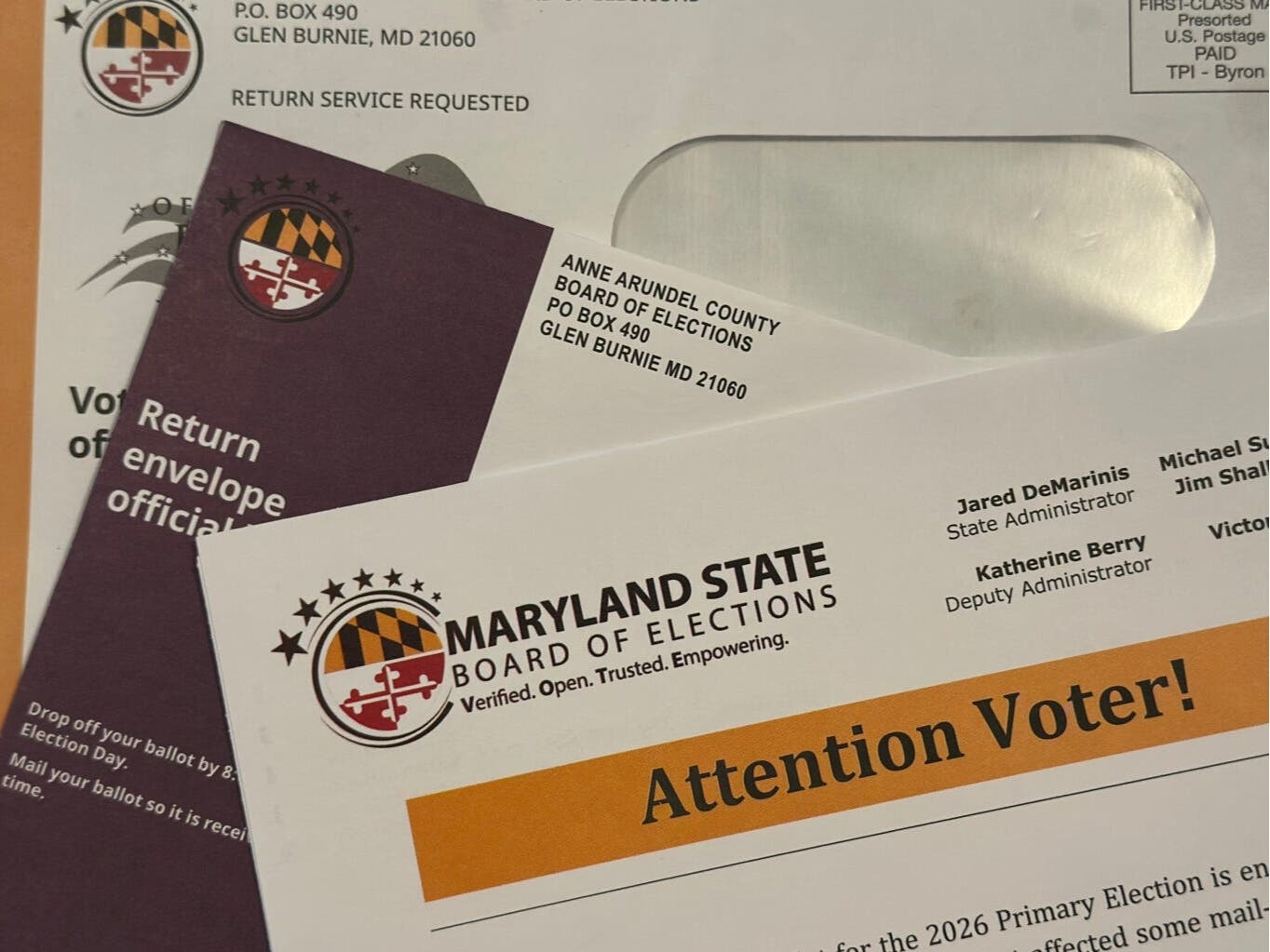
One of the plaintiffs, Del. Robin Grammer (R-Baltimore County), said Monday, ahead of the filing, that the complaint stemmed from what he called a mail-in ballot “fiasco” after the state Board of Elections had to replace more than 437,000 mail-in ballots.
The complaint sought for canvassing to be shown via livestream video and to allow observers to watch ballots to be counted.
With the specific exception of livestream, the judge wrote that the general public, candidates and their representatives can watch ballots being counted because they “are already enshrined into law.”
“While most of the facts are not in dispute in this case, and, while conspiracy theories abound, the court finds that the printing and distribution of erroneous ballots was an honest mistake,” the judge wrote. “Those replacement ballots indicated that the previous ballots should not be used. In addition, SBE followed up with another mailing to those same voters notifying them of the mistake, and urging them to vote only the corrected ballots.”
A representative with Secure the Vote didn’t respond to a request for comment.
The complaint was briefly mentioned Thursday afternoon during an online state Board of Elections meeting.
“There’s no temporary restraining order enforced and the state board and the local boards are free to continue canvassing mail-in ballots as they have been, as guided by this board,” said David Korbin, an assistant attorney general working with the board. “What will happen next, we’ll see.”
Diane Butler, one of the five members on the state board, said the state should provide some guidance when it comes to canvassing after she received some complaints.
Board Vice Chair Jim Shalleck asked state Board of Elections Administrator Jared DeMarinis if there’s a definition of “reasonable distance” where observers can watch ballots being counted at local election offices and “have closer access.”
DeMarinis said there are state regulations when it comes to observing the counting of mail-in and provisional ballots. A specific distance isn’t specified because each county and Baltimore City have a local board of canvassers that are responsible to “maintaining order and safeguard all records and documents.”
“It is open and transparent,” DeMarinis said.
Lose complaint, win primary
As for the plaintiffs in the suit, some may continue to use so-called “election integrity” as part of their platforms with expectations to garner the Republican nomination this week and face opponents in the Nov. 3 general election.
According to the state Board of Elections on Thursday night, Grammer and Del. Robert Long were two of the top three vote-getters in the Republican primary to represent District 6 in Baltimore County. Fellow Republican Del. Ric Metzgar, who isn’t part of the lawsuit, was the other candidate in the top three. They are anticipated to face Democrats Megan Ann Mioduszewski, Rayneika Robinson and Artus W. Huffman.
Here’s how the other plaintiffs fared:
- Baltimore County resident Patrick Dyer is expected to receive the Republican nomination for the county executive position after being up by more than 7,000 votes. Dyer could face Baltimore County Councilmember Julian Jones, who was ahead by nearly 7,000 votes for the Democratic nomination.
- Another Baltimore County resident, Jeffry McDonald, also appears to have easily won the Republican nomination with about 67% of the vote in the state delegate race to represent District 42B. McDonald’s general election opponent will be Del. Michele Guyton, who ran unopposed for the Democratic nomination.
- Kevin Ford was the top vote-getter in the Republican state Senate primary to represent District 42 which straddles parts of Baltimore and Carroll counties. As of Thursday night, Ford received 3,039 votes in Baltimore County and 1,993 votes in Carroll County, for a total of 5,032. He is expected to face Stephanie Popescu, who was the top vote-getter for the Democratic nomination with a total vote tally of 3,780. The winner will replace Republican Sen. Chris West, who decided not to seek reelection after being in the Senate since January 2019.
- Adam Wood was unsuccessful against Ford in seeking the Republican nomination to represent District 42. Wood was in second place in Carroll County, but third and last place in Baltimore County.
- Former Baltimore County Republican delegate Nino Mangione easily won the Republican nomination for the County Council District 5 seat. Mangione will face Democrat Shawn McIntosh who ran unopposed.
- Cheryl Riley was in first place with nearly 2,600 votes, or about 44% of the total vote, to receive the GOP nomination for the 8th Congressional District. Once all votes are counted and certified by July 6, Riley’s Democratic opponent will be Rep. Jamie Raskin, who easily won the Democratic nomination ahead by more than 60,000 votes.
- Sallie Taylor, the lead plaintiff in the lawsuit, sought one of the three Republican spots for a delegate in Carroll County. She was in fourth and last place with 4,734 votes and behind the third-place candidate by about 2,400 votes.
- Brigitta Mullican was one of two top vote getters to represent Montgomery County’s Republican Central Committee’s District 17.
- Maryland Matters is part of States Newsroom, a network of news bureaus supported by grants and a coalition of donors as a 501(c)(3) public charity. Maryland Matters maintains editorial independence. Contact Editor Steve Crane for questions: scrane@marylandmatters.org. Follow Maryland Matters on Facebook and Twitter.