Politics & Government
Maryland Geothermal Energy Program Faces Delays Amid Cost Concerns
Utility companies' cost estimates are 'not only exorbitant, but speculative,' regulators say.
July 28, 2026
A program to install geothermal energy systems in several Maryland housing complexes is facing delays amid concerns about cost-effectiveness, two years after its passage.
Find out what's happening in Across Marylandfor free with the latest updates from Patch.
A 2024 state law required the state’s two largest gas utilities to propose plans for installing the underground energy systems at a few pilot sites. But it also allowed them to pass the costs for the projects onto all of their customers, so long as they got approval from Maryland regulators at the Public Service Commission.
In a December ruling, the commission determined that the proposals from Baltimore Gas & Electric and Washington Gas were “not only exorbitant, but also speculative and therefore carry the possibility of increasing even more.”
Find out what's happening in Across Marylandfor free with the latest updates from Patch.
“At a time when affordability is on the minds of every ratepayer in Maryland, the Commission cannot in good conscience approve pilot programs that are so costly,” the commission wrote.

In its December order, the commission said it planned to hire a consultant to help the two utility companies refine their proposals, and hopefully lower the costs. In a statement to Maryland Matters, commission spokesperson Kathy Fueston said that officials are “in the final stages” of inking a deal with the contractor.
Geothermal systems make use of a network of underground pipes filled with a water-based solution to harness the relatively consistent temperatures below the surface, which range from 40 to 70 degrees Fahrenheit, in order to heat and cool homes. The systems, which already power at least 1,000 Maryland homes, as well as schools and other large buildings, are considered an efficient and eco-friendly alternative — especially to natural gas.
Maryland, which has ambitious goals to reduce its greenhouse gas emissions 60% relative to 2006 levels by 2031, is among a handful of states that have passed legislation allowing gas utilities to build the systems, funded by their customer base, just like the gas infrastructure they construct and maintain. At least one utility-owned system, in Massachusetts, is up and running.
But in Maryland, the delays thus far have frustrated residents of Northwest Park Apartments, a collection of small brick apartment buildings near Silver Spring that Washington Gas proposed to outfit with a new geothermal system. This month, more than 100 residents of the complex filed a letter with the PSC, urging it to expeditiously hire the consultant and move the program forward.
At Northwest Park, a tight-knit group of tenants, many of them immigrants, have campaigned hard to transition their building away from natural gas, alongside community advocates from Action in Montgomery and local environmental groups.
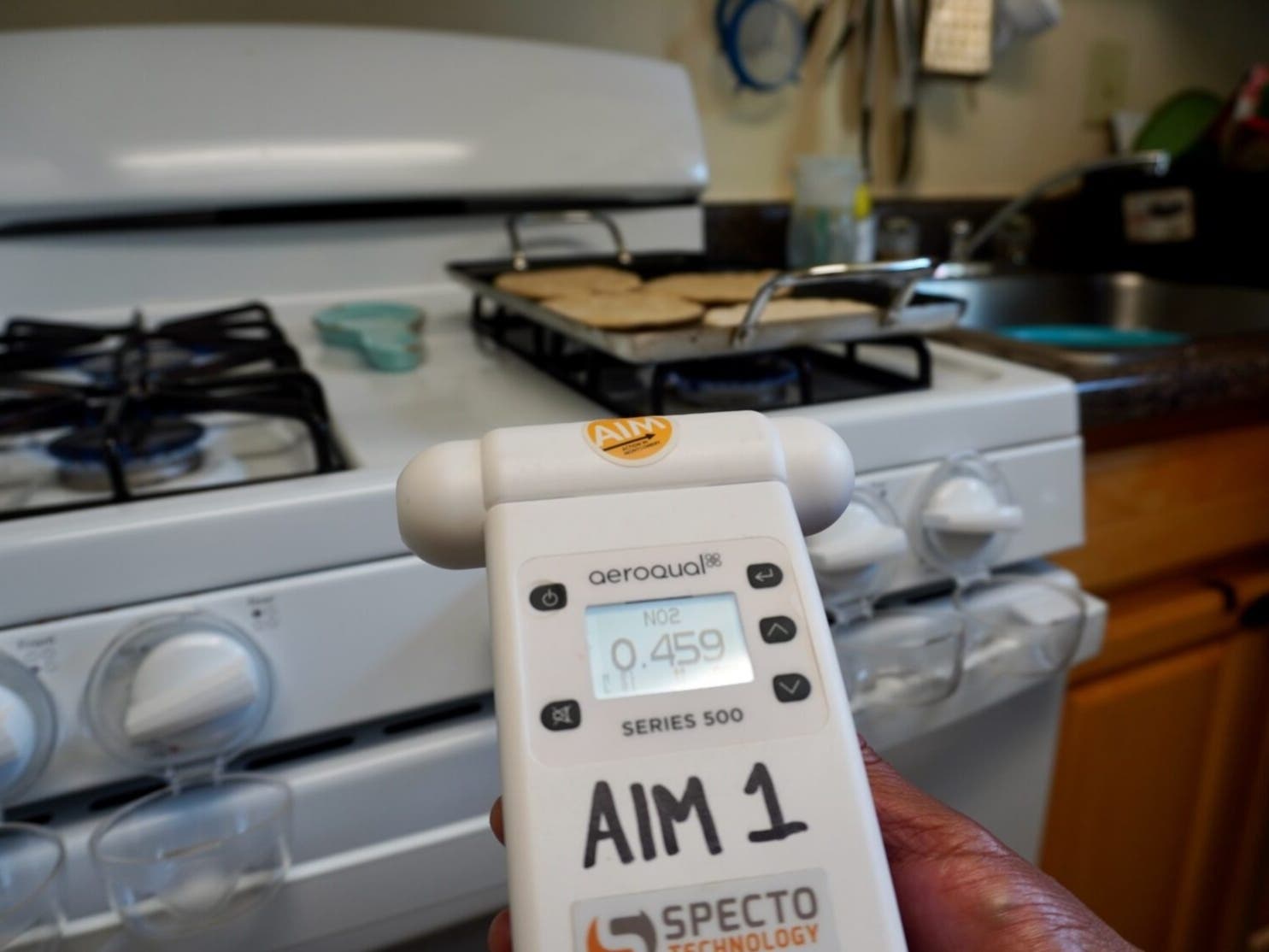
Tenant volunteers wielding handheld nitrogen dioxide testing machines have gone home-to-home throughout the community, turning on gas burners and showing residents the levels of the gas, which is a respiratory irritant, in their homes.
During the demonstrations at Northwest Park, they’ve made copious amounts of homemade tortillas and boxes of mac and cheese, determined not to waste the gas they burn. They contributed their findings to a 2024 report entitled “Cooking up Danger,” released by Beyond Gas DC, a coalition of environmental nonprofits, faith groups and more.

When the volunteers from the apartment complex heard about 2024’s WARMTH Act, which set up the geothermal pilot program, they thought they’d found their saving grace. Here was a program that would transition the whole apartment complex away from natural gas at one time, and provide tenants with new electric appliances — and it came with a way to pay for it.
But although the apartment complex was selected by Washington Gas for the pilot project, progress has been slow.
One volunteer, Lilian Chavarria, who has lived in the complex for 18 years, works by morning cleaning homes, but dedicates her afternoons to the apartment community, conducting the nitrogen dioxide tests around the complex, and often meeting with Washington Gas to discuss the geothermal project.
Sometimes, Chavarria said she wonders it a luxury apartment complex would have received quicker passage through the bureaucratic hoops currently ensnaring the project.
“But we have workers, immigrants and people who — whether you like it or not — are an important base for this country, and for its development. But unfortunately, we’re not seen,” Chavarria said.
Another volunteer, Carolina Morales, who has lived in the complex for 12 years, along with her husband and two sons, said it’s been challenging to watch the delays transpire.
“I feel a bit of frustration. I think all of us feel the same, because we’ve worked really hard for this project to come about,” Morales said. “We’ve worked at the grassroots level, and we’ve been educating our neighbors and telling them the reason for this project — and for the commission not to take it as seriously as we are, it is something that is concerning to us.”
Del. Lorig Charkoudian (D-Montgomery), who sponsored the WARMTH Act, remains hopeful that the costs can be constrained.
“It’s urgent that we make this happen, and I strongly believe we can do it at a lower cost than the cost that the utilities are presenting,” Charkoudian said.
It’s possible the utility companies, having never installed geothermal systems, are “overbuilding,” Charkoudian said. It’s possible there could be creative solutions to reduce cost, like tapping into a geothermal system already online at a school neighboring Northwest Park Apartments. In a December filing with the PSC, Washington Gas noted that it was “actively evaluating a range of potential modifications,” including working with the school system.
Charkoudian noted that the project is critical, despite its cost, which Washington Gas estimated at $40 to $50 million.
“It would be much easier to do this in new construction, but new construction is likely to be higher-income communities,” Charkoudian said. “Doing this as a retrofit in naturally occurring affordable housing is technically the hardest thing to do … and yet it is the equitable and appropriate thing to do.”

After the project is operational, Washington Gas estimated that its nonparticipating customers would see a $5 to $8 increase on their monthly bills. Households using the geothermal energy would transition off the gas system, and simply pay a monthly fee to fund the system.
At Northwest Park, residents would pay $12.50 monthly. At a nearby senior living facility that would also benefit from the pilot, residents would owe $3 monthly and nearby single family homes would owe $30 monthly. But the commission balked at this cost.
In a statement to Maryland Matters, the company wrote that it “recognizes the importance of moving this effort forward.”
“We remain committed to working collaboratively with the Commission, Delegate Charkoudian, community members, and other stakeholders to develop a cost-effective, innovative geothermal pilot that delivers meaningful benefits while supporting Maryland’s energy and affordability objectives,” the statement read.
Baltimore Gas & Electric proposed two projects — one in Columbia, including the Verona at Oakland Mills apartments, two nearby community centers and an ice rink, and a second in Baltimore, including a dormitory building at Coppin State University and the nearby St. Stephen’s Court Apartments.
BGE estimated that the Columbia project would cost about $54.1 million, and the Baltimore project $43.5 million. But it argued that if regulators approved both projects, it could save about $13 million in administrative costs.
The Maryland Office of People’s Counsel, which represents ratepayers, argued that BGE’s proposal included “unreasonable and unjustified” spending, including $7.3 million in “other” operations and maintenance costs and $8.6 million in “other” capital costs. It called for the commission to limit BGE to one project, and limit its budget to $30 million, on par with the Massachusetts project.
BGE argued that the $30 million cap “would require detrimental modifications to the proposed systems and would leave no room for unforeseen costs.”

In a statement, the company noted that it “believes exploring new technologies like geothermal are an important part of Maryland’s energy future, but those efforts must also make sense for customers.”
“Affordability has been a guiding principle throughout this process,” read the statement from a company spokesperson. “We appreciate the Commission’s continued review and remain committed to working collaboratively to identify solutions.”
As regulators debate the future of the pilot program, residents cope with mounting bills, and hope that a future, more efficient, geothermal system could ease their burden.
Morales said she recently had to seek government assistance with her energy costs, after receiving one monthly bill reaching $800. She waited for months, and ultimately received the assistance, she said — but not before her power was cut for two days in the heat of summer, forcing the family to camp out in the living room, beside a pair of open windows.
“It was a very difficult process,” Morales said.
For the residents at Northwest Park, the dangers of natural gas are particularly worrisome. The building lies about two miles from Flower Branch Apartments, where a building exploded in August 2016, killing seven people and injuring dozens more.
They know the painful stories of the victims. One woman who survived the blast came to live at Northwest Park, Chavarria said, and is still unable to walk because of her injuries.
“When the fire happened … I just became more afraid,” she said. “So I said: ‘We need to do something.’”