Politics & Government
Maryland Public Defender Launches Partnership To Improve State's Criminal Justice System
Maryland Public Defender Natasha Dartigue says that Maryland Justice Partnership is not just another task force, but 'a call to action.'
January 13, 2026
Maryland Public Defender Natasha Dartigue stressed that the launch Monday of a new partnership to change the state’s criminal justice system is not just another “task force.”
Find out what's happening in Across Marylandfor free with the latest updates from Patch.
“This launch is a call to action,” Dartigue said at the public defender’s training center in Linthicum Heights. “The work will be difficult at times, and it will be long. We won’t solve the problems in weeks or even months, but as long as we stay committed and keep impacted communities at the center of every decision … we can make significant change in Maryland.”
The launch of the Maryland Justice Partnership, which will be led by the public defender’s office, comes two days before the General Assembly convenes Wednesday for the 90-day legislative session in Annapolis. The timing is intentional: Dartigue said the launch was scheduled now “because we need coordinated implementation as bills move through committee.”
Find out what's happening in Across Marylandfor free with the latest updates from Patch.
The partnership aims to implement recommendations of the Maryland Equitable Justice Collaborative, a historic alliance between the public defender and the Maryland Attorney General’s Office that dissolved Nov. 26, after two years of work.
The group presented 18 recommendations to end mass incarceration that include decreasing use of excessive by police, increasing mental health services in jails and improving the parole process. About three dozen groups of state agencies, law enforcement personnel and nonprofit and community organizations, among others, were part of that collaborative.

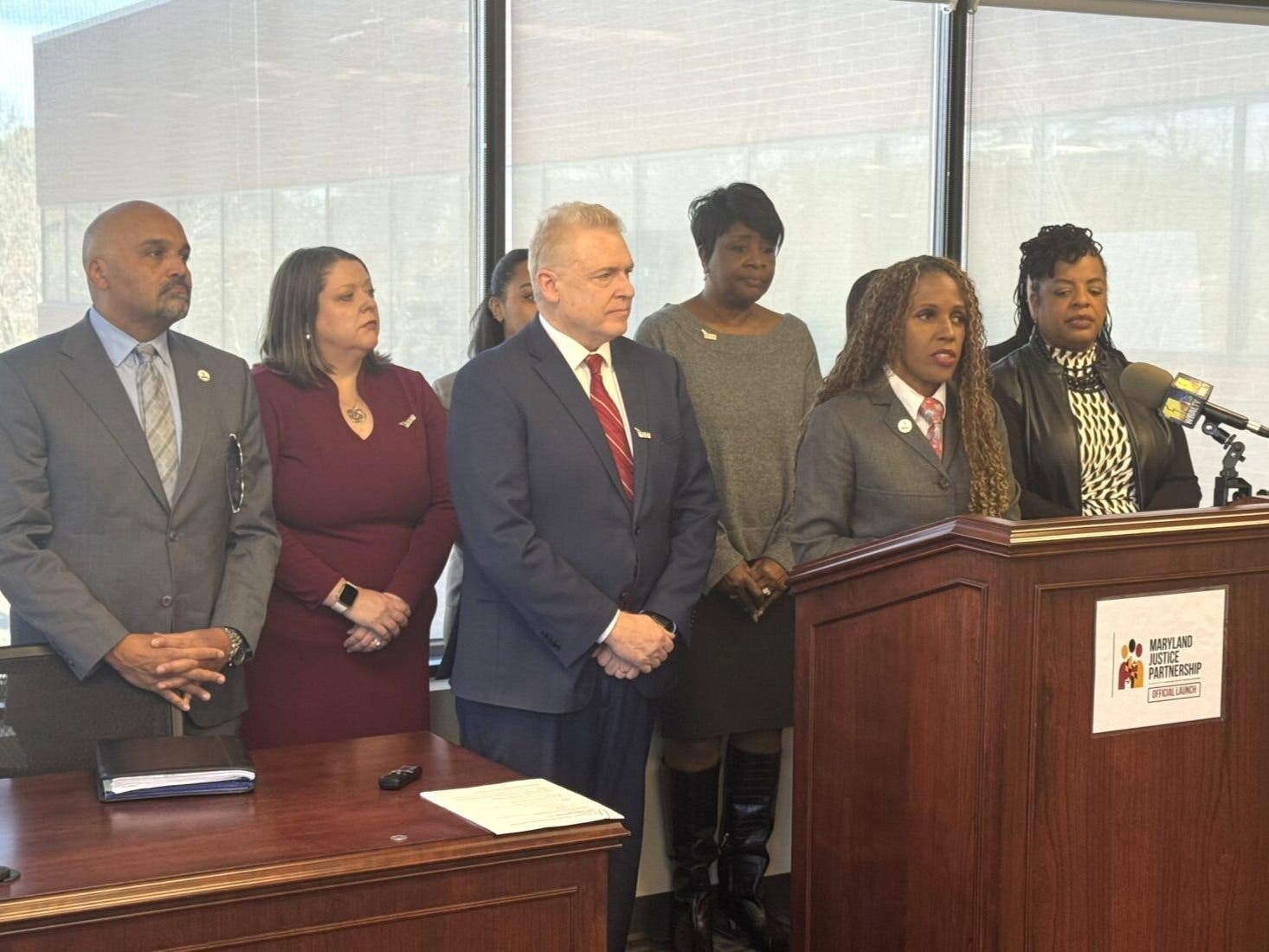
State officials, higher education and community leaders attend the launch of Maryland Justice Partnership at the Maryland Public Defender’s training center in Linthicum Heights. (Photo by William J. Ford/Maryland Matters)
Some of those same individuals, such as Gordon Pack, traveled to Linthicum Heights Monday to join the new partnership.
“The beautiful thing about collaboration and having the state involved in these things is that you can see things from every perspective,” said Pack, a formerly incarcerated individual who now does advocacy work focused on reforms to probation, parole and reduce recidivism in jails and prisons.
At least one state official who joined Pack and dozens of other criminal justice reform advocates was Betsy Fox Tolentino, acting secretary for the Department of Juvenile Services.
“We’re going to be able to hear from lots of different stakeholders, really listen closely [and] understand how everyone’s experiencing the system,” she said in a brief interview after the launch Monday.
“When we understand that, then we can come together and come up with real solutions that get the outcomes that we want to see for all our young people, all our communities,” Tolentino said.
Some work will focus on youth, according to a partnership summary, calling for the state to institute restorative practices, expand graduation pathways to complete GED programs without leaving school and strengthen judicial training for judges to understand adolescent brain development, implicit bias and trauma.
Another push is to for the state to stop automatically charging youth as adults, legislation that is scheduled to be reintroduced this year and sponsored by Sen. William C. Smith Jr. (D-Montgomery) after failing in the 2025 session.
The bill last year would have raised the age at which a youth could be tried as an adult, from 14 to 16. It also would have made those 16 and younger eligible for juvenile court if charged with certain crimes, including first-degree assault, third-degree sex offense and certain offenses involving firearms.
Two other pieces of legislation the collaborative did support passed in the 2025 session: the Second Look Act, which gives those incarcerated for at least 20 years the ability to petition for a sentence reduction, if they met several other criteria; and medical and geriatric parole, whih requires parole hearings for those over age 60 who are incarcerated with severe medical conditions.
Similar to the collaborative, the new partnership will comprise six implementation hubs: community safety and crisis response; pretrial justice and diversion; behavioral health justice; fair sentencing and parole reform; community reintegration and stability; and youth justice and educational equity.
A main statistic the partnership likes to cite about the importance of its work: Blacks account for about 30% of the state’s population, but make up about 71% of the state’s prison population.
Terri Collins-Green, director of social work in the public defender’s office, said work to reduce mass incarceration must also include assessing mental health.
“When mental health services are inaccessible … [they] are too often met with law enforcement rather than care,” she said.
A reevaluation of where some of the collaborative recommendations stand could be done in the spring.