Politics & Government
Mondays In Annapolis: Lobbyists, Citizens Come From Across The State To Push Policy Initiatives
With the session in full swing, the Maryland State House is seeing the regular rush of Monday evening activity from advocacy groups.
February 10, 2026
Charles Jewett came from Queen Anne’s County to Annapolis Monday evening to talk with lawmakers as a first-time advocate, urging them to support state funding to cancer research and tobacco use prevention programs.
Find out what's happening in Across Marylandfor free with the latest updates from Patch.
“I’m new to this, so I am in learning mode,” Jewett said. He speaks through an electrolarynx, a device pressed to the underside of his jaw to replace the voice box that was removed due to throat cancer. Jewett says it’s helpful for lawmakers to hear firsthand accounts from people affected by state policies.
“They can’t know everything. They can’t be experts in everything,” Jewett said. “They have to pull information, data and stories. I think that’s what’s really critical is bringing the power of the visual story and the mass of people that have been affected.”
Find out what's happening in Across Marylandfor free with the latest updates from Patch.

Queen Anne’s County resident Charles Jewett is one of hundreds of advocates who came to Annapolis Monday to talk to lawmakers. (Photo courtesy Casey O’Neill/American Cancer Society Cancer Action Network)
He was just one of hundreds of advocates who descended upon the State House complex in a Monday night ritual, when that “mass of people” turned out to push their legislative priorities — whether that’s voicing support for specific bills, pushing back against proposed budget cuts or sending other messages to lawmakers.
It’s common for lobbyists and advocacy groups to arrange demonstrations or meetings on Mondays, when lawmakers typically do not gavel in until 8 p.m., giving folks from across the state time to show up after work hours and catch delegates and senators on their walk to the State House for floor sessions.
This year, snow, frigid temperatures and a federal holiday delayed many of the typical Monday evening advocacy demonstrations, but they were back in full force this week.
The American Cancer Society Cancer Action Network brought Jewett and abouit 50 other advocates to urge lawmakers to support funding for tobacco prevention and cessation programs, while defending regulations under the state’s Clean Indoor Air Act.
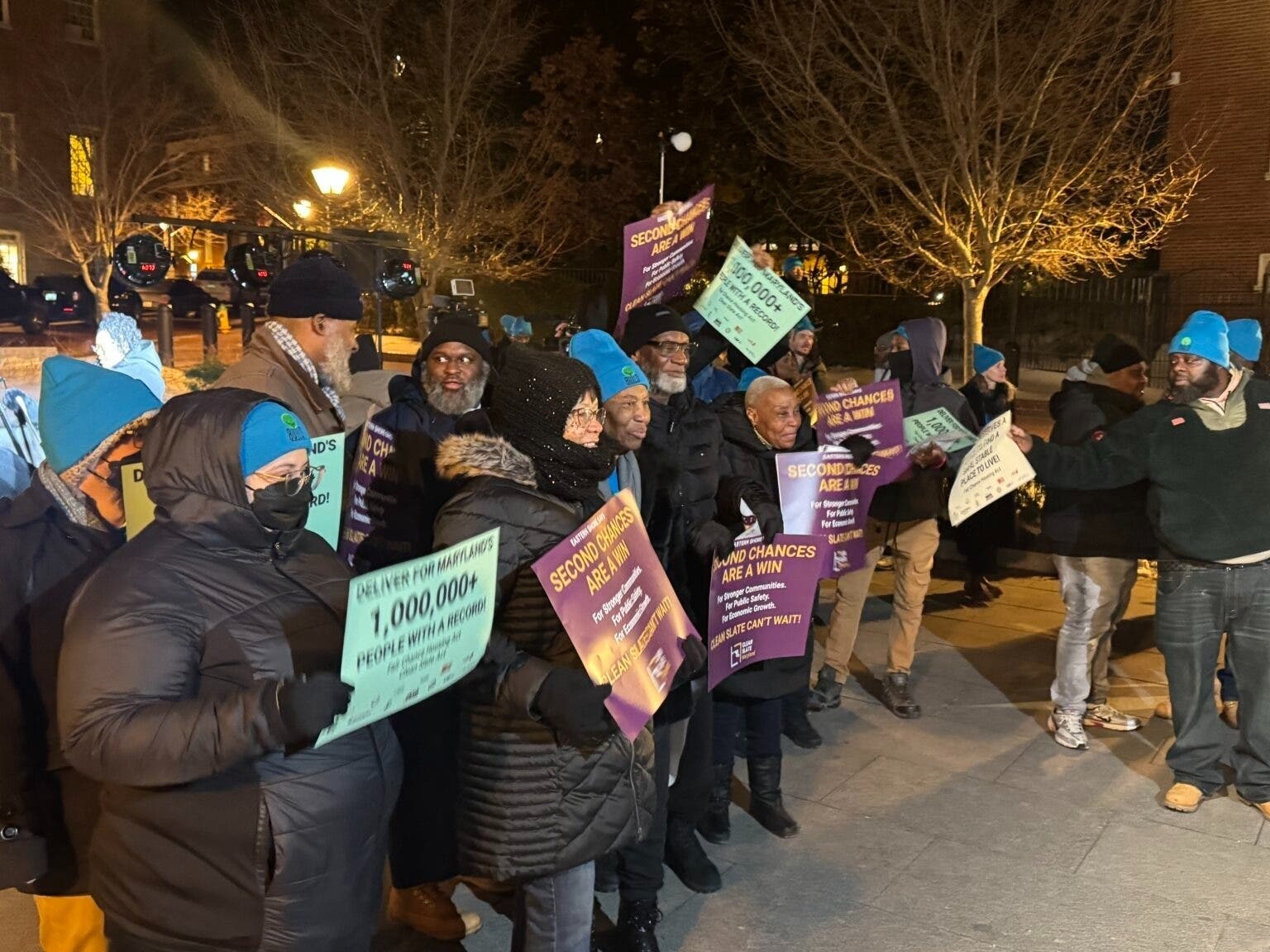
Meanwhile, close to 100 criminal justice and housing advocates rallied in the cold on Lawyers Mall to highlight legislation to provide greater opportunities for people who were formerly incarcerated. The Clean State Act — House Bill 360 and Senate Bill 483 — would expunge some misdemeanor convictions that could otherwise keep people from getting jobs, housing and even education opportunities.
Under the legislation, any person’s record would be cleared if they had been charged with certain misdemeanor offenses and “at least three years have passed since the date of the disposition of the case.” Misdemeanor convictions for second-degree assault or a “domestically related crime” would not be eligible for expungement under the bill.

Sen. Mike McKay (R-Western Maryland) speaks Monday in support of legislation to clear a person’s criminal record for certain misdemeanors. Behind him is House Majority Leader David Moon (D-Montgomery), sponsor of a House version of the bill. (Photo by William J. Ford/Maryland Matters)
Advocate Sheena Meade said that about 407,000 adult Marylanders would be eligible if the bill passed. She said 13 other states have passed such initiatives, which she called “a people’s issue, not a politics issues” with bipartisan support led by House Majority Leader David Moon (D-Montgomery) and Sen. Mike McKay (R-Western Maryland).
McKay summarized his support for the legislation with part of a Bible verse from Amos 7:7, in which “the Lord was standing by a wall made with a plumbline, with a plumbline in his hand.”
“When you have served your time and you’ve done everything you’re supposed to do, we need to make sure that policy and the Maryland General Assembly is as close to the plumbline as possible,” McKay said.
Those same advocates supported “fair chance” housing policies to ensure that people with conviction histories can have equal housing opportunities. Fair chance policies limit background checks for rental applications so that previous criminal records do not hinder someone’s ability to rent.
The legislation is still being drafted, but advocates like Gary Mitchell, a minister from Salisbury, say it’s urgent to push the legislation forward to help people like him, who faced challenges finding housing after serving time for retail theft and “unarmed bank robbery.”
“I emphasize ‘unarmed’ to be clear — I never physically hurt anyone. I served my time and was released in 2022,” Mitchell said. “No one who has served their time and is trying to rebuild their life should have to face another sentence when they come home, a sentence of housing discrimination.”

Gary Mitchell of Salisbury speaks about the difficulties getting housing after serving time for unarmed bank robbery. With him is Del. Marlon Amprey (D-Baltimore City). (Photo by William J. Ford/Maryland Matters)
While rallygoers braved the cold on Lawyers Mall, dozens of members with the American Federation of Teachers (AFT) Maryland worked their annual lobbying night inside the House office building Monday.
They hope to convince lawmakers to pass legislation such as the Safe Staffing Act of 2026. The measures, House Bill 624 and Senate Bill 411, which would require certain hospitals to establish a clinical staffing committee, are scheduled for bill hearings next week.
Another AFT priority deals with adding 911 specialists to the “hometown heroes” tax exemption that currently allows retired law enforcement, correctional officers, fire and emergency personnel to exempt $15,000 of retirement income annually. Hearings were held last month on House Bill 13, sponsored by Dels. Joe Vogel (D-Montgomery), Jessica Feldmark (D-Howard) and Teresa Reilly (R-Cecil and Harford). A Senate version sponsored by Sens. Cheryl Kagan (D-Montgomery) and Mary Beth Carozza (R-Lower Shore) was also heard in committee last month.
A third priority is collective bargaining for nontenure-track faculty at the 12 institutions in the University System of Maryland, St. Mary’s College and Morgan State University. The Senate Finance Committee held a hearing Thursday on Senate Bill 6, sponsored by Sens. Benjamin Kramer (D-Montgomery) and Clarence Lam (D-Anne Arundel and Howard), while House Bill 106, sponsored by Del. Linda Foley (D-Montgomery), is scheduled to be heard Tuesday by the Government, Labor and Elections Committee.
Foley sponsored a similar measure last year that sought to allow for full-time, part-time and adjunct faculty to collectively bargain. The Senate approved an amended version, but it didn’t advance beyond the House Appropriations Committee.
While traveling to Annapolis is just one of many steps for members to have their voices heard with lawmakers, AFT Maryland President Kenya Campbell said it remains an important one.
“A lot of our members are intimidated with this process,” she said. “You should be a part of the decision making that happens. Lobby night is a big time for us to gather, when we come together, but we’re doing a lot of work behind the scenes. I think [members] are a little more prepared for the process, not always the outcome, but the process. I think that that’s helpful.”