Politics & Government
Moore To Mark Two Years Since Key Bridge Fell, As Construction Effort Continues
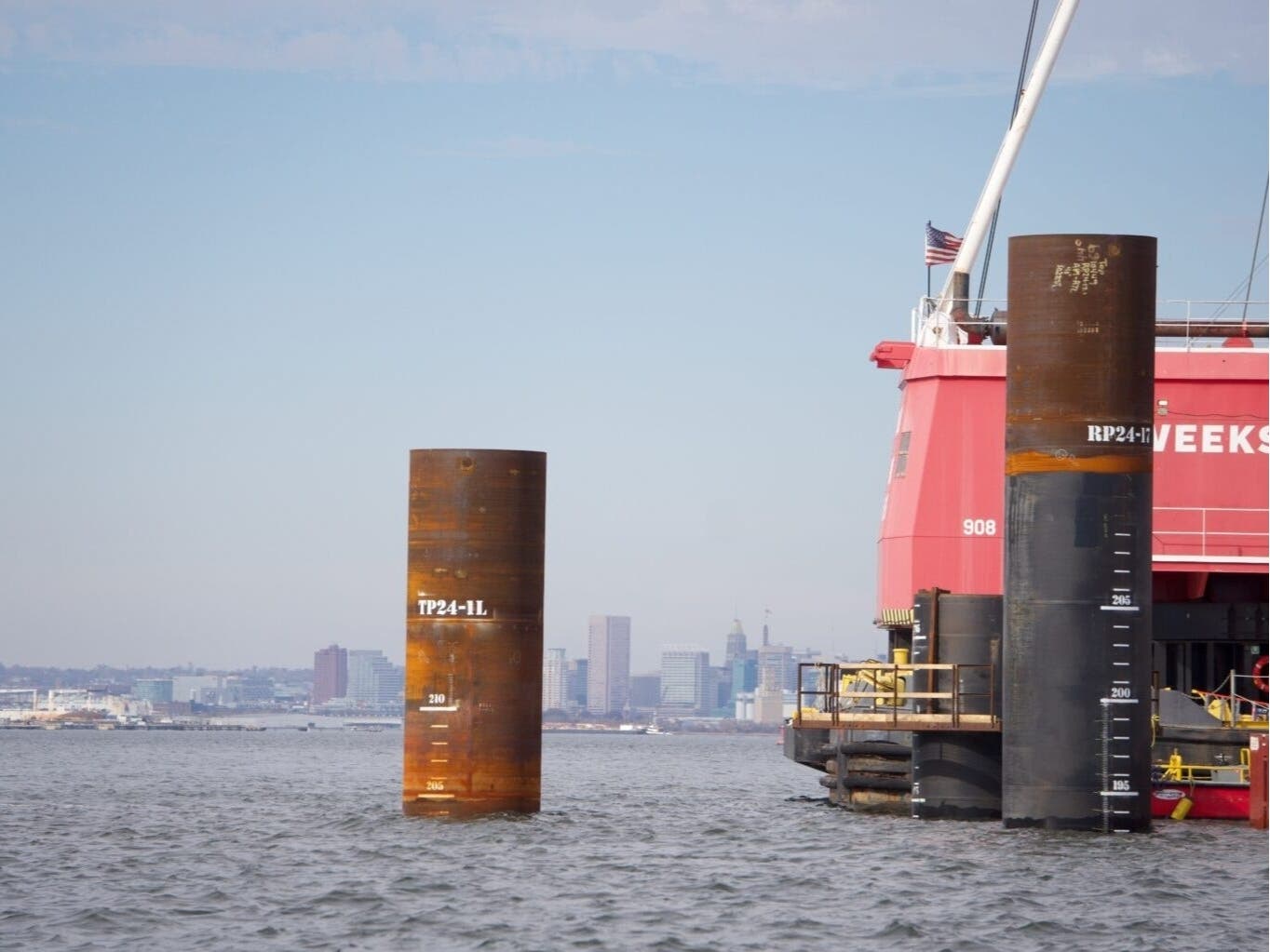
Crews are driving steel piles into the Patapsco River for the foundation of the new bridge.
March 26, 2026
Two years after a container ship toppled Baltimore’s Francis Scott Key Bridge, killing six construction workers and shocking the region, crews are busy driving foundational piles into the Patapsco River for a new bridge — and finishing design plans for a soaring new structure.
Find out what's happening in Across Marylandfor free with the latest updates from Patch.
Maryland officials, including Gov. Wes Moore (D), are expected to mark the two-year anniversary of the tragedy during a commemoration event on Wednesday, overlooking the bridge site along the Patapsco.
Earlier this week, Moore touted fresh data from the Port of Baltimore, which was blocked by the bridge collapse in 2024. The port handled approximately 50 million tons of cargo in 2025, marking the second-best year in its history.
Find out what's happening in Across Marylandfor free with the latest updates from Patch.

Gov. Wes Moore (D) speaks at the one-year commemoration of the collapse of the Francis Scott Key Bridge in Dundalk. (Photo by Christine Condon / Maryland Matters)
As time passes, less and less evidence remains of the old Key Bridge.
By January, crews had removed the concrete deck from all of the portions of the bridge left standing in the wake of the collapse. The steel and concrete pier structures were also removed on land, though some remain standing in the river.
The Maryland Transportation Authority is aiming for the new bridge — estimated to cost $4.3 billion to $5.2 billion — to open to traffic by the end of 2030. But there’s plenty of work standing in the way.
By June, the agency is likely to complete the full design plans for the new two-mile-long, cable-stayed bridge. It’s a major milestone that will also kick off cost and scheduling negotiations with the contractor building the bridge, Kiewit, said Jim Harkness, chief engineer at the transportation authority.
“We have a very complex site here, in terms of some of the conditions out in the water. We obviously have to work with a live federal navigation channel at the same time. So there are a lot of complexities to this project, and the team has really worked to design their way through that, and we’re very proud,” Harkness said during a news conference this week.
The state agency has faced blowback for doubling its initial cost estimates and delaying its original, far more ambitious, timeline. At first — less than two weeks after the disaster — the agency projected that the bridge would cost $1.7 billion to $1.9 billion and could open in 2028. The authority has blamed the higher tab on material costs, and a new pier protection system for the bridge, aiming to protect it from future ship strikes.
The more recent months in those two years have been marked by increased political tension over cost estimates and schedules between Moore and President Donald Trump (R).
But there have been revelations, too. The National Transportation Safety Board reported that the blackout aboard the Dali, the fully loaded container ship that struck the bridge, was caused by a single loose wire, which started a cascade of failures that plunged the ship into darkness as it careened closer and closer to the bridge.

Maryland Transportation Authority chief engineer Jim Harkness, right, and Brian Wolfe, the authority’s director of project development, speak about a test pile-driving effort for a new bridge on Nov. 5, 2025. (Photo by Christine Condon/ Maryland Matters)
The board confirmed, too, that word of the out-of-control ship never reached the immigrant workers repairing potholes on the bridge — and that they might have had a very narrow window of time to escape. Six workers died in the collapse. One worker survived the fall from the bridge and an inspector escaped the bridge before it collapsed.
Trump’s transportation secretary, Sean Duffy, has also pushed back against Maryland rules requiring a certain amount of minority contractors be used in the project. Trump himself has threatened to withhold congressionally approved funding for the rebuild, amid political fights with Moore.
But all the while, work has continued.
In November, crews began driving 200-foot-long steel piles into the Patapsco riverbed to test the foundation upon which the new bridge will sit. Testing wrapped up in February, Harkness said.
Now, workers are installing the massive cylindrical piles that will actually form part of the bridge’s foundation. Some of those piles came from the testing and can be reused.
“The pile foundations all passed the tests, so those test piles were removed. But the remaining piles that supported that project are now being incorporated into the foundations of the new bridge,” Harkness said.
A new bridge can’t come fast enough for community members experiencing transportation delays, with no connection between Dundalk and communities in Anne Arundel that were once joined by the Key Bridge.
Melissa Quintana, owner of Little Crystal Bijoux, a small jewelry and art shop in Dundalk, said she lost a significant number of local customers after the bridge went down, because her store was no longer located along many customers’ commutes.
“By the end of the year, when I was looking at how much business I had lost, it was to the tune of about 40%, which is absolutely terrifying for anybody — but especially a small indie artist,” Quintana said.
Now, online orders and convention sales make up a far bigger portion of her sales, Quintana said during this week’s news conference.
“It’ll be nice to reconnect with old friends, and to have that really vital part of our infrastructure back,” Quintana said.

Crews worked to remove the steel that once carried Interstate 695 over the Francis Scott Key Bridge, in this Nov. 5, 2025. (Photo by Christine Condon/ Maryland Matters)
Maryland Matters is part of States Newsroom, a network of news bureaus supported by grants and a coalition of donors as a 501(c)(3) public charity. Maryland Matters maintains editorial independence. Contact Editor Steve Crane for questions: scrane@marylandmatters.org. Follow Maryland Matters on Facebook and Twitter.