Politics & Government
School Cellphone Ban, Machine Gun Bill Advance In MD Legislature
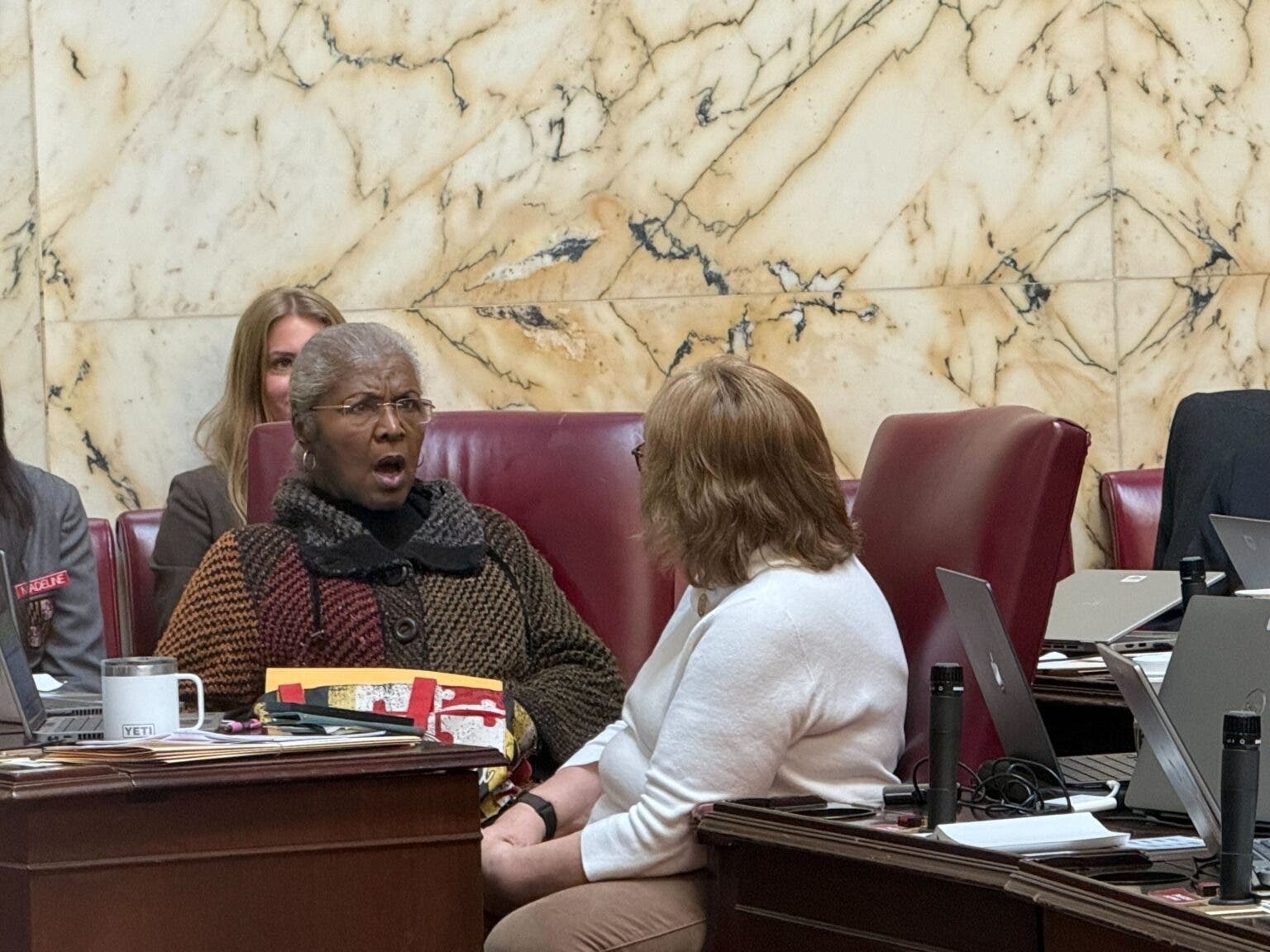
A state ban on cellphones in schools is named for Sen. Joanne C. Benson, called "a leader on making sure that our kids are able to learn."
April 9, 2026
After the news was announced on the Senate floor Wednesday morning, Sen. Joanne C. Benson's (D-Prince George’s) jaw hung open in shock, and the chamber erupted in applause.
Find out what's happening in Across Marylandfor free with the latest updates from Patch.
Sen. Kevin Harris (D- Calvert, Charles and Prince George’s) had just declared that the Maryland Phone-Free Schools Act would be named for Benson, honoring her decades of work on education.
“She’s been such a leader on making sure that our kids are able to learn. And she has identified the fact that the phones are really a problem in our schools,” said Speaker Pro Tem Malcolm Augustine (D-Prince George’s). “She’s just been such a leader on this. She’s been such a leader for this body.”
Find out what's happening in Across Marylandfor free with the latest updates from Patch.
The bill requires each local board of education to develop and implement, by the 2027‑2028 school year, a policy to prohibit the use of “electronic communication devices” by students during the academic school day.
The bill — which already passed in the House — passed the Senate on second reading on Wednesday and awaits a final vote in the chamber.
House rejects more record-keeping measures to gender marker bill
The House beat back a handful of amendments Wednesday to a bill that would make it easier for adults to change the sex designation on their birth certificates and sent the measure back to the Senate, where it previously passed by a one-vote margin and its fate now is uncertain.
Senate Bill 626 allows adults to change their birth certificate gender marker without having to provide documentation from a physician, as is required now, and creates a new gender marker of “X” for nonbinary individuals. It was amended in the full Senate to require that the Secretary of Health maintain a separate record of changes to birth certificates, then approved and sent to the House.
The House Health Committee stripped the Senate amendment this week, after advocates raised concerns that those records could make it easier to target transgender individuals in a politically tense time.
The full House rejected an amendment from Del. April Miller (R-Frederick) that have essentially restored the Senate amendment that was stripped out in committee. It also beat back an amendment by Del. Lauren Arikan (R-Harford) that would have required the state to log someone’s designated sex at birth into the state’s medical information-sharing system known as CRISP (Chesapeake Regional Information System for our Patients).
Arikan said she wanted to ensure that doctors working in emergency rooms had enough information on an individual’s gender transition to ensure adequate medical care. But Del. Ashanti Martinez (D-Prince George’s) said that not only does the state keep original copies of altered documents, but any change that creates additional lists of transgender individuals could be dangerous for the targeted community.
“This is focused on a particular community of Marylanders who have a hard time making sure their documents reflect their reality,” Martinez said of the bill. “This bill is going to allow them to no longer have to fill up doctor’s offices to get a letter to say who they are. Instead, they’ll be able to self-select the same way they’re able to do with their licenses.”
The House voted 91-36 to approve the bill and sent it to the Senate. It is does not agree to the House changes to the bill, the two chamber have only until Monday to work out a compromise, or the bill will die.
Cheltenham commission headed to the governor’s desk
The House gave unanimous approval Wednesday to a bill creating a Commission on the House of Reformation and Instruction for Colored Children, which will research what are believed to be unmarked graves of Black youths who died in state custody at the former reformatory.
Senate Bill 776 now heads to the governor’s desk for his signature.
The bill would require the commission to “research the history, operations, and resident deaths” at the former state-run reform school in southern Prince George’s County. Supporters of the bill believe youth who died at the facility in the 19th and early 20th centuries may be buried in unkempt unmarked graves there.
The Senate bill was sponsored by Sen. William C. Smith Jr. (D-Montgomery). A companion House bill, sponsored by Del. Jeffrie Long Jr. (D-Calvert and Prince George’s), was unanimously passed Wednesday out of the Senate Judicial Proceedings Committee, which Smith chairs. The bill was a priority of the Legislative Black Caucus this year.
“It’s historic. Very proud of the work that the House and Senate did on this,” Smith said Wednesday. “I’m even more proud of just the prospect of just the idea of what this commission is going to do, and the stories they’re going to uncover, the history that they’re going to reveal … It’s going to be a moment for us to not only educate ourselves, but for us to learn from what happened in the past, but then educate future generations of Marylanders.”
Machine-gun convertible ban approved, sort of
During a double session Wednesday, the House approved other legislation, such as prohibiting the sale or manufacture of firearms that can be converted into automatic weapons.
House Bill 577 sponsored by Del. Nicole Williams (D-Prince George’s) was approved by a 92-39 vote and heads to the Senate with just five days left until the session’s last day Monday, known as Sine Die.
The same vote was recorded Wednesday in the House on the Senate version sponsored by Sen. Sara Love (D-Montgomery).
One word in the measures doesn’t make the bills identical for approval to send the governor’s desk for his signature.
In the Senate version, it states the Maryland State Police “shall” adopt regulations that would publish a list of prohibited machine gun convertible pistols. The house uses the word “may.”
The Senate didn’t concur with the House amendment, so legislators will have to discuss which word will pass muster.
“It’s those things that that drives lawyers crazy, but I am sure that the House and the Senate will be able to work it out,” Williams said Wednesday evening.
Hours before the House version was approved, delegates debated the bill for about 25 minutes.
The bill would essentially ban the sale or manufacture of semiautomatic pistols that use a “cruciform trigger bar,” which can be converted by hand or using a household tool into a machine gun to fire multiple rounds.
That pistol converter is commonly known as a Glock switch because it being the handgun most easily converted into an automatic weapon. However, the measure doesn’t target Glocks, which discontinued a series of pistols in November that were easily compatible with converters.
That’s why opponents such as Del. Robin Grammer Jr. (R-Baltimore County) said the bill “is broadly unconstitutional and would be found to be that when it’s challenged in courts.”
The bill wouldn’t apply to current law enforcement officers or those who are retired, and those in the military.
Also, current gun owners who own a Glock would be allowed to keep them.
House Majority Leader David Moon (D-Montgomery) said the bill mainly goes after copycat manufacturers.
“Doesn’t take guns away from anyone, but it does pursue a push [for] manufacturers to do better with their products, and they are already doing it, so this is an easily implementable bill,” he said.
“Product manufacturers don’t kill people. Product manufacturers don’t pull the trigger,” said Minority Leader Jason Buckel (R-Allegany). “Criminals commit crime. They do not care about your regulatory offenses. The only people who care about the regulatory offenses are lawful gun owners… Common sense has left the room.”
Tax credit for stillbirth stalled
Sen. Jeff Waldstreicher (D-Montgomery) hopes this is the last year he asks parents to come to Annapolis and recollect some of the hardest days of their lives – experiencing the stillbirth of a child – to pass legislation that would offer a small financial reprieve for families going through such a tragedy.
But while the Senate has approved the legislation two years in a row, the House has still not taken up the issue this year as Sine Die looms.
“It is challenging for any parent to come here to Annapolis in this very formal setting and share the most difficult and intimate details of their lives,” Waldstreicher said during a press conference Wednesday, alongside families who have gone through the stillbirth of a child. “We’re asking the House to look closely at the legislation, to hear the stories of stillbirth parents and to pass the bill.”
Senate Bill 356 would create a one-time $1,000 tax credit for families of a stillborn child to help offset the unexpected medical and funeral costs that families endure.
Those financial burdens add to the costs invested in preparing their home for the arrival of their newborn – a day that, for those families, did not come.
Maureen Gaffney, a mother to two stillborn children and four living children, said that while the financial burdens of stillbirth were challenging, the hardest part of the experience is “the silence.”
“Our babies are born into a silent room. The cries never come. And then we return to the world that often expects us to carry the loss quietly,” Geffney said. “This bill is more than financial support. It’s a recognition for the voice of the baby who never cried, and a message to families like mine that our children matter.”
SB 356 sits in the Ways and Means Committee. Waldstreicher said it was “frustrating” that the bill was not moving in the House, saying that he has not received a “legitimate reason” for the bill stalling.
“The House has expressed no fiscal cost to the bill and no objection to the underlying policy that we’re trying to pass,” he said. “That’s why we’re here today to ask the House to take a look at this bill with fresh eyes … and to find the empathy that I think is necessary to move the bill forward.”
Chair Jheanelle K. Wilkins (D-Montgomery) said there were concerns whether a tax credit is the most appropriate remedy for such hardships.
“A stillbirth is a devastating experience,” she said in a written statement. “We are interested in an approach that would allow this support to be delivered more directly, such as through a grant program.
“We will continue working on a path forward that centers equity and ensures families receive meaningful, timely support,” she said.
Maryland Matters is part of States Newsroom, a network of news bureaus supported by grants and a coalition of donors as a 501(c)(3) public charity. Maryland Matters maintains editorial independence. Contact Editor Steve Crane for questions: scrane@marylandmatters.org. Follow Maryland Matters on Facebook and Twitter.