Politics & Government
Trio Of GOP Candidates For Governor — Out Of Nine Total — Meet In Debate
All three Republicans described the state as on the edge of economic troubles.
May 20, 2026
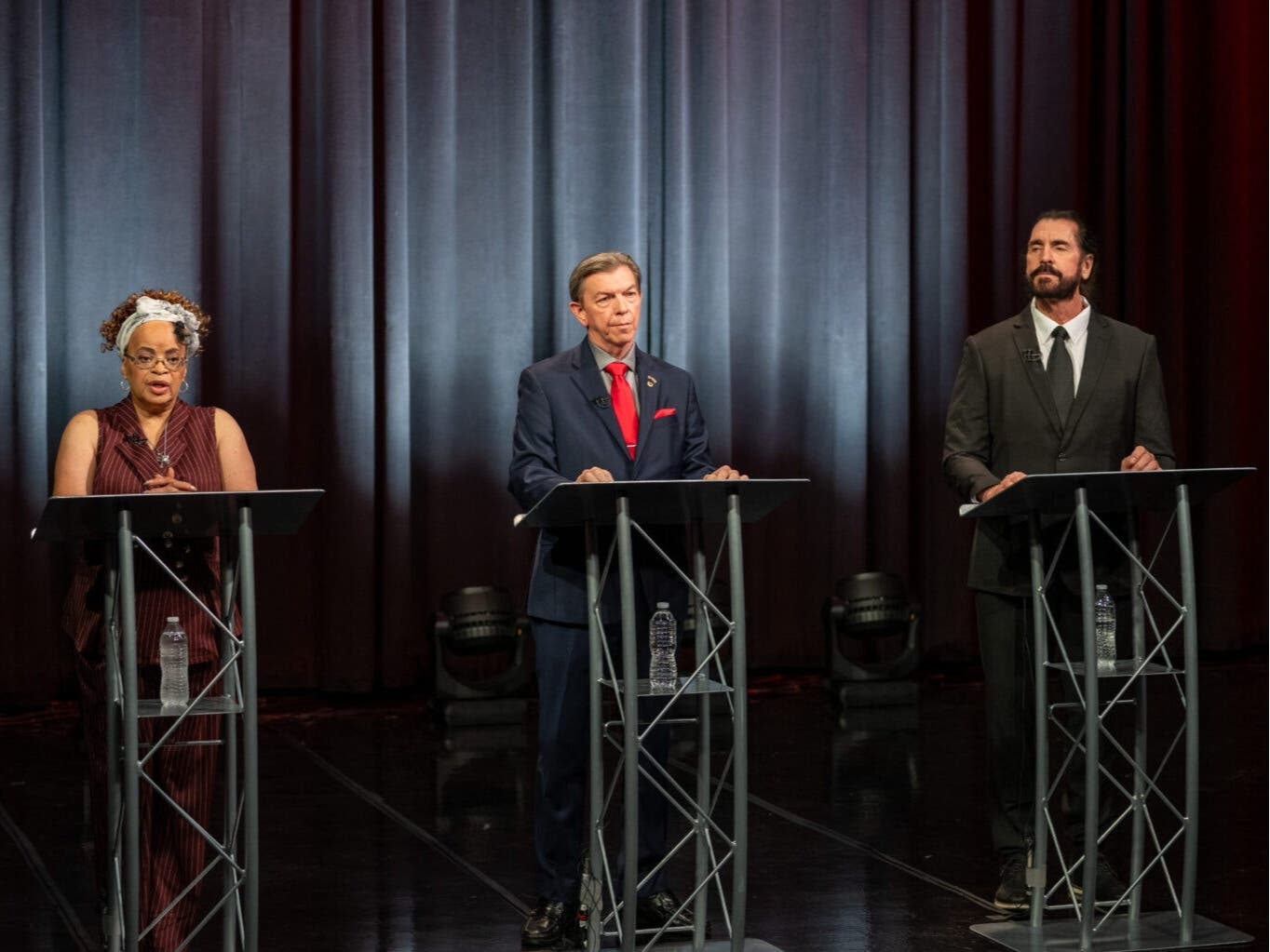
A debate among Republican candidates for governor Tuesday lacked fiery exchanges, name recognition and two-thirds of the nine primary candidates.
Find out what's happening in Across Marylandfor free with the latest updates from Patch.
The 60-minute debate, hosted by Maryland Public Television and WYPR, featured Douglas Larcomb, John Myrick and Shannon Wright. Among the missing Republicans were Dan Cox, the party’s 2022 gubernatorial nominee, and Ed Hale Sr., a lifelong Democrat who recently switched parties and is the biggest fundraiser by far among the Republicans.
Cox did not respond to a request for comment on his absence. But a spokesperson for Hale’s campaign said the Baltimore businessman’s “time is better spent on the ground with Marylanders. His debate is with [Gov.] Wes Moore and he looks forward to that conversation in the general election.”
Find out what's happening in Across Marylandfor free with the latest updates from Patch.
Moore, who faces a token primary challenge, has raised more than $13 million in this term and had $6.3 million in the bank, according to campaign finance reports filed Tuesday. Hale reported raising $210,471 and having $108,846 in his bank account.
The three candidates who were on stage Tuesday fielded questions on topics ranging from President Donald Trump to the rebuilding of the Francis Scott Key Bridge and the state’s fiscal condition.
All three Republicans described the state on the edge of economic troubles.
“We are on the Wes Moore School of Economic Ruin plan, and we have been extorted, we have been swindled, and we have been hustled,” said Larcomb, a Frederick County Republican.

Douglas Larcomb, a Frederick County Republican candidate for governor. (Photo by Michael Ciesielski Photography/Courtesy of MPT)
A year ago, Moore and the Democrat-controlled legislature passed a budget that included $1.6 billion in new taxes and fees. This year, the governor and General Assembly had to erase a $1.5 billion spending gap as it passed a nearly $71 billion budget.
“I will drop that budget by $10 billion and we’re going to cut taxes and cut fees on motor vehicles, and so on, fishing licenses, everything,” Larcomb said.
Similarly, Myrick — who ran a brief and unsuccessful 2024 campaign for U.S. Senate — complained of “runaway taxes, runaway fees.”
“We will also bring in an independent audit team to look at every dime spent of Maryland’s money, because that again is your hard-earned tax dollars, not Monopoly money,” Myrick said. “Where we find waste, we will cut it. Where we find fraud, we will prosecute it, because no one will steal your money on our watch.”
Shannon Wright, who is seeking to become the first Black woman governor of Maryland, said the state needs to re-examine its spending.
“I believe that all of the things that we need to do can be found in the money and the budget we already have,” she said. “It’s just how you spend it. And as a mom and a wife, I know how to stretch $1 and be able to find the pennies in the couch cushions.”
The candidates also focused on affordability issues.
Topping the list for Myrick was the cost of energy.
“We have energy plans that will cut energy prices in half in the first three years of our administration,” said Myrick, who did not detail how he planned on achieving that goal.
Similarly, Larcomb said he would work with Senate President Bill Ferguson (D-Baltimore City) and House Speaker Joseline Peña-Melnyk to “repeal the Advanced Clean Cars Two Act, which is not practical, not possible, unaffordable, unsustainable.”
Larcomb said because the legislature has banned 287(g) agreements, under which local police agencies cooperate with federal immigration officials, he would use state resources to document undocumented immigrants.

Shannon Wright, a Republican vying to become the state’s first Black woman governor. (Photo by Michael Ciesielski Photography/Courtesy of MPT)
“So, the governor’s office has an office called the Governor’s Office of Immigration Affairs,” Larcomb said. “We can do our own background checks, so we can have all of the undocumented come in, issue temporary work permits while they’re here, and driver’s licenses that say for non-federal use. So we need to navigate what we have and get them on the tax rolls.”
All three said they agreed to a large degree with President Donald Trump, even if they did not always agree on his approach.
Running close to Trump could make it easier to win a primary but tougher to win a general election. In Maryland, two of every three voters supported Kamala Harris in 2024 and Joe Biden in 2020. Polls since Trump took office shows Maryland voters have not softened their opinion on the Republican president.
A Republican governor would almost certainly have to work with a legislature with a Democratic supermajority. Former Gov. Larry Hogan, an immensely popular two-term Republican, frequently butted heads with Democrats and saw many of his priorities watered down or stymied.
Wright said she would rely on “legislative priorities that make sense” to build consensus.
“There’s a lot more that unites us than divides us,” she said. “The difference is our opinions on how we get there, but when you put people first before politics, you get to the place you try to go a lot quicker and smoother, that’s one thing. Another is I have the experience of working with organizations that are very democratic and very ethnic. I understand how to bring folks to the table.”
Larcomb proposed an unusual idea to hold the majority party publicly accountable.
“I would implement a public consensus voting system online, so that all registered voters, no matter whether you’re not affiliated, Democrat, Republican, doesn’t matter, you’ll have a chance to vote on every issue that is on the General Assembly floor, including ideas that I have about laws that need to be repealed to help us all out financially,” he said.
Myrick said he hoped to build consensus with Democrats.
“But if we can’t, I have no problem whatsoever using the bully pulpit of the governor’s office to go out and let Marylanders know exactly who’s standing in the way,” he said. “And politicians are similar in many fashions to cockroaches. Neither one likes the light. You only have to embarrass folks a couple of times, and they’ll come back to the table.”

John Myrick, one of nine Republican candidates for governor. (Photo by Michael Ciesielski Photography/Courtesy of MPT)
Moore awaits with millions
Myrick, who is running with former Del. Brenda Thiam, has raised almost $22,000 since he announced his candidacy last year. During that same period, he reported spending more than $34,000 — an amount that includes more than $16,000 in in-kind contributions. He reported $4,100 in cash on hand.
Wright was the Republican nominee for Baltimore mayor in 2016 and 2020. In April, Wright filed an affidavit stating her campaign had not raised nor spent $1,000. As of Tuesday afternoon, Wright had not filed a campaign finance report.
Larcomb filed an affidavit last week with the state board of elections. He claimed no contributions or expenditures in a cumulative amount of $1,000.
Moore, a first-term Democrat who is seen as a potential national candidate, has crisscrossed the state and country. He raised millions for his re-election while boosting his name recognition.
Candidates eye executive orders for priorities
In some cases, the Republican candidates said they would lean on executive orders to accomplish some goals.
Wright, when asked about diversifying the state’s economy away from federal jobs, said she would focus on areas related to education.
“Education is key in a whole bunch of areas,” Wright said. “So, what we’re going to do is write an executive order to introduce academic savings accounts, so that when folks move to this state to take a job, they know the cost of their children’s quality education is covered.”
Wright did not offer details about the accounts or how they differ from programs including 529 college savings plans.
Myrick said he would use his executive authority to place a moratorium on data centers “until we can bring the energy issue back in line and make things more affordable for Marylanders.”
In one of the only attempts at an exchange between the candidates, Wright took issue with Myrick’s proposal.
“I find it interesting that my opponents, who claim to also be from the party of less government and more freedom, want to restrict who can come where and do what, so in my administration, with your votes as your next governor, we are not going to put a moratorium,” she said.
Instead, Wright said she favored requiring data centers to supply their own energy and provide leftover energy to surrounding communities.
Maryland Matters is part of States Newsroom, a network of news bureaus supported by grants and a coalition of donors as a 501(c)(3) public charity. Maryland Matters maintains editorial independence. Contact Editor Steve Crane for questions: scrane@marylandmatters.org. Follow Maryland Matters on Facebook and Twitter.