Politics & Government
Voting Rights Act For Maryland Stirred Emotions Well Before Monday Meltdown
Supporters say the measure breaks systemic barriers in local elections and opponents call it a political power grab.
April 15, 2026
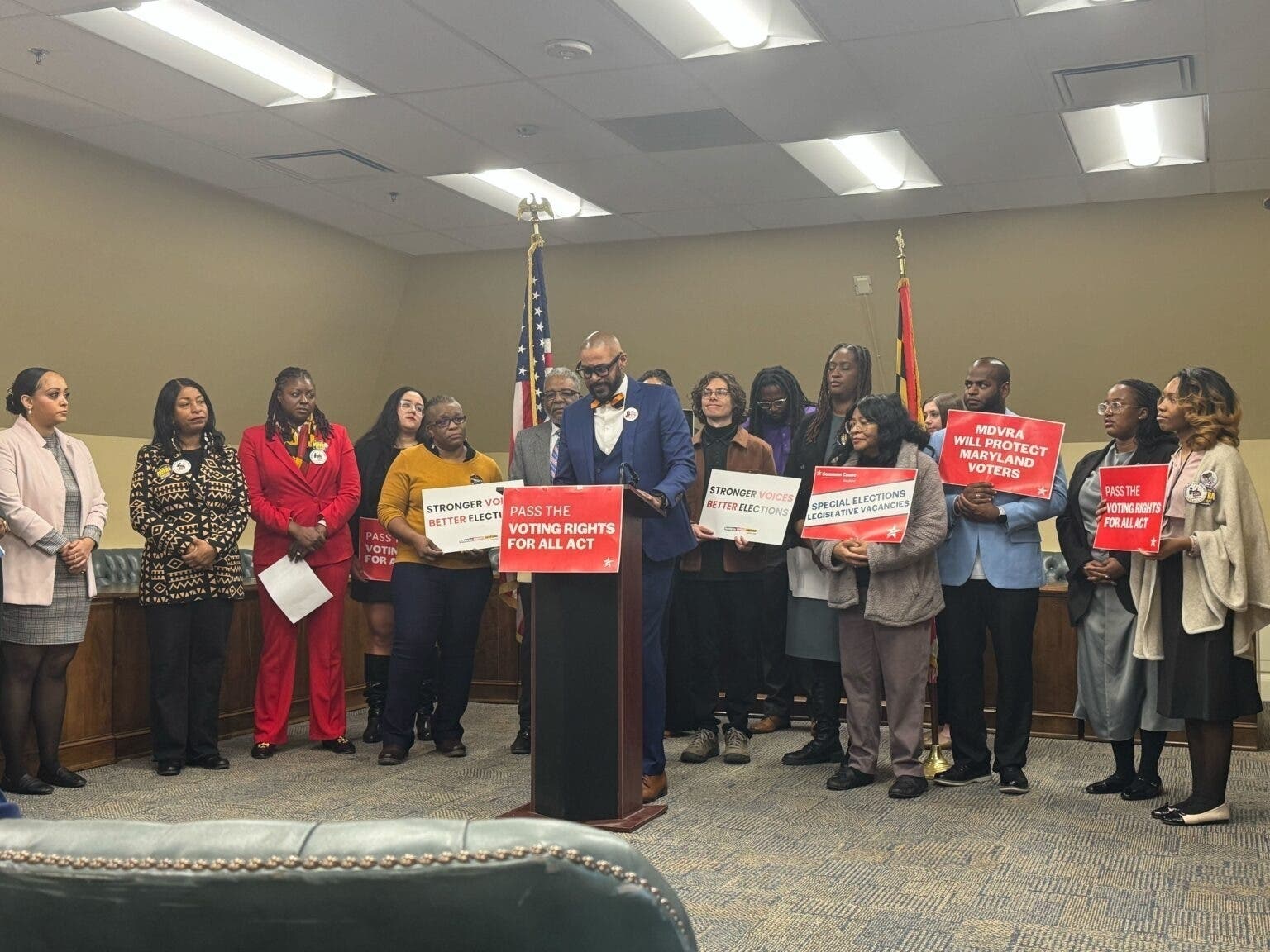
The Maryland Voting Rights Act of 2026 was already stirring strong emotional responses, even before it led the House of Delegates to explode in a shouting match in the final minutes of the legislative session Monday night.
Find out what's happening in Across Marylandfor free with the latest updates from Patch.
The emergency legislation, which lets citizens or the attorney general sue county and local governments over their voting plans, is the “right and fair” thing to do, the way Sen. Charles Sydnor III (D-Baltimore County) sees it. To Senate Minority Whip Justin Ready (R-Frederick and Carroll) it’s little more than another attempt by the Democratic majority to “rig the system.”
But to Del. Greg Wims (D-Montgomery), who has been involved in voting rights advocacy in Maryland for more than 50 years, it’s needed now more than ever.
Find out what's happening in Across Marylandfor free with the latest updates from Patch.
Wims, now 76, told a short story to the House Saturday on his work as president of the state NAACP that helped the late Randolph “Rudy” Cane become the Eastern Shore’s first Black elected state representative in 1998.
“I brought up Rudy Cane because it took a court battle, about four years, to fight for the right to be elected in Snow Hill,” said Wims, who sponsored the House version of the Voting Rights Act. “That was just about 30 years ago. We don’t want that to happen, again, especially with what we’re seeing on the federal level.”
The bill comes as the U.S. Supreme Court is expected to rule in the coming months in a Louisiana case that could further erode protections of the federal Voting Rights Act, which the court has steadily weakened in recent years.
The justices have been asked to determine if a Louisiana congressional map, which added two majority-Black districts in 2024, is illegal. If the court determines it is, racial protections in congressional redistricting could become much more difficult nationwide.
Wims said Tuesday that the legislature’s approval of Senate Bill 255, the Voting Rights Act of 2026, will allow the attorney general or a resident to file a lawsuit based on “polarized voting.” It also pushes to ensure county and municipal elections don’t dilute voters based on their race, color, sexual orientation, among other characteristics.

Senate Minority Whip Justin Ready (R-Frederick and Carroll) speaks on the Senate floor April 1. (Photo by William J. Ford/Maryland Matters)
Republicans, like Ready, see it not as voter protection but as a political power play in a state with limited Republican representation.
“It’s another example of a super-majority [legislature] drunk on power trying to push every little play where there’s any opposition in their agenda,” Ready said. They just … have to meddle and be completely in control of everything.
“We don’t like who won the presidential election.’ Whether you like it or not, we’re just going to change everything about Maryland that isn’t lock-stepped, left-wing blue,” Ready said. “I just don’t think that’s smart. How far are we going to go with this?”
Attorney General Anthony Brown (D) said in a statement Tuesday the legislation allows his office to protect voters. “At a time when federal voting rights protections are being dismantled, Maryland acted to protect its own,” he said.
A major part of the bill makes it an emergency measure, which means the bill becomes law effectively immediately after being signed into law by the governor. The bill was approved about a minute left before the General Assembly adjourned Sine Die on Monday night — after the House erupted in shouting, as Democrats cut off debate by Republicans, who appeared intent on talking the bill past the midnight deadline for the session.
If signed by the governor, Maryland would join eight other states that enacted statewide voting rights legislation.
The legislature’s approval doesn’t affect statewide races in the June 23 primary election, but dozens of county and municipal races are taken place starting in the spring.
‘Right and fair’
Sydnor, lead sponsor of the Senate version of the bill, has worked on similar versions since 2022. He said Tuesday that his work on the issue stems from a local lawsuit he was part of in 2021.
That’s when the NAACP sued the Baltimore County Council over a redistricting plan that is claimed to have diluted the strength of Black voters. The plan would have given seven out of nine county districts a majority-white voter base in a county that’s about a third Black and a little more than half white.
The storm after the calm: Placid final day erupts in final minutes in House, Senate
“I think it’s extremely important,” Sydnor said. “I will fight for what I believe is right and fair. This is just a tool to ensure that people will have the ability to push back when people put forth discriminatory systems, silence people and to disallow people from having their rightful place at the table.”
Sydnor said this form of voter dilution is in other parts of the state — in St. Mary’s County, members of the county commission and school board represent different districts in the county, but they are elected by county voters at large.
That’s why AnnMarie Abell, chair of the county’s Democratic Central Committee, submitted written testimony in support of Sydnor’s bill.
“So, elected officials can willfully ignore the voters in their district while governing, even voting against their district’s interests, because after all, they really don’t need their districts votes to win,” Abell wrote.
But others, like the Maryland Association of Counties (MACo), worry about the bill’s focus on local governments.
“Counties support fair and representative election systems and comply with existing federal and state law,” wrote MACo Legislative Director Kevin Kinnally. “However, SB 255 creates a parallel enforcement framework that increases litigation exposure and costs without providing a clear, collaborative process for resolving concerns at the local level.”
Maryland Matters is part of States Newsroom, a network of news bureaus supported by grants and a coalition of donors as a 501(c)(3) public charity. Maryland Matters maintains editorial independence. Contact Editor Steve Crane for questions: scrane@marylandmatters.org. Follow Maryland Matters on Facebook and Twitter.