Politics & Government
What Comes After The ICE Arrest Video?
Immigrants picked up in Maryland find themselves detained far from home.
January 12, 2026
Many immigrants who used to live in Maryland now find themselves in detention centers many miles away, anxiously awaiting their fate.
Find out what's happening in Across Marylandfor free with the latest updates from Patch.
Most of the individuals picked up by Immigration and Customs Enforcement officers are initially processed and temporarily held in Salisbury or Baltimore, then transferred to detention facilities nationwide.
After that, three out of four are moved to Louisiana or Texas, with others going to Pennsylvania, Virginia and about a dozen other U.S. states – separating them from their families, their lawyers and their support systems.
Find out what's happening in Across Marylandfor free with the latest updates from Patch.
“I believe it’s a deliberate strategy by the Trump administration to separate detained immigrants from their families,” said Len Foxwell, an Annapolis communications consultant who has become an activist on the issue.
The long-distance moves “make it harder for them to communicate with legal counsel and with their family members who are trying to advocate on their behalf,” he said, “and to increase the chances that they will appear before a very conservative judge who will be less inclined to set bonds, so that they can be released back to their families.”
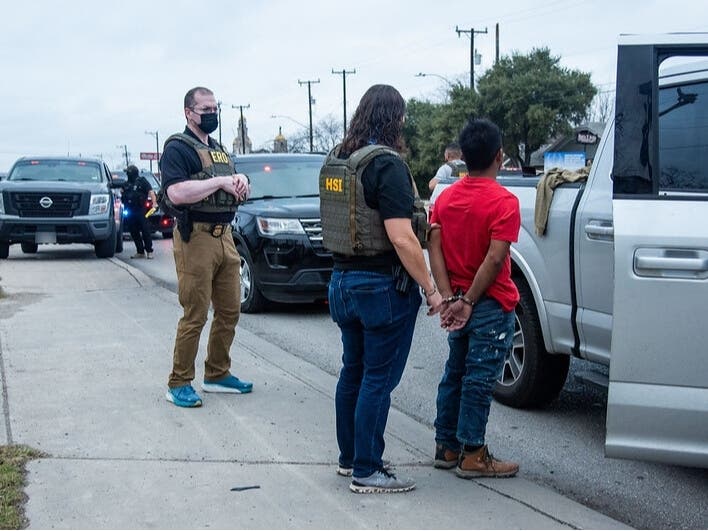
Visibility of this enforcement surge is garnering significant public scrutiny. Viral footage of forcible detentions and aggressive tactics is flooding social media, but the narrative often ends there. While the public witnesses the arrest, the complex legal and detention processes that follow remain largely invisible.
More than 3,300 Marylanders were detained by ICE in 2025, twice the number of preceding years
New findings by Capital News Service, however, provide clarity on the process in Maryland. By analyzing data compiled by the Deportation Data Project, CNS has learned that 98% of people picked up on the street in Maryland go directly to holding rooms in Baltimore or Salisbury.
Individuals are only supposed to stay in these hold rooms for 72 hours, under a limit imposed by federal mandate. Yet about a quarter of individuals arrested in the field and booked into the Baltimore holding rooms have gone above that 72-hour limit.
CNS reached out to ICE for a statement but did not receive a response.
After that, they are moved to other states to wait for a decision about their future. One man CNS found in the database has been moved from place to place a total of 10 times since his arrest in January.
For lawyers, these constant moves make representing their clients harder.
“They are being picked up and once they are processed, they all move around,” said Anthony Fatemi, a Maryland immigration lawyer who says he has clients in Texas, Louisiana, New Jersey and Pennsylvania, among other locations.
“At times, it is difficult to locate them because they are constantly being moved around,” he said. “By the time we get hold of the court and try to file our paperwork, they have moved to another state.”
However, Fatemi gives the administration the benefit of the doubt.
“I believe it is more (that) … facilities are limited in space and in the number of beds available,” he said, adding that the administration’s recent push to build and renovate facilities supports his theory.
Though he admits he has never seen immigration enforcement to this extent in his more than 25 years as an immigration lawyer, he is optimistic that these conditions won’t last.
Maryland Matters
“You can stretch a rubber band, you think it’s going to break. But if you let go, it comes back,” said Fatemi. “It’s a similar situation. We’re going to come back to normalcy. It’s not going to stay like this.”
The statistical analysis tells part of the post-arrest story. In a few cases, individuals have been released and then recounted the events to friends in more personal detail.
This reliance on long-distance transfers follows a significant change in state law. In 2021, the General Assembly passed the Dignity Not Detention Act, forcing counties to sever decades-old ties with ICE.
Following the passage of the law, facilities in Frederick, Worcester and Howard counties closed, effectively erasing the state’s ability to house hundreds of detainees. In Worcester County alone, officials noted the jail had previously housed “up to 200” detainees under its contract.
With those local beds legally unavailable, federal agents have adapted by holding individuals in temporary processing rooms before transferring them to the nearest available out-of-state federal facility.
For Daniel Fuentes Espinal, that 1,000-mile journey began in a Lowe’s parking lot.
A beloved pastor for Jesus Te Ama Easton and the owner of a local construction company, Fuentes Espinal was arrested by ICE agents on the morning of July 21.
The pastor did not want to personally tell his story to CNS. His friend Foxwell offered to do it for him.
He was held in the Salisbury and Baltimore holding rooms before being transferred to an ICE detention center in Alexandria, Louisiana. From then on, Foxwell says, Fuentes Espinal was talking to his daughter, once a day, for a few minutes.
The pastor’s arrest hit the Easton community hard, and it hit Foxwell, too.
Foxwell’s son had been best friends with Fuentes Espinal’s son growing up. So, when Foxwell’s son died tragically in a car accident in June, Fuentes Espinal had stepped up to deliver the eulogy.
“The relationship between the pastor and I and between our respective families runs very deep, and it’s very personal,” said Foxwell. “So I was devastated to hear, just weeks after my son’s funeral, that he had been kidnapped by ICE.”
While Foxwell helped the family manage communications and turn press attention to the story, Fuentes Espinal’s daughter, Clarissa Fuentes Diaz, tracked his transfer.
Then she got busy making calls and finding lawyers. She served as a liaison and intermediary for her detained father, who had limited access to the Internet and phone.
Foxwell was about to board a plane for St. Louis from Baltimore in early August – around two months after Fuentes Espinal was detained – when his phone began to ring. It was a call from Fuentes Espinal’s daughter.
After spending a month in detention in the Alexandria detention facility, over 1.000 miles from home, Fuentes Espinal had been granted bail. He was coming home, at least for now.
“It was a very emotional moment for me. It’s a very emotional moment for her,” Foxwell said. “And it just, it was one of those moments in my life that I will never forget.”
Now, Fuentes Espinal continues to work as a pastor and in construction on the Eastern Shore as he waits to work through his immigration process.
“It appears it’s going to have a positive ending, but we cannot stop the fight right now,” Foxwell said. “We have to remain vigilant, and we have to keep up the pressure on this administration.”