Politics & Government
What Went Right, And What Went Wrong, In Maryland On Election Day?
"Unprecedented" is a word that's been used by election officials, advocates and lawmakers alike to describe the 2020 presidential election.
By Bennett Leckrone
November 4, 2020
“Unprecedented” is a word that’s been used by election officials, advocates and lawmakers alike to describe the 2020 presidential election ― and that phrase rang true on Tuesday.
Find out what's happening in Across Marylandfor free with the latest updates from Patch.
More than 2 million Marylanders had cast their ballots before Election Day as the state emphasized early and mail-in voting. As of 10 p.m., 475,249 voters had cast their ballots in person on Tuesday, with some still trickling into voting centers in Calvert County.
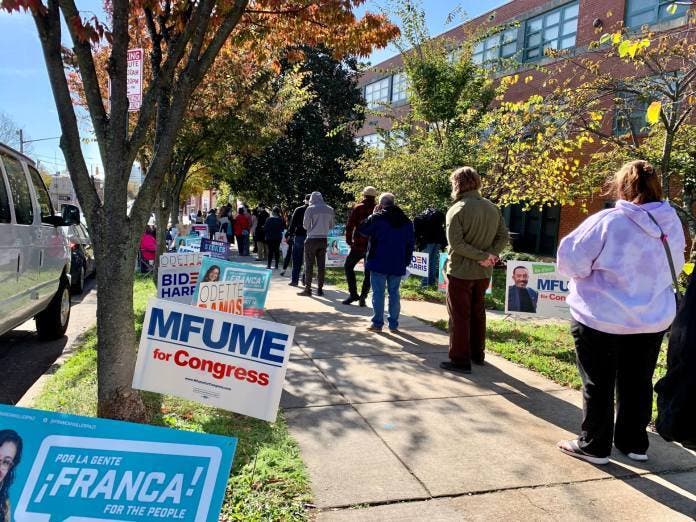
In many of the state’s large jurisdictions, Election Day wait times were brief and lines were short throughout the day. In smaller counties like Calvert, however, voters stood in line for hours after polls closed at 8 p.m.
Find out what's happening in Across Marylandfor free with the latest updates from Patch.
The coronavirus pandemic left election officials scrambling to come up with a workable in-person voting system earlier this year. Faced with election worker shortages and worries about the spread of COVID-19, the State Board of Elections eventually decided to open larger, fewer in-person voting centers for Election Day voting.
Voters line up outside of Camden Yards on Election Day. Photo by Hannah Gaskill. Voters form a line outside the White Oak Community Recreation Center shortly after polls opened on Tuesday morning. Photo by Danielle E. Gaines. Signs direct voters at FedEx Field in Landover on Election Day. Photo by Bruce DePuyt. Prince George’s County Executive Angela D. Alsobrooks (D) answers questions from reporters at FedEx Field in Landover. Photo by Bruce DePuyt. Franca Muller Paz, Green Party candidate for District 12 council in Baltimore City, talks with voters at Barclay Elementary/Middle School. Photo by Elizabeth Shwe. Brandon Scott (D) talks with U.S. Sens. Benjamin L. Cardin (D) and Chris Van Hollen (D) outside Baltimore’s Mount Pleasant Church on Election Day. Photo by Hannah Gaskill. Brandon Scott (D) declares victory in the Baltimore mayoral race after independent challenger Bob Wallace conceded Tuesday night. Photo by Elizabeth Shwe. Sen. Paul G. Pinsky (D-Prince George’s) encourages voters in Greenbelt to vote for Joe Biden and Kamala Harris for president and vice president. Photo by Josh Kurtz. A bullhorn left by Gladys Weatherspoon’s campaign encourages voters to vote for her in the county’s circuit court judicial race. Photo by Josh Kurtz. Poll workers look on as voters cast ballots at FedEx Field in Landover on Election Day. Photo by Bruce DePuyt. Gov. Lawrence J. Hogan Jr. (R) answers questions from reporters outside the Pip Moyer Recreation Center in Annapolis on Election Day. Hogan presented a proclamation to poll workers commemorating “Election Heroes Day” on Monday. Photo by Bennett Leckrone.
On Tuesday, Maryland Matters reporters met with voters and spoke with election officials at in-person voting centers across the state. Here’s what went right, and what went wrong, during Election Day voting on Tuesday.
What went right
For many voters, long wait times were a nonfactor on Tuesday. At voting centers in Baltimore City, Anne Arundel and Montgomery counties, small lines formed before the polls opened and quickly dissipated once voting began.
When Maryland Matters arrived at Morgan State University, which during early voting saw long lines, there were more campaign volunteers than voters waiting in line.
Among the more than 400,000 voters on Election Day were many first-time voters: Maryland Deputy Elections Administrator Nikki Charlson said roughly 13,500 Marylanders used the state’s same-day registration process on Tuesday.
And according to the Democratic data firm TargetSmart, more than 4 million first-time voters had already cast their ballots in the presidential election across the country as of Tuesday morning.
Among those first-time voters was Kevin Pankonien, a first-time voter who cast his ballot at the Paul Laurence Dunbar High School in Baltimore on Tuesday. He had allocated the entire day to vote, and was surprised by how quickly he was able to finish the voting process.
Pankonien said he was disappointed by how the Trump administration has handled the COVID-19 pandemic. “Rather than fighting with each other, we need to unite and take on the battles as one, rather than battling with each other.”
Taylor Hook, another first-time voter who arrived at Annapolis High School to vote on Tuesday morning, said she was inspired to come out because of the Trump administration’s handling of the COVID-19 pandemic. She also felt that Trump hasn’t paid enough attention to the Black Lives Matter movement during his time in office.
“He just gave up,” Hook said, “And that’s unacceptable to me.”
Charlson cautioned against comparing Election Day turnout in 2020 to past elections. She said the pandemic has transformed this election into something that doesn’t have a historical precedent.
“This was just a very different election,” Charlson said. “In terms of comparing it to prior elections, it’s just too different an election to do so.”
What went wrong
Last-minute voters in Calvert County waited in line for hours after polling centers closed at 8 p.m. The long lines caused a statewide delay in the release of election results, although The Associated Press declared Democratic presidential candidate Joe Biden the winner in Maryland before any results were released.
Local election officials didn’t necessarily view the long lines as a bad thing. Gail Hatfield, the longtime Calvert County election administrator, lauded voters for their patience and said she’s never seen such a high turnout during her time as an election worker.
“Today’s been an astronomical day for our county,” Hatfield said, estimating that turnout in the county could be upwards of 85 percent.
The long lines worried advocates, who were concerned that some voters might not be able to stand for hours as they waited to cast their ballot. Joanne Antoine, the executive director of Common Cause Maryland, said accessibility was an issue across the board at this election.
Antoine said the long lines could be due to the fewer-than-usual early voting centers in the state. Other rural counties, like Cecil County, also reported longer wait times than other jurisdictions.
She noted that, in a normal election, issues over long lines usually crop up in larger jurisdictions like Baltimore City or Prince George’s County.
“There’s a lack of capacity there,” Antoine said. “In a lot of these smaller counties, we wouldn’t see lines, or it wouldn’t be on our radar like this where we’re watching these jurisdictions.”
Even when results began to be posted late Tuesday night, many of them were incomplete or missing Election Day voting figures.
One delay in election results was caused by the slow transfer of thumb-drive data from ballot scanners to the state’s central voting database. Each thumb drive, which contains voting data from ballot scanners, takes about eight to ten minutes to manually transfer into the database, according to a statement from the State Board of Elections.
In larger jurisdictions, with more scanners and thumb drives, this process is time-consuming. According to the statement, state election officials are “working on a solution” to the speed up transfer times and will provide an update on Wednesday morning.
However, election officials never expected to have a complete ballot count on Tuesday night, and have for weeks been preparing voters to wait for results. Mail-in ballots, which local boards will accept until the morning of Nov. 13, will likely continue to trickle in over the next week.
Danielle E. Gaines and Hannah Gaskill contributed to this report.
bleckrone@marylandmatters.org
Share this:
For more stories from Maryland Matters, visit www.marylandmatters.org.