Crime & Safety
When ICE Arrests You, What Happens To Your Car?
In Maryland, abandoned 'ghost cars' become collateral damage in the Trump administration's deportation mission.
June 1, 2026
Whenever you leave your house, tell your wife, girlfriend, uncle, mother or father the roads you’re going to take.
Find out what's happening in Across Marylandfor free with the latest updates from Patch.
That way, when Immigration and Customs Enforcement arrests you, your family will know where to look for your car.
This is the advice that Paola Subervi, a community activist living on the Eastern Shore, gives her immigrant neighbors. She knows the consequences of a lost car, a stolen truckload of tools or the massive fees of a tow lot.
Find out what's happening in Across Marylandfor free with the latest updates from Patch.
“Everything that you worked so hard to get,” she said, “to have what you have, it’s all gone.”
That’s why she and other volunteers spend a lot of time these days looking for abandoned cars.
There are plenty of them out there lately, all across Maryland – ghostly relics of immigration raids that happened when there was no one left behind to drive the vehicle home.
It’s hard to say exactly how many cars have been abandoned in this way. ICE doesn’t tell local police when they make arrests, and the agency says it doesn’t know how many cars have been stopped.
Nevertheless, many officials and activists say these “ghost cars” are an acute problem for families, and a painful side effect of President Donald Trump’s mass deportation efforts. People with legal status, clean criminal records and even U.S. citizenship have been arrested from their cars.
In more than 30 interviews, the Howard Center for Investigative Journalism uncovered numerous accounts of families left searching the streets for their vehicles. Some have never gotten them back.
County sheriffs file lawsuit challenging Community Trust Act
These interviews with community advocates, county-level politicians, immigration attorneys, tow truck drivers, local police and relatives of detained immigrants reveal the series of compounding hardships that begin with a deserted vehicle.
Officials say that under the Trump administration, car-based arrests are common.
“They’ll actually surveil someone at a location, wait until they drive … and then they conduct a traffic stop and take the person into custody from the car,” said Earl Stoddard, a Montgomery County official who helps coordinate the county’s response to ICE.
An ICE spokesperson told the Howard Center that agents “take steps” to ensure that a vehicle left after an arrest is “secured, and does not impede traffic flow.” The arrested person is “permitted to arrange for someone to pick up the vehicle,” the spokesperson said in an email.
If that’s not possible, the spokesperson said, “the local police department is contacted to arrange for towing.”
But in interviews, many police departments in Maryland said that’s simply not the case.
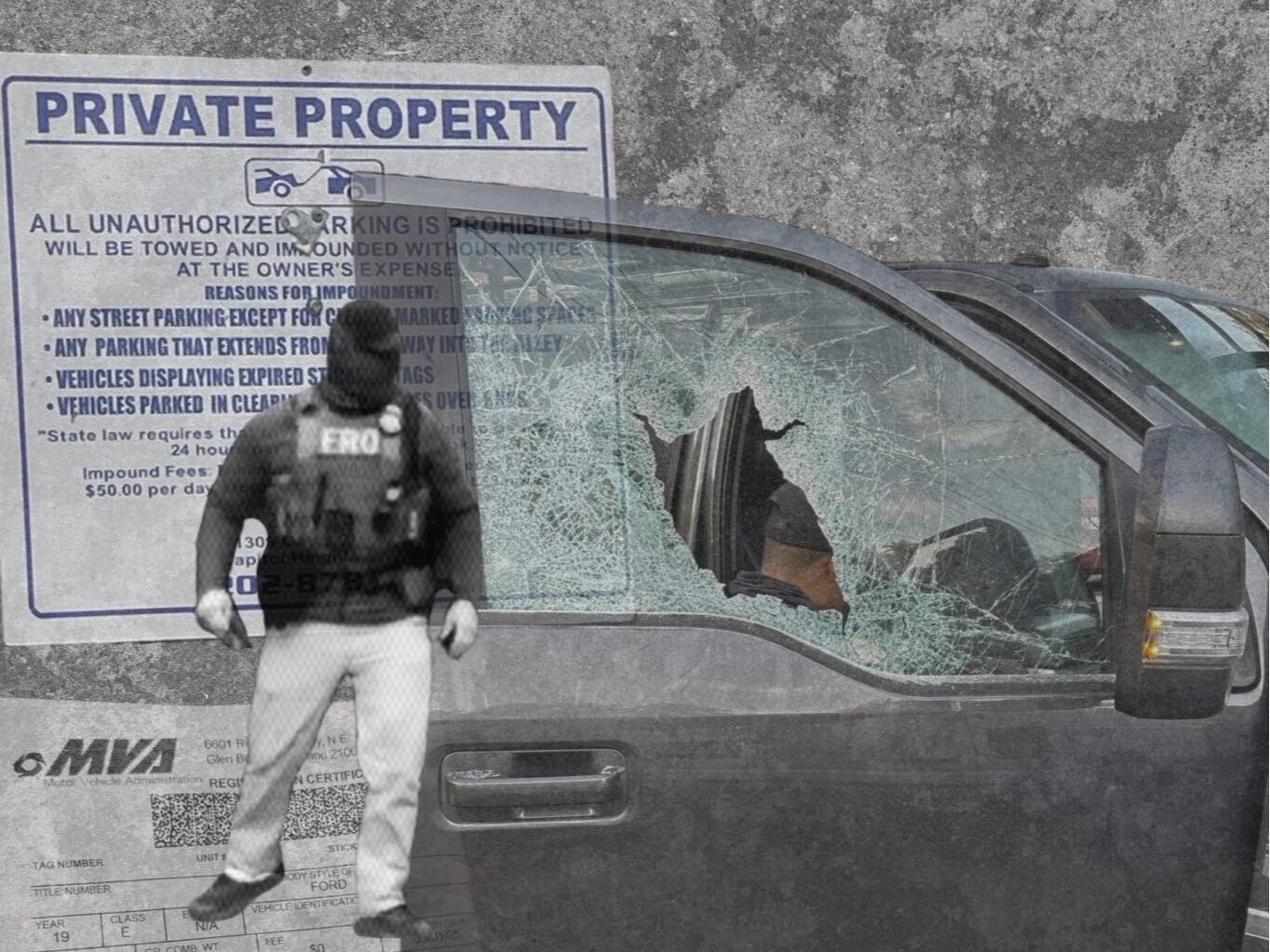
In Montgomery County, immigration agents are “leaving cars with broken driver’s side windows on the side of the street,” said Stoddard, an assistant chief administrative officer in the county’s executive’s office.
Those cars become the police department’s responsibility, he said. But ICE doesn’t give a heads-up before abandoning them.
“As their operations have ramped up,” Stoddard said, “we’ve gotten less and less information.”
In many cases, local police don’t find out about an arrest at all, said Stoddard. ICE frequently makes arrests in parking lots or at gas stations. When a car is on private property, he said, the business owner is responsible for the tow.
County officials say they don’t have much power to intervene.
“There’s a little bit of helplessness, that I can’t actually stop them,” said Montgomery County Executive Marc Elrich of the county’s police force. “We realized that you can’t tell the police that – even though we think this is illegal, what (ICE agents) are doing – you can’t get between them and the person they’re trying to pick up.”
Quotation
I was dispatched to this minivan. It was so obviously just a family's vehicle and they had broken both windows ... I saw this child’s pink butterfly hair clip covered in broken glass.
– Ariel Woods, a volunteer with the Immigrant Rights Collective, on cars abandoned after ICE arrests
That leaves activists to step in and try to reunite detainees’ families with their cars. Sometimes they are the first to tell family members of an arrest.
“[We] look through the windows and such and see what we can find to identify what’s going on, who is the person detained,” said Doug Hertzler, a volunteer with the Immigrant Rights Collective who has tracked dozens of empty vehicles. He uses the documents he sees inside the cars, like mail or registration paperwork, to reunite them with their owners.
The Immigrant Rights Collective has recorded more than 50 cars abandoned after arrests in Prince George’s and Montgomery counties since January. But that may be the tip of the iceberg.
Another organization, People Over Papers, has logged at least 8,500 car-based immigration arrests on its nationwide platform that crowdsources reports of ICE activity since Trump’s inauguration, according to the nonprofit’s founder.
More than 800 abandoned cars have been reported to the organization from across the country since May of last year. That’s when the group started allowing users to report abandoned vehicles.
The empty cars tell the stories of families and working people going about their daily lives, said Ariel Woods, another volunteer with the Immigrant Rights Collective.
“I was dispatched to this minivan,” she recalled. “It was so obviously just a family’s vehicle and they had broken both windows … I saw this child’s pink butterfly hair clip covered in broken glass.”
The people paying closest attention are volunteers – networks of friends and citizens who respond to needs they see in their community.
Woods and Hertzler volunteer with IRC chapters in Montgomery and Prince George’s counties, and the organization has other offshoots in the state and across the region.
On the Eastern Shore, Subervi works with an ad hoc group that has sprung up in the past year. While she works as a tax preparer, her advocacy reaches beyond her clientele.
“We try to help each other out and cover each other and just try to keep each other safe,” she said.
Constant fear
Noemi’s husband called her early one morning with bad news: ICE officers had just pulled him over.
In the background, she heard a voice tell him to roll down his window and hand over his papers. Before he could tell her where he was, the line went dead.
Noemi had to act quickly. She searched the surrounding streets, hoping to see the black pickup truck he relied on for work.
Though she looked for four hours, she didn’t have any luck until her husband called from a detention center.
“The first thing I asked him was where he had left the car,” Noemi told the Howard Center. “Because I had heard that if the family didn’t pick it up in time, it could get towed.”
The truck was outside an apartment building, he told her, in a lot reserved for tenants. The immigration agents had moved it there, he said, after his arrest.
Voluntary departures spike as immigrants face squalid detention, pressure to leave
A family friend with legal status volunteered to drive it home, and just in time. When he got to the truck, he told Noemi, someone was leaving a note on the windshield that said it would soon be towed away. Instead, the friend drove it safely back to Noemi’s house.
But her troubles were just beginning. Her husband spent four weeks in a detention center.
“I wouldn’t wish it on anyone. We were a family … but then, it was only us two,” she said, referring to herself and her son.
Even now, she can immediately recall the pain of those first few hours spent searching.
“We are all still suffering,” said Noemi, who asked that she be identified only by her middle name for fear of retribution … People simply don’t have the opportunity or the time to say where they’ve left their cars.”
Finally, their lawyer was able to secure a bond hearing for her husband, and he was released. He will have another hearing to help determine his status next fall.
Immigrant families in Maryland live with the knowledge that, each time a person leaves their house, they might not come back. When someone doesn’t come home on time or stops answering the phone, fear grows.
But answers can be hard to come by. In part, that’s because ICE’s practices vary day by day.
Advocates have observed a range of behaviors during arrests. Sometimes, agents drive a car a little way off the road, and sometimes they leave it right in the street. Observers have seen keys thrown on the ground, or left in the ignition, or confiscated.
And while ICE officers sometimes allow arrestees to call their families immediately, they often do not.
That leaves families scouring social media for videos of arrests and tracing their relative’s typical routes.
Advocates point out that for many people, cars are a key part of everyday life.
“Sometimes the car is a work van, with thousands of dollars of tools inside and materials,” said Pablo Blank, the director of immigrant integration at CASA, an advocacy organization. “Sometimes it’s the car that the family uses to drive kids to school and to go to work.”
So after an arrest, families must act quickly. As the minutes tick by, the threat of towing looms closer and closer.
Tow lot losses
In front of a hydrant, facing the wrong way. Abandoned on an exit ramp. Haphazardly blocking a fire station.
Woods, the IRC volunteer, has seen cars parked by ICE agents all over town. The goal, she believes, is often to have the vehicles towed as fast as possible.
So when she saw a car abandoned on an exit ramp on the way home from her daughter’s school the other day, she knew she had to act.
The details fell into place. She found the car key in the road and drove to a nearby lot. She drew a map of its location and figured out the owner’s address using papers left on the passenger seat. Eventually, the family was reunited with their car.
But many immigrants aren’t as lucky. And while towing is an inconvenience for anyone, it can be catastrophic for the families of detained people.
That’s because many lots are unwilling to release the car to anyone but the titled owner. Often, that’s the person who’s been locked up.
“We had to go through hell,” Subervi said of the ordeal. She stepped in to help a family reclaim its brand-new truck after a lot owner demanded a signed title from the owner, who had been detained. Thankfully, she said, he’d given her, his tax preparer, power of attorney.
Some local police see this as a problem.
“We’ve had situations where family or household members with a legitimate connection to a vehicle cannot retrieve it simply because their name is not on the title. That creates unnecessary hardship and can leave vehicles in impound longer than needed,” said Matt Muzzatti, support services commander for the Takoma Park police, in an email.
Meanwhile, fees pile up. A tow ordered by Prince George’s County police can cost over $200, for example, and storage fees could be $50 a day.
A local business was charged $925 for towing a work truck and trailer when the driver, an employee, was detained by ICE in Montgomery County. The Howard Center reviewed receipts provided by the company, whose owner asked that its name be withheld out of fear of retribution against its employees.
For families who own their own vehicles, those costs only increase the already-high price of detention.
“They are trying to use whatever money they have available to pay for an attorney,” said CASA’s Pablo Blank. “If recovering the car, because of bureaucratic barriers, is not an option in the first days, then it will become financially impossible.”
Although advocates try to intervene, they say some immigrants have lost their cars to the lots.
One family, Hertzler said, wasn’t able to afford car payments alongside their other costs.
“The car was repossessed from the towing company by the lender,” he said. “They had no other choice.”
Limited options
Some Maryland leaders are trying to help.
Recently, the Montgomery County Council passed an ordinance that allows tow lots to return cars to people who can show that the car’s owner is a member of their household, using documents like a lease or utility bill.
But above all, local officials encourage community members to take action.
Elrich asked residents to photograph and record ICE activity. “It puts a little bit of pressure on them. They don’t like it,” he said.
“They’d prefer to be able to act quickly and extract somebody,” he said. “Anytime you turn it into a public event, it puts some challenges in their way.”
Community groups like the Immigrant Rights Collective respond to arrests, but they also provide other services, like delivering groceries and running fundraisers.
Woods said she recently heard from a woman who couldn’t find her husband’s car. A few days later, the woman messaged again. Her husband had phoned her from the Baltimore detention center.
“She just said he seemed devastated and crushed,” Woods said. “She was telling me that he was crying on the phone.”
But he was able to give his wife more information about the car, and the group was able to find it. They also covered the cost of a tow, and are going to help pay for a new key.
“They can still drive their kid to school,” Woods said. “That is kind of a typical success story.”
Maryland Matters is part of States Newsroom, a network of news bureaus supported by grants and a coalition of donors as a 501(c)(3) public charity. Maryland Matters maintains editorial independence. Contact Editor Steve Crane for questions: scrane@marylandmatters.org. Follow Maryland Matters on Facebook and Twitter.