Health & Fitness
How Hogan Will Use New Arsenal Of Rapid-Results Coronavirus Tests
Maryland secured 250,000 rapid-response coronavirus tests, Gov. Larry Hogan said. How will he deploy the $8 million arsenal?


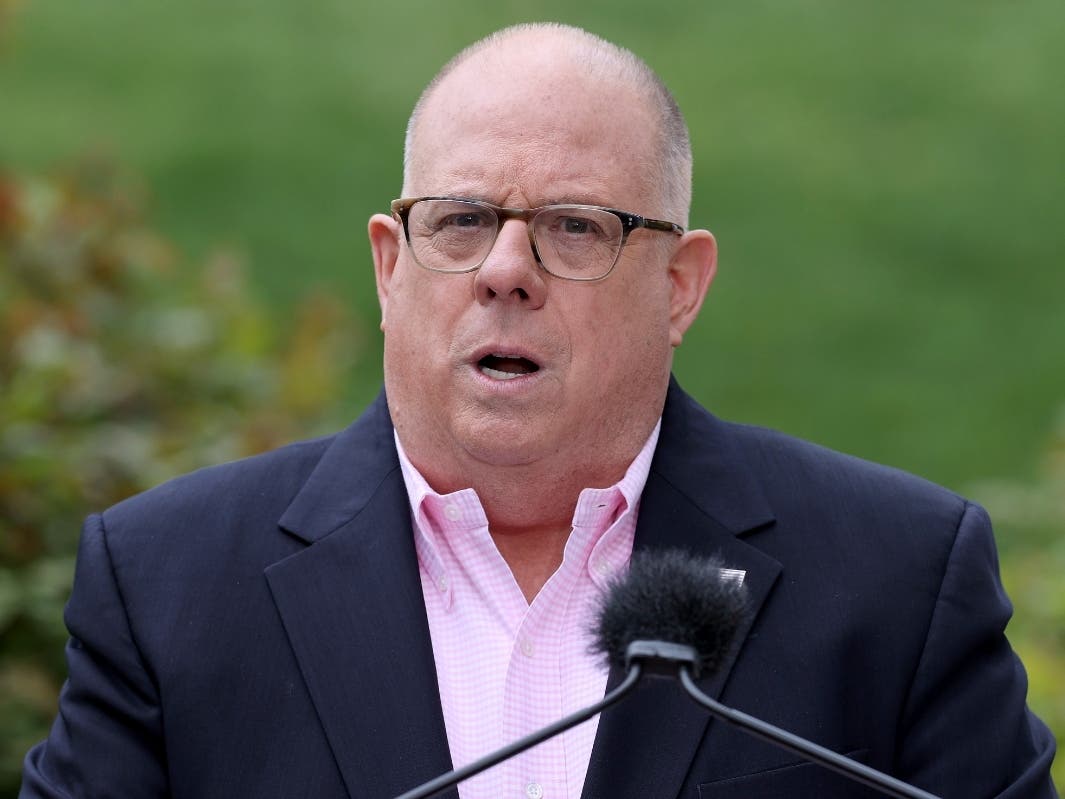
SPARKS GLENCOE, MD — Maryland will acquire 250,000 rapid-response coronavirus tests, Gov. Larry Hogan said Thursday. These tests deliver results in 15 to 20 minutes.
The deal is part of a 10-state compact, backed financially by the Rockefeller Foundation and a grant from the Centers for Disease Control and Prevention. Hogan said the kits cost $8 million in total.
"Over the past six months, in the face of one of the most daunting challenges of our lifetime, America’s governors have stepped up and led," Hogan said. "We didn’t let the politics get in the way."
Find out what's happening in Annapolisfor free with the latest updates from Patch.
The states announced their initial agreement to amass 3.5 million rapid-results tests on Aug. 4. Hogan executed the deal with the governors from Louisiana, Massachusetts, Michigan, North Carolina, Ohio and Virginia during the final days of his tenure as chairman of the National Governors Association.
The preliminary compact did not officially purchase the test kits. It instead committed to obtaining them.
Find out what's happening in Annapolisfor free with the latest updates from Patch.
Utah, Arkansas and Rhode Island have since joined the partnership, bringing the total testing goal to 5 million. Each state will eventually secure 500,000 of these speedy tests.
Hogan's Thursday announcement is the first step toward reaching this benchmark. Maryland is the first state in the agreement ink its deal with a supplier.
New Jersey medical manufacturer Becton, Dickinson and Company will supply the first batch of the Food and Drug Administration-authorized tests. The business has an office in Sparks Glencoe, Baltimore County, where Hogan announced the deal.
"This is the latest, state of the art technology in rapid testing which will help to slow the spread of COVID-19 and help our states to speed up economic recovery," Hogan said.
The governor says these rapid-response kits will not replace the traditional coronavirus tests. They will act as a supplement to areas where community spread is a larger risk.
Hogan plans to deploy the new system to assisted-living and correctional facilities. The state is also discussing using the kits in college dormitories.
"This acquisition will give us another valuable tool in that strategy, which has successfully completed more than 2.1 million tests to nearly 25 percent of our state’s population," Hogan said.
The rapid-results tests are slightly less accurate than the typical kits. Hogan said they are about 87 percent accurate and generate a few false positives.
Anybody who tests positive will follow up with a traditional coronavirus test to confirm their diagnosis. The quick results help the Department of Health identify potential threats and immediately isolate them.
The Rockefeller Foundation, Duke University and Arizona State University recently published guidelines on how to best use rapid-response testing. The foundation believes its financial commitment will help the United States scale up its coronavirus testing as the flu season approaches.
The country currently conducts less than 30 million coronavirus tests-per-month, Rockefeller Foundation President Dr. Rajiv Shah said. He hopes widespread rapid-results kits will push the nation's testing to at least 70 million tests-per-month.
"Testing is really the only way out," Shah said. "Complete shutdowns of the U.S. economy, here in Maryland or anywhere else in the nation, are simply not viable or affordable to the people who suffer the most when that takes place: essential workers and working families."
Thursday's acquisition follows Hogan's trend of procuring tests in unique ways.
When Maryland was low on coronavirus tests in April, Hogan leveraged his unique relationship with South Korea to buy 500,000 testing kits from the country. His wife, Yumi Hogan, is from South Korea. She coordinated the effort with South Korea's ambassador, drawing rebuke from President Donald Trump.
Coronavirus Update
Last Friday, Hogan said the counties can open all their businesses and move into the third and final stage of coronavirus recovery. Twenty of Maryland's 24 jurisdictions have taken the governor's offer. Only Anne Arundel County, Baltimore City, Montgomery County and Prince George's County remain in Stage 2.
The state's schools may also begin reopening for some in-person instruction, Hogan announced in late August. So far, 16 of the Maryland's 24 school districts have returned some students to school buildings for hybrid or in-person learning.
Maryland added 503 coronavirus cases on Thursday, bringing the state's total to 14,078 infections. The state also reported seven more coronavirus-related deaths Thursday. The virus has killed 3,679 Marylanders.
The state's positivity rate has seen an uptick since it bottomed out at 3.08 percent on Aug. 21. Now, the seven-day rolling average sits at 3.71 percent. The weekly positivity rate topped out at 26.88 percent on April 17.
Hospitalizations have trended downward since they hit a recent peak of 592 on Aug. 1. Thursday's 358 hospitalizations are down from their overall peak of 1,711 on April 30. The 92 patients in the intensive care unit are the fewest since March 28.
New cases have seen a spike as of late, prompting states to add Maryland to their quarantine orders. Most notably, Connecticut, New Jersey and New York placed Maryland on their joint travel advisory on Tuesday. Maryland was previously on the restricted list from July 21 to Aug. 25.
The trio requires travelers from 34 states and one territory to self-quarantine for 14 days when visiting their pact, which was established on June 24. To land on the group's travel advisory, which is updated each Tuesday around noon, states must have either:
- An average of more than 10 new cases-per-100,000 residents per day over a rolling week.
- Or an average positivity rate of more than 10 percent over seven days.
When the list was amended this week, Maryland had an average of 10.34 new infections-per-day per 100,000 people. By Thursday, that case rate dropped to 9.61.
That per capita mark maxed out at 18.03 on May 7. New cases-per-day per 100,000 residents hit a recent low of 5.6 on June 24 before returning to a recent high of 15.55 on July 31.
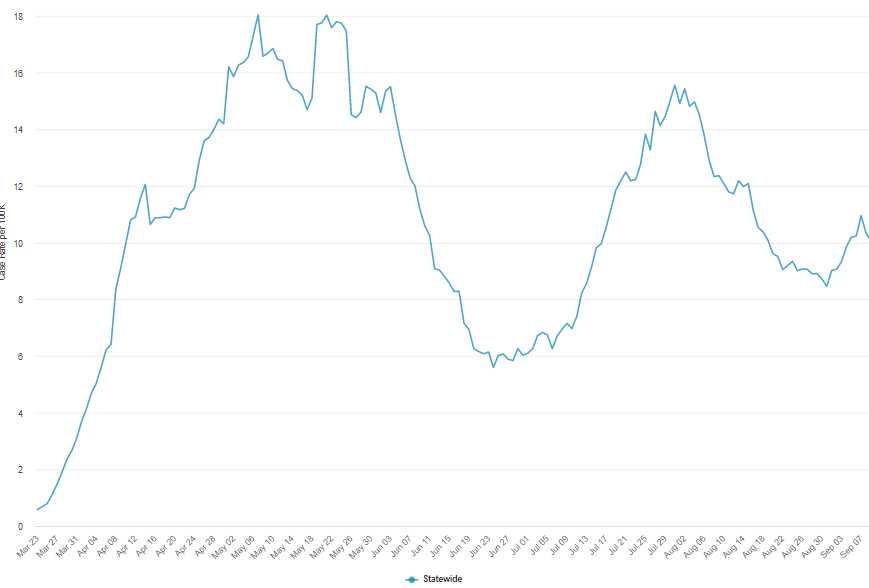
As long as Maryland averages less than 604 new coronavirus infections-per-day and keeps its positivity rate low, it will fall off the northeastern quarantine order on Tuesday. The state currently averages 580.86 new cases per day and its positivity rate has been below the mandate's 10 percent benchmark since June 3.
Maryland has its own travel order. Hogan implemented the advisory on July 29, after spending months saying Maryland would not restrict travel from other states.
The mandate does not prohibit out of state visitation. The advisory instead discourages travel to states with a positivity rate greater than 10 percent.
Travelers coming from those states should immediately get a coronavirus test when they return to Maryland. These travelers should also quarantine until they receive a negative test result, the order says. These 11 states are currently on Maryland's quarantine and test mandate:
- Alabama
- Arizona
- Florida
- Georgia
- Idaho
- Louisiana
- Mississippi
- Nebraska
- Nevada
- South Carolina
- Texas
RELATED:
- MD Lands On Quarantine Order Again, Must Isolate in CT, NJ, NY
- Movie Theaters, Concert Venues Can Reopen: Hogan's Plan Explained
- Maryland Schools May Begin Safely Reopening: Governor Hogan
- Hogan Reflects On Tenure As Chair Of Governors Association
Have a story idea? Please contact me at jacob.baumgart@patch.com with any pitches, tips or questions. Follow me on Twitter @JacobBaumgart and on Facebook @JacobBaumgartJournalist to stay up-to-date with the latest Anne Arundel County and Prince George's County news.
Get more local news delivered straight to your inbox. Sign up for free Patch newsletters and alerts.