Neighbor News
My tour: the cemetery
St. Anne's parishioner Ginger DeLuca leads Maryland Day tour of St. Anne's Cemetery.

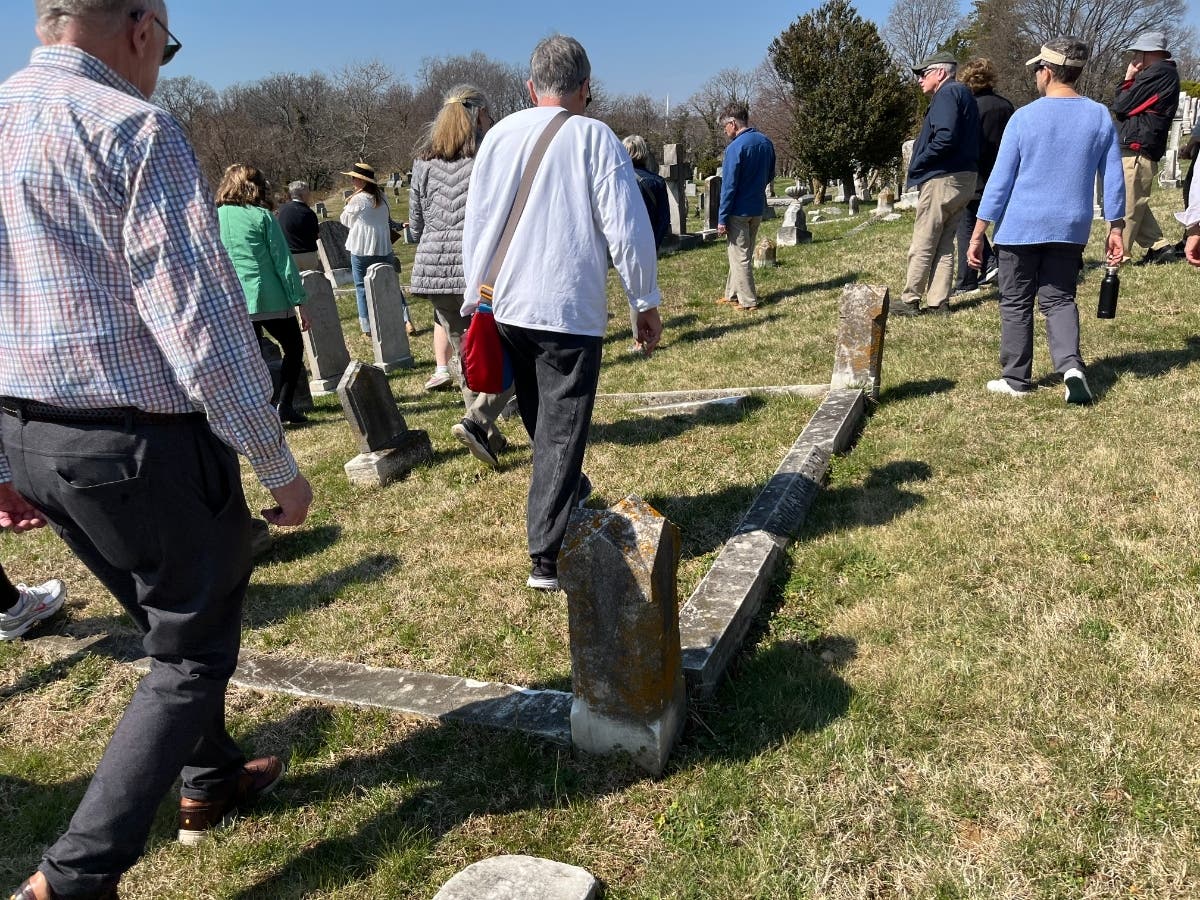
St. Anne’s cemetery is an amazing place. It’s one that St. Anne’s parishioner Ginger DeLuca has fallen in love with. She shared that love and an overwhelming amount of historical knowledge when she acted as tour guide for two Maryland Day tours.
A former school teacher, the St. Anne’s parishioner began cleaning up the graveyard because she needed something to do during the pandemic. She wanted to clean the headstones, remove the ivy, create entrance gardens and make the cemetery a better place. She’s the chairman of St. Anne’s Cemetery Committee and still going strong, trying to clean the cemetery and identify its inhabitants.
Find out what's happening in Annapolisfor free with the latest updates from Patch.
She and her cemetery stewards meet most Thursdays at 9 a.m. to work in the gardens. Since she’s been working there, she’s learned three things: “You don’t want to be buried on top of a hill, because your headstone may eventually fall down. You don’t want to be buried by the water, because you may end up in it. And, don’t plant a tree or bush next to your grave. It will swallow the stone over time.”
Find out what's happening in Annapolisfor free with the latest updates from Patch.
Those residing in the cemetery sound like a “Who’s Who” of Annapolis and St. Anne’s. There’s the Randalls. Alexander “Alex” Randall is connected to three of the stained-glass windows at St. Anne’s. One was donated in honor of his first wife, Catherine; another to his second wife’s father, John Blanchard, rector of St. Anne’s from 1825 -1874; a third to his sister’s husband, Peter Hagner, who served as a federal employee in the U.S. Treasury Department for more than 55 years. Randall’s family placed the carved reredos behind the altar in his memory. There’s also a Randall Street in downtown Annapolis.
Another stain-glass window honors William Southgate, St. Anne’s rector from 1869 -1899. The Southgate Fountain in Church Circle is also named for him.
There are people from the Chase-Lloyd House, the Hammond-Harwood House, and the Brice House in Annapolis. All those prominent families have family members in the cemetery, so Ginger is advocating the Hammond-Harwood House tour later this spring.
The first cemetery dates back to 1692 when Middle Neck Parish, later to become St. Anne’s, was established by an order of King William and Queen Mary of England. Since the church wasn’t built until 1704, it was a churchyard burial ground without a church. It was also the only cemetery in the city. As the city’s cemetery, everyone was buried there, not just St. Anne’s parishioners. The cemetery houses plantation owners, militia members, Union and Confederate soldiers, lawyers, politicians, and well-known furniture makers and tailors, first wives, second wives, beloved children and entire families, including those buried in separate sections because of a family feud. It also includes the indigent and enslaved and their descendants.
Between 1775 when the first church was demolished and 1792 when the second church was built, it again became a cemetery surrounding a hole in the ground.
Following the 1694 town plan, construction around Church Circle became prolific and downtown Annapolis continued to grow into the late 18th century. With all the construction, the graveyard shrunk in size and became full.
Since then, the cemetery has expanded. The first major expansion was when pasture land was given by a bequest by Miss Elizabeth Bordley in 1790. Since then, additional lands have been added … Locust Grove Cemetery (1887), land near the Arundel Center and the Goldstein Treasury Building (1961) and Cedar Bluff Cemetery (1990). A columbarium is planned for the future.
During its 334-year history, it has set some trends. Some headstones resemble bed headboards and have foot stones to show the bed’s foot. Flowers were sculpted into headstones, symbolizing the “Language of Flowers.” Some sculptures were used as headstones. Other graves were marked by crosses.
The cemetery even has a Lazurus Tree, whose top was sheared off by a tornado. Once believed to be dead, it has grown back with a vengeance.
If you have a chance, the cemetery is well worth a visit. In fact, the tour was so much fun that a few people (including myself) took the tour twice. Also, help is always needed for cemetery clean up and documenting gravestones into Find a Grave. Find out more at https://www.stannes-annapolis.org/cemetery