Community Corner
Study Eels Collected On Special Ladder At Eden Mill Dam
Residents of all ages can sign up now to help extract eels, weigh them and collect data Tuesday morning with park naturalists.


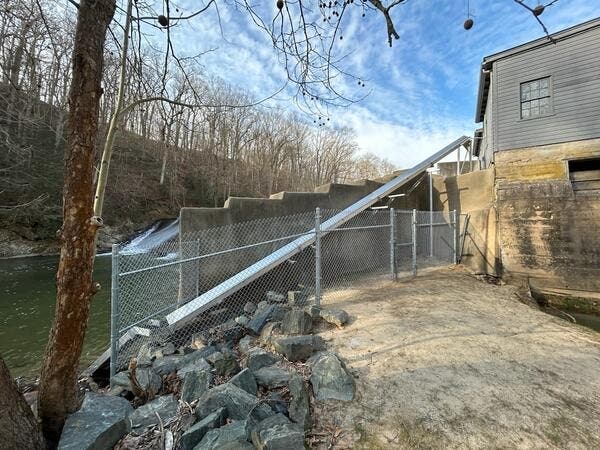
PYLESVILLE, MD — Residents can help collect data from the eel ladder set up at Eden Mills Nature Center Tuesday morning.
People of all ages are invited to join park naturalists and extract the eels from the ladder, then weigh and document data. The eels then will be released upstream.
The data collection will start at 10 a.m. at the nature center, located at 1617 Eden Mill Road. Residents need to register online to help with the project.
Find out what's happening in Bel Airfor free with the latest updates from Patch.
As part of work done at the Eden Mill Dam in September 2025, an eel ladder was installed to help increase the American eel population in Deer Creek beyond the dam.
According to the Harford County Parks and Recreation Department, American eels "play an important role in the ecosystem and will lead to improved water quality above and below the dam." Essentially, the ladder helps the eels navigate up and over the dam so they can continue swimming.
Find out what's happening in Bel Airfor free with the latest updates from Patch.
The technical design of the eel ladder incorporated site‑specific hydrology, engineering requirements and eel biology to ensure safe and timely passage, according to the U.S. Geological Survey's Eastern Ecological Science Center.
USGS worked with Harford County and project partners including MDNR, USFWS and the Maryland Fish and Wildlife Conservation Office to guide the design and construction of the eel ladder. Construction took place from September through October 2025.
Jim Thompson with the Maryland Department of Natural Resources told Patch that eels are common throughout the Bay watershed.
"In fact, Deer Creek has some of the highest abundances of eels in Maryland. This could be in part because as the eels migrate up from the ocean, they are drawn to the Susquehanna River but are blocked by the Conowingo Dam (Conowingo Dam also has an eel ladder now though) and seek habitat in the rivers that feed into the Susquehanna below Conowingo Dam - Deer Creek on the western side and Octoraro Creek on the eastern side," Thompson previously told Patch.
The ladder essentially is a covered metal gutter filled with running water with a substrate that eels can grab ahold of and climb up the eel ladder. There's running water on the other side that helps the eels slide down where they land in a bag and are then taken by Maryland DNR employees who help relocate the juvenile eels further upstream.
All eels captured with this ladder at the Eden Mill Dam will be released after being counted, although a few may be saved for education and outreach, or additional studying, officials said.
American eels carry baby mussels that clean the water and improve ecosystem health. Larval mussels attach to the gills of eels and other fish and receive a ride upstream, where they drop and burrow into the substrate to spend their lives filtering material from the water.
Dispersal of the mussels is dependent on the movement of the host fish. The mussels, in turn, help improve water quality by retaining, removing and recycling nutrients and sediment before it enters the Chesapeake Bay. Each mussel filters more than 10 gallons of water per day.
There are now three dams in Maryland that support American eel passage: Eden Mill Dam, Daniels Dam and Conowingo Dam.
Get more local news delivered straight to your inbox. Sign up for free Patch newsletters and alerts.