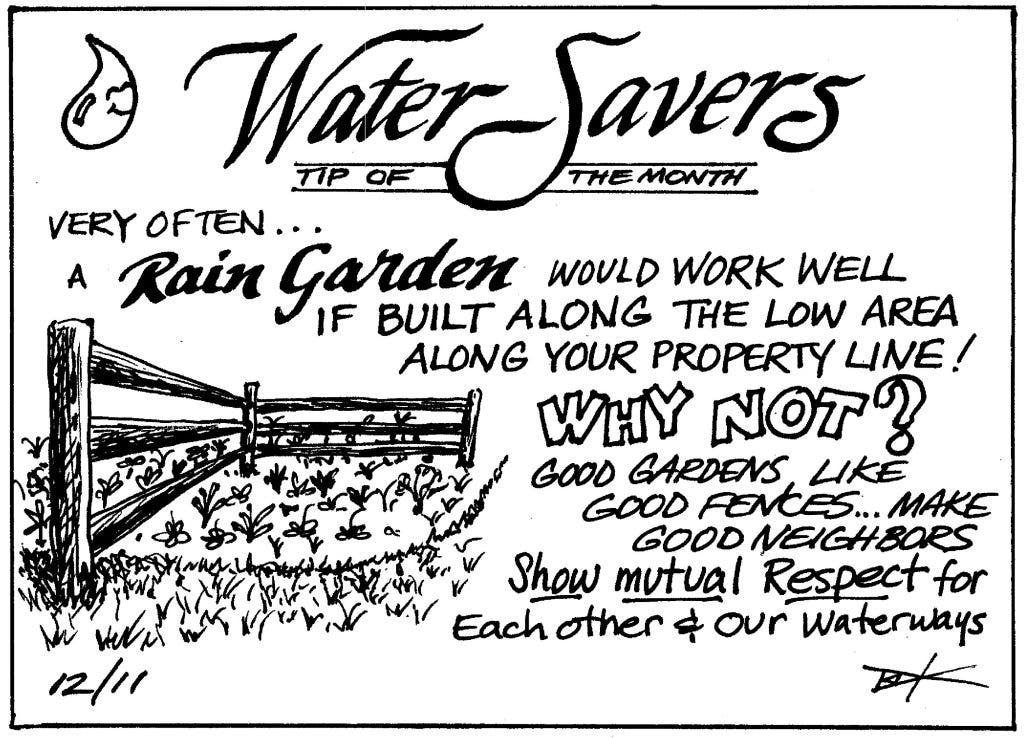
I'm trying to imagine the future. It seems like a pretty good bet that one day soon we'll all be tasked with containing the rain water runoff from our properties. If we are unable to do so, will there be some sort of fee or penalty? I can't imagine how it would be enforced or policed, but I do think we should get started. Even if there is no penalty, the rewards for decreasing stormwater runoff are great. If the water running off your property doesn't contain any sediment, pet waste or fertilizer, just adding to the size of the flow down the road contributes to the problem anyway. While it seems logical that sources like Agriculture, Industry and Commercial properties would make up the biggest source of polluted runoff, 64% of the land in Anne Arundel County is private property. Studies show that 39% of the Phosphorus and 46% of the Nitrogen comes from our yards! So we can definitely help make the waters clean and healthy again.
For some yards it's pretty easy to contain the rain. But if you live in a hilly area, or even on a gentle slope, it can be difficult or impossible. You can imagine a situation where one neighbor's runoff crosses over to another's property down the hill. Sometimes the fence or property line between two neighbors is a low spot where water collects or runs through.
Rather than letting it become a sore spot or a reason to have resentment, how about turning it into a reason to cooperate and team up with the neighbors? You may be able to solve the issue by building a rain garden, allowing the water to soak into the ground. Rain gardens are beautiful and functional. If the flow of water across the property line is heavy during peak storms, a more elaborate installation may be needed. In cases like these, it's a very good first step to get together with the neighbors to discuss the options. All too often, one side will "armor" their border with barriers rather than openly deal with the problem. It's nobody's fault if the natural water course flows across a property line. The shape of the land is usually adjusted with new construction, but if the house up the street is ten feet higher in elevation than yours, the water will flow down hill.
Find out what's happening in Broadneckfor free with the latest updates from Patch.
Neighborhoods with nice improvements and amenities like sidewalks and such will probably have stormdrains designed to whisk the water away to the nearest creek or river. The old conventional wisdom was "collect and convey." Nowadays we know it is far better to let it soak into the ground before it gets to the waterways. Not only will it be filtered in this way, but erosion will be greatly reduced, we can limit nutrient and biological pollution and the groundwater aquifers will be recharged.
So much of the work needed is on a large scale, it's easy to forget that the single biggest factor is our own neighborhoods. Let's resolve to recharge our neighborly friendships as we clean up the Bay!