Schools
International Baccalaureate Program Makes Waves at Elementary Schools
Patch takes a look at one of the county's three IB programs at Germantown Elementary in Annapolis, where students may be learning Spanish by the end of the year.
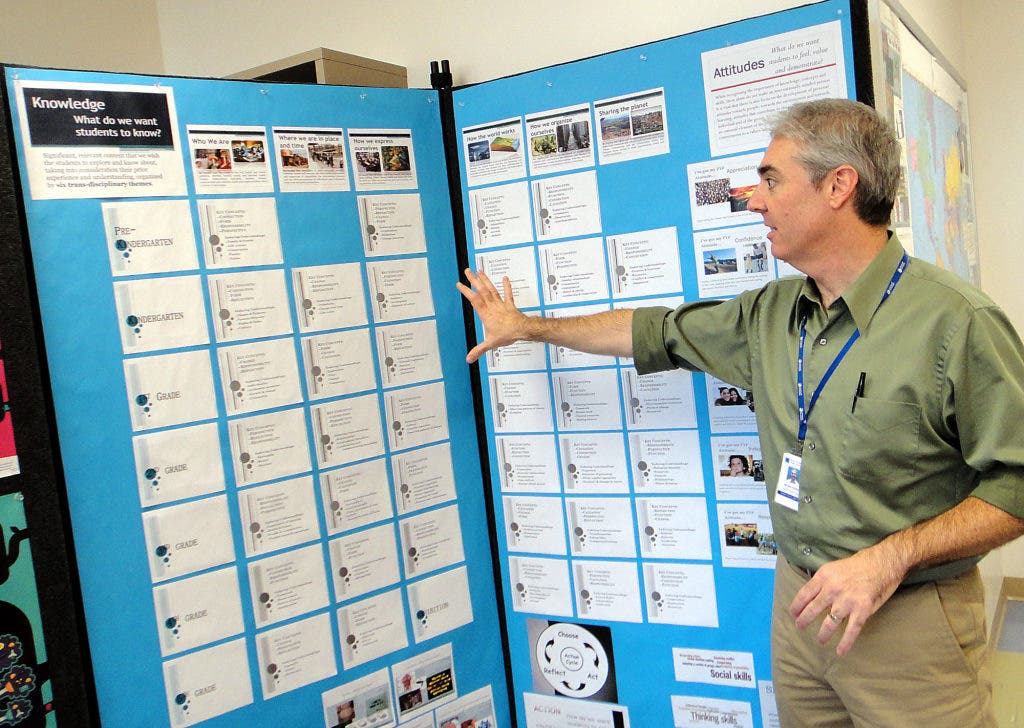


A new way of teaching is unfolding at , and among the new concepts that will be taught to grade-schoolers is a foreign language.
Interest in the International Baccalaureate (IB) (PYP) is high all across the county because this is the first year the program has operated in Anne Arundel County at , Manor View and elementary schools.
Currently, three schools have the IB Middle Years Programme (MYP) in the county: Annapolis Middle School, MacArthur Middle School and Old Mill Middle School North. The MYP program continues into high school where three schools offer the IB Diploma Programme: Annapolis High School, Meade High School and Old Mill High School. Students from all over the county can apply to these magnet schools.
Find out what's happening in Broadneckfor free with the latest updates from Patch.
The curriculum taught at an IB school doesn’t differ from other schools. State standards take priority. But the way the concepts are conveyed adopts a holistic view of students’ education, and how the different subjects are interrelated.
At Germantown, a hallway is covered in self-portraits done by a kindergarten class. Above each portrait is a word the artist chose to describe themselves, using one of a few new terms they’ve learned this year through the change in teaching styles.
Find out what's happening in Broadneckfor free with the latest updates from Patch.
Cadie is reflective. Jack is an inquirer. Amelia is principled. Others are risk-takers, or reflective. You don’t come across introspective kindergartners like these every day.
Teachers at Germantown are still adapting to the IB program, said Principal Walter Reap. They’re fundamentally changing how they convey material, while implementing new concepts such as the learner profile, a long-range way of thinking about education.
One of the tenets of IB is developing broad concepts over a number of years—notions such as gender, race, heroism and culture aren’t limited to a grade level or subject. These are concepts that can be taught over the course of a student’s entire educational career.
Reap said these extra steps will go a long way toward making students more successful in the long run.
“Before, we were only thinking about pre-K to five. Now, we’re talking about experiencing these concepts at the middle- and high-school level. Ultimately, they’ll be better prepared to move on to college,” Reap said. “Before, the lessons were the center. Now, the learners are the center.”
Keeping students' minds open to the world beyond the classroom is another principle of IB. With that in mind, students will soon begin taking the first steps into learning a new language some time this year. That’s not an option, or a goal. It’s a requirement of the IB program.
Learning a new language may seem like a daunting task for an elementary student, but Germantown comes with its own unique learning curve. More than 45 percent of the students there can already speak Spanish. Learning a second language isn’t as difficult, and learning a language you’re already immersed in is even easier.
“We’re providing experiences that some people go a lifetime and not have,” Reap said. “We’re forcing a type of evolution that would not happen in a regular school. In terms of becoming more effective communicators, it’s broadening that spectrum.”
Still, the adoption rate for the program has been slower for some. Reap said early grade levels have adopted the standards more quickly than others. Some teachers simply aren’t as eager to jump head-first into the new concepts and merely dip their toes in, but others have developed ambitious new lessons that give students the chance to learn without a firm textbook backbone.
As fourth-graders approached their classroom one day, they saw pictures of a list hanging down from the ceiling. No context was given by the teacher. Instead, students were asked to come up with their own questions which drove the lesson for the day on Oskar Schindler.
Piece by piece, the facts clicked into place about the nature of the list, leading to a revelatory moment rare on most Friday afternoons in social studies.
This isn’t a textbook approach to fourth-grade education, but it’s evidence of the new style of learning at Germantown.
Karma O’Neill, whose son was in the classroom that day, said she thinks IB has already proven to be a good change for the school.
“This is a hands-on approach to learning. And in many ways I think it’s helping students think outside the box,” she said.
The teacher for that class, Heather Giustiniani, said the differences in the teaching process are sometimes subtle, and not easily recognized. Students may not notice much of a difference. But by combining lessons with other subjects, and sometimes even other teachers, the nature of the lessons is changing.
“We’re integrating curriculum in a way that has more meaning to it than before,” she said.
Though this is the first year IB standards have been implemented at the elementary schools, they are currently operating at the candidate-level of the program. At the end of the second year, the school will be tested by IB World program coordinators in order to reach full adoption status.